
Body snatching. Body snatchers at work.

A painting on the wall of a public house in Penicuik, Scotland United Kingdom[edit] Graveyard watchtower, Edinburgh Before the Anatomy Act of 1832, the only legal supply of corpses for anatomical purposes in the UK were those condemned to death and dissection by the courts. Those who were sentenced to dissection by the courts were often guilty of comparatively harsher crimes. Interfering with a grave was a misdemeanour at common law, not a felony, and therefore only punishable with a fine and imprisonment rather than transportation or execution.[3] The trade was a sufficiently lucrative business to run the risk of detection, particularly as the authorities tended to ignore what they considered a necessary evil.[4] Mortsafe in Greyfriars Kirkyard, Edinburgh Mort houses, such as the circular Udny Mort House in Aberdeenshire built in 1832, were also used to store bodies until decomposition, rendering the cadavers useless for medical dissection.[6] Public outcry[edit]
Burke and Hare murders. The Burke and Hare murders (also known as the West Port murders) were a series of murders committed in Edinburgh, Scotland over a period of about ten months in 1828.

The killings were attributed to Irish immigrants William Burke and William Hare, who sold the corpses of their 16 victims to Doctor Robert Knox as dissection material for his well-attended anatomy lectures. Burke and Hare's accomplices were Burke's mistress, Helen McDougal, and Hare's wife, Margaret Laird.[1] From their method of killing their victims came the word "burking", meaning to smother and compress the chest of a murder victim, and a derived meaning, to suppress something quietly.[2][3] Historical background[edit] Old Surgeons' Hall, Edinburgh (substantially altered since the time of the murders) Before 1832, there were insufficient cadavers legitimately available for the study and teaching of anatomy in Britain's medical schools.
Burke and Hare[edit] Murders[edit] Mary Paterson Daft Jamie Mrs Docherty. The Worlds of Burke and Hare. The Body Snatcher. The Body Snatcher (1884) is a short story by the Scottish author Robert Louis Stevenson.
First published in the Pall Mall Christmas "Extra", in December 1884, the story is based on characters in the employ of Robert Knox, around the time of the Burke and Hare murders. Plot summary[edit] The story begins with a group of friends sharing a few drinks, when an eminent doctor, Wolfe MacFarlane, enters. One of the friends, Fettes, recognizes the name and angrily confronts the new arrival. Although his friends all find this behaviour suspicious, none of them can understand what might lie behind it .
It transpires that MacFarlane and Fettes had attended medical school together, under the famous professor of anatomy, Robert Knox. On one occasion, Fettes identifies a body as that of a woman he knew, and is convinced she has been murdered. Later, Fettes meets MacFarlane at a tavern, along with a man named Gray, who treats MacFarlane in a rude manner. Anatomy murder. An anatomy murder is a murder committed in order to use all or part of the cadaver for medical research or teaching.

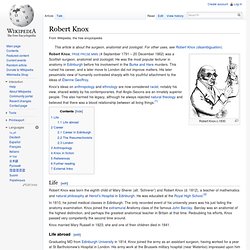
It is not a medicine murder because the body parts are not believed to have any medicinal use in themselves. Robert Knox. Robert Knox c.1830 Robert Knox, FRSE FRCSE MWS (4 September 1791 – 20 December 1862) was a Scottish surgeon, anatomist and zoologist.
He was the most popular lecturer in anatomy in Edinburgh before his involvement in the Burke and Hare murders. This ruined his career, and a later move to London did not improve matters. His later pessimistic view of humanity contrasted sharply with his youthful attachment to the ideas of Étienne Geoffroy. Knox's ideas on anthropology and ethnology are now considered racist, notably his view, shared widely by his contemporaries, that Anglo-Saxons are an innately superior people. Life[edit] Knox married Mary Russell in 1823; she and one of their children died in 1841.
Life abroad[edit] Graduating MD from Edinburgh University in 1814, Knox joined the army as an assistant surgeon, having worked for a year at St Bartholomew’s Hospital in London. Career[edit] Career in Edinburgh[edit] Bill advertising Knox's anatomy lectures in 1828. Echoes of the resurrection men. Background information on grave robbing in Scotland. This large scale desecration of graves led, as one can imagine, to a bitter battle of wits between on the one hand the outraged local populace endeavouring to protect the bodies of their loved ones and on the other the body-snatchers hell-bent on snatching them.

The burial grounds of Scotland still bear stark witness to these ghoulish events of long ago. In many a kirkyard one can still see the physical evidence of the increasingly sophisticated methods that were employed to help protect the dead until they were too corrupt to be of interest to the anatomists. An early and simple approach was to heavily compact the soil when filling in a grave and to put in several layers of branches to make digging more difficult. Sometimes prodigiously heavy slabs of stone known as mort-stones were placed on top of the grave to further deter the diggers. In 1816, Superintendent Gibb of the Aberdeen Harbour Works gifted such a mort-stone to St Fittick’s churchyard at Nigg.