
기획연재. Moving People Changing Places - Every object tells a story. Everyone has objects that are dear to them: objects which have been handed down through the family, have survived a journey, been given by a loved one or kept to commemorate an important time.
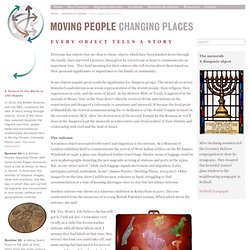
They hold meaning for their owners who tell stories about them based on their personal significance or importance to the family or community. 11 "Modern Antiques" Today's Kids Have Probably Never Seen. Even though I'm fairly ancient, I've never seen a Model T outside of a classic auto show. So I realize that there are many things that have been obsolete since the elastic waistband was invented and would confound anyone under age 70. Articles, TOUT-FAIT: The Marcel Duchamp Studies Online Journal. In a 1961 interview with Katherine Kuh, Marcel Duchamp, when asked about his readymades, let it be known that the concept behind those objects might be “the most important single idea to come out of my work.” (1) In June 1967, the self-proclaimed “an-artist” (2) - anticipating his final departure a mere sixteen months hence ("Quite simply, I am waiting for death") - elaborated on his concept of the readymade: “Ultimately, it should not be looked at… It’s not the visual aspect of the Readymade that matters, it’s simply the fact that it exists.… Visuality is no longer a question: the Readymade is no longer visible, so to speak.
It is completely gray matter. It is no longer retinal.” When pressed by his interviewer about the paradox of the readymades having “ended up being ‘consumed’ in museums and exhibitions, and sold as art objects” (particularly in light of the editions produced by the Galleria Schwarz in Milan in 1964), Duchamp replied: Robert Motherwell. Retinal implant restores vision for eight blind people.
Last week we heard about the Argus II, a device that can restore partial sight to some blind people, and this week a new retinal prosthesis is promising to go one step further.
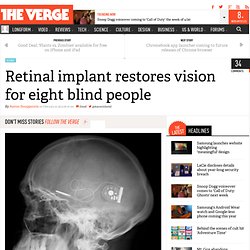
While the Argus II relies on glasses, an externally-mounted video camera, and a separate processing box, the Alpha IMS system detects light coming into the eye via electrodes implanted underneath the patient's retina, before feeding it into a microchip that sends the signals to the brain. The brain then processes the data as it would organic signals from a healthy eye, and the patient sees a black and white image. Rolex Awards for Enterprise : Touching upon a vision. Sumit Dagar is a 29-year-old, Indian visionary whose technological skills, inventiveness and passion for design have prepared him for a place among today’s young, hi-tech entrepreneurs.
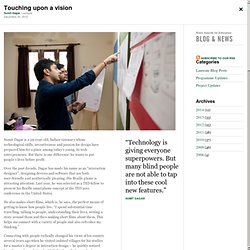
But there is one difference: he wants to put people’s lives before profit. Over the past decade, Dagar has made his name as an “interaction designer”, designing devices and software that are both user-friendly and aesthetically pleasing. His Braille phone is attracting attention. Last year, he was selected as a TED fellow to present his Braille smartphone concept at the TED 2011 conference in the United States. He also makes short films, which is, he says, the perfect means of getting to know how people live. Why Nikola Tesla was the greatest geek who ever lived. Additional notes from the author: If you want to learn more about Tesla, I highly recommend reading Tesla: Man Out of Time Also, this Badass of the week by Ben Thompson is what originally inspired me to write a comic about Tesla.
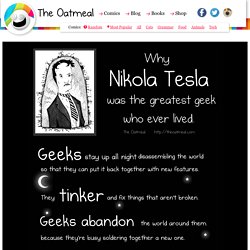
Ben's also got a book out which is packed full of awesome. There's an old movie from the 80s on Netflix Instant Queue right now about Tesla: The Secret of Nikola Tesla. Ben Franklin on Patents; in which he provides a Selfless model for Sharing and Cooperation; Inspires us with his Generosity; and Lends Moral Authority to the Principles of Free Culture… ~ Moving to Freedom. In which he provides a Selfless model for Sharing and Cooperation; Inspires us with his Generosity; and Lends Moral Authority to the Principles of Free Culture… I wasn’t surprised to learn of Ben’s position on patents: In order of time, I should have mentioned before, that having, in 1742, invented an open stove for the better warming of rooms, and at the same time saving fuel, as the fresh air admitted was warmed in entering, I made a present of the model to Mr.
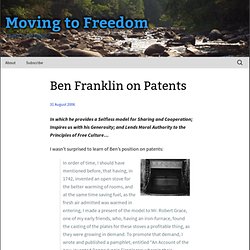
Robert Grace, one of my early friends, who, having an iron-furnace, found the casting of the plates for these stoves a profitable thing, as they were growing in demand. Music to my ears. Tor (anonymity network) Tor (previously an acronym for The Onion Router)[4] is free software for enabling online anonymity and censorship resistance.
Tor directs Internet traffic through a free, worldwide, volunteer network consisting of more than five thousand relays[5] to conceal a user's location or usage from anyone conducting network surveillance or traffic analysis. Using Tor makes it more difficult to trace Internet activity, including "visits to Web sites, online posts, instant messages, and other communication forms", back to the user[6] and is intended to protect the personal privacy of users, as well as their freedom and ability to conduct confidential business by keeping their internet activities from being monitored. Silk Road (marketplace) For the historical trade routes, see Silk Road.
In 2013, the Federal Bureau of Investigation (FBI) shut down the website[12] and arrested Ross William Ulbricht under charges of being the site's pseudonymous founder "Dread Pirate Roberts".[4] On 6 November 2013, Silk Road 2.0 came online, run by former administrators of Silk Road.[13] It too was shut down and the alleged operator was arrested on 6 November 2014 as part of the so-called "Operation Onymous”. Ulbricht was convicted of all seven charges in U.S. Federal Court in Manhattan relating to Silk Road and was sentenced to life in prison.[14] Further charges alleging murder-for-hire remain pending in Maryland.[2][15][16] Hacking the Revolution - By Daniel Calingaert. Pick a country, any country, touched by the Arab Spring, and chances are that Western technology has been used there to suppress pro-democracy movements.
Even though this directly undermines U.S. efforts to promote democracy and Internet freedom in the Middle East and elsewhere, President Barack Obama's administration has remained oddly silent about it. If the White House won't act, it's time for Congress to pick up the slack. European companies have provided software to security services in Bahrain, Egypt, Libya, Syria, and Yemen to monitor email and voice communications. In Bahrain, dissidents were confronted by interrogators with intercepted email messages and were tortured. U.S. surveillance technology was reportedly provided to Egypt (from Narus, a subsidiary of Boeing) and Syria (from the Silicon Valley-based firm NetApp), though both companies deny knowledge of the sales.
The use of Western technologies to censor Internet content is even more widespread. France’s Wi-Fi gates swing open: Free Mobile activates 4M hotspots. France’s Free Mobile launched with enormous hoopla in January, offering dirt-cheap mobile voice and data plans that far undercut its competitors, but it sat on a key component of its innovative mobile strategy until today.
On Thursday, Free’s parent Iliad announced that it has opened up its 4 million-hotspot community Wi-Fi network to its smartphone customers, creating the world’s largest carrier-run mobile data offload network. The Wi-Fi hotspots aren’t the usual access points you find in coffee shops and airport terminals. Rather, they’re embedded in the Freebox Internet gateways of its DSL and fiber-to-the-home customers throughout France. The network has been around since 2009, when customers first began agreeing to share part of their broadband access with other Iliad customers. But until now, Free’s new and fast-growing base of smartphone customers hasn’t been able to tap into that huge resource – at least not automatically.
Robot Readable World. The film. I recently cut together a short film, an experiment in found machine-vision footage: Robot readable world from Timo on Vimeo. Wp-content/uploads/2013/02/20130212-NRC.nl-Deze-design-mijnenveger-is-levensgevaarlijk.pdf. Www.designacademy.nl/Portals/0/98-105 Olandesi.pdf. Mark Rettig’s vent on the Connecting movie. Movie with Kieran Long of V&A on young designers. Dezeen and MINI World Tour: in our next movie recorded at the MINI Paceman Garage in Milan last month, MINI head of design Anders Warming discusses the design of the new MINI Paceman and design journalist and curator Kieran Long gives us his thoughts on how the current generation of designers compares to the great masters. Warming explains that the idea behind the design of the MINI Paceman was to combine the signature styling of the classic MINI with new features such as four-wheel drive and horizontal tail lights.
"When you look at [the car] you feel and you see MINI, but you realise there is so much new to it," he says. He also stresses that a lot of the design of the car was done by hand. "People say cars are just [designed] by computers today," he says. "A car is really done by hand. Repressive desublimation. Aporia. The Top 8 Collaborative Consumption Stories Of 2012. Planned obsolescence. Guardian Sustainable Business.
The UK Energy Consumption Guide from Evoenergy. A Manifesto for Networked Objects — Cohabiting with Pigeons, Arphids and Aibos in the Internet of Things. Making Sense Of The Internet Of Things. Editor’s note: Matt Turck is a managing director of FirstMark Capital. Follow him on Twitter @mattturck. The emerging Internet of Things — essentially, the world of physical devices connected to the network/Internet, from your Fitbit or Nest to industrial machines — is experiencing a burst of activity and creativity that is getting entrepreneurs, VCs and the press equally excited. The Sensing Planet: Why The Internet Of Things Is The Biggest Next Big Thing. Why Sensors Are a Force of Context. Www.leighbureau.com/speakers/KAshton/essays/interview_fool.pdf. RFID Technology Offers Sustainability Opportunities in Korea and Beyond.
Did Wal-Mart love RFID to death? On June 11, 2003, those with a stake in radio-frequency identification technology enjoyed an early Christmas. At 8:30 that morning, before a packed house at the Retail Systems Conference in Chicago, Wal-Mart CIO Linda Dillman announced that the world's largest retailer would require its top 100 suppliers to tag pallets and cases of goods with radio-frequency identification (RFID) tags.
RFID promised fast tracking of anything -- boxes, tools, cars -- through a radio-wave-emitting tag and a nearby reader. Develops Ultra-sensitive Human-detecting Sensor Technology Capable of Detecting Minute Movements, including Human Breathing. Targets security and monitoring applications. Smartphone apps: Is your privacy protected? Smartphone apps can do more than provide you with entertainment, information or useful services -- they can also invade your privacy. Apps can trace your Web habits, look into your contact list, make phone calls without your knowledge, track your location, examine your files and more.
They can also automatically send information such as location data to mobile ad networks. In addition, apps can gather the phone number and the unique ID number of each type of phone: the Unique Device Identifier (UDID) on the iPhone, the International Mobile Equipment Identity (IMEI) number on the BlackBerry, and (depending on the make) the IMEI or the Mobile Equipment Identifier (MEID) on an Android phone. Personal information that apps gather about you can be matched to these IDs. RF Code Blog: The Data Driven Data Center. Programming is not scary. Ethnographic Approach.