
The Teacher's Guide To Wikipedia In The Classroom. This guide, in the form of 11 questions and answers, helps clarify certain misconceptions about what has come to be one of the most popular and frequently used websites in the world.
It also can can be found in its entirety on wikipedia.com. As it is created by Wikipedia–or some arrangement of its volunteer editors–it is undoubtedly biased, but equally informative. Background Concepts such as open source, copyleft, collaborative writing, and volunteer contributions for the public good can be new and unfamiliar ideas to many students. Wikipedia offers an opportunity for educators to explore concepts of public trust that are likely to continue growing in prominence throughout the lives of today’s population of youth. Some common questions that students and educators ask about Wikipedia are answered below based on the status of Wikipedia and on reasonable projections for its immediate future. What does wiki mean? Honors event. Ellipsis. Ellipsis (plural ellipses; from the Ancient Greek: ἔλλειψις, élleipsis, "omission" or "falling short") is a series of dots that usually indicates an intentional omission of a word, sentence, or whole section from a text without altering its original meaning.[1] Depending on their context and placement in a sentence, ellipses can also indicate an unfinished thought, a slight pause, and nervous or awkward silence.

Aposiopesis is the use of an ellipsis to trail off into silence—for example: "But I thought he was . . . " When placed at the beginning or end of a sentence, the ellipsis can also inspire a feeling of melancholy or longing. The most common form of an ellipsis is a row of three periods or full stops (. . .) or a precomposed triple-dot glyph (…). The usage of the em dash (—) can overlap the usage of the ellipsis, especially in dialogue. Style guides often have their own rules governing the use of ellipses. Love, Teach: Don't Date a Girl Who Teaches. I stumbled across this sweet, darling blog post by another blogger entitled "Date a Girl Who Teaches".

It lists examples of traits common to teachers and explains why they would be desirable to men. Here's one: It is easy enough to date a girl who teaches. She won’t want expensive gifts; you can buy storybook for her birthday, flowers for Teacher’s day, craft punchers for Christmas. You can buy her anything but please spare her with coffee mugs; she has lots from her students.
Positively saccharine. I read the post, then immediately began writing my own version. Don't Date a Girl Who Teaches Let's say you meet a girl. Well, I'm here to tell you to snap out of it. She will speak to you as if you're a student when you're wrong in an argument (and probably if you're right, too). She's highly trained in the art of keeping her cool in an argument, and one of those ways of keeping cool is delivering some of the most mind-blowingly annoying one-liners on the planet. "Use your words. " "Oh, please. Affect and effect. The words “affect” and “effect” are frequently misused and confused, one being used incorrectly in place of the other.

But they have no senses in common. Both words can be used as either nouns or verbs, so that's not a foolproof distinction. Blooms_taxonomy_chart. Toward a common definition of "flipped learning" - Casting Out Nines. We’ve seen a significant ramping up of interest in – and exposure to – the flipped/inverted classroom over the last few years, and it’s been nice to see an uptick in the amount of research being done into its effectiveness.
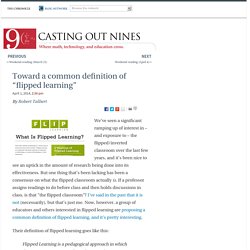
But one thing that’s been lacking has been a consensus on what the flipped classroom actually is. If a professor assigns readings to do before class and then holds discussions in class, is that “the flipped classroom”? I’ve said in the past that it is not (necessarily), but that’s just me. Now, however, a group of educators and others interested in flipped learning are proposing a common definition of flipped learning, and it’s pretty interesting. Their definition of flipped learning goes like this: Note first that the authors are not defining what the flipped classroom is but rather what flipped learning is. Let's dance through life!
Bloom’s Revised Taxonomy is indeed a good tool to structure, to organize and to reflect on lessons as well as to facilitate deeper understanding.

After reading Bloom’s and ICT Tools I found a very nice guideline on Storybird: Bloom’s Taxonomy in the Classroom which is an overview of actions, questions and activities for teaching practices. Plan 1: I share this with my colleagues and use this guideline for planning and reflecting my lessons more often. I would have never thought that there are so many more adjustments and adaptions of Bloom’s taxonomy. Several search keys in Google later I found Bloom’s Taxonomy for the iPads which interest me the most at the moment. Here are two examples: It really got me questioning how I chose the iPad Apps for our trial at school. Even more impressive for me the following iPadagogy Wheel. Plan 2: I’m definitely going to share this with my colleagues as well.