
2011 February 6 - An Anomalous SETI Signal. Discover the cosmos!

2012 September 17 - A Solar Filament Erupts. Discover the cosmos!
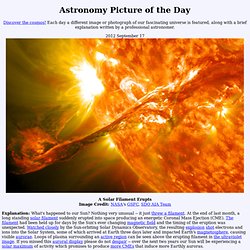
Each day a different image or photograph of our fascinating universe is featured, along with a brief explanation written by a professional astronomer. 2012 September 17 Explanation: What's happened to our Sun? Nothing very unusual -- it just threw a filament. At the end of last month, a long standing solar filament suddenly erupted into space producing an energetic Coronal Mass Ejection (CME). Astronomy Picture of the Day. Discover the cosmos!
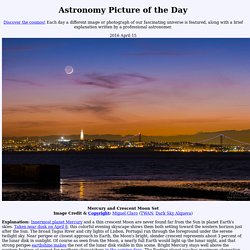
Each day a different image or photograph of our fascinating universe is featured, along with a brief explanation written by a professional astronomer. 2016 April 15 Mercury and Crescent Moon Set Image Credit & Copyright: Miguel Claro (TWAN, Dark Sky Alqueva) Explanation: Innermost planet Mercury and a thin crescent Moon are never found far from the Sun in planet Earth's skies.
Taken near dusk on April 8, this colorful evening skyscape shows them both setting toward the western horizon just after the Sun. Tomorrow's picture: Heliopause Electrostatic Rapid Transit System Authors & editors: Robert Nemiroff (MTU) & Jerry Bonnell (UMCP)NASA Official: Phillip Newman Specific rights apply.NASA Web Privacy Policy and Important NoticesA service of:ASD at NASA / GSFC& Michigan Tech.
2012 March 14 - Angry Sun Erupting. Discover the cosmos!
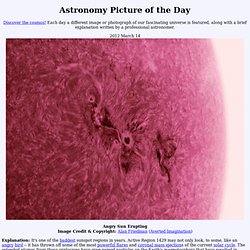
Each day a different image or photograph of our fascinating universe is featured, along with a brief explanation written by a professional astronomer. 2012 March 14 Explanation: It's one of the baddest sunspot regions in years. Active Region 1429 may not only look, to some, like an angry bird -- it has thrown off some of the most powerful flares and coronal mass ejections of the current solar cycle. The extended plumes from these explosions have even rained particles on the Earth's magnetosphere that have resulted in colorful auroras.
2012 February 8 - Enceladus Backlit by Saturn. Discover the cosmos!
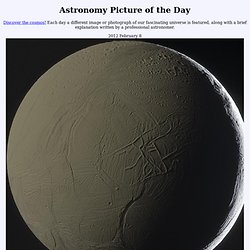
Each day a different image or photograph of our fascinating universe is featured, along with a brief explanation written by a professional astronomer. 2012 February 8 Explanation: This moon is shining by the light of its planet. Specifically, a large portion of Enceladus pictured above is illuminated primarily by sunlight first reflected from the planet Saturn. The result is that the normally snow-white moon appears in the gold color of Saturn's cloud tops. 2012 January 24 - January Aurora Over Norway. Discover the cosmos!

Each day a different image or photograph of our fascinating universe is featured, along with a brief explanation written by a professional astronomer. 2012 January 24 Explanation: What's that in the sky? An aurora. A large coronal mass ejection occurred on our Sun five days ago, throwing a cloud of fast moving electrons, protons, and ions toward the Earth. 2012 January 22 - Saturn's Hexagon Comes to Light. Discover the cosmos!
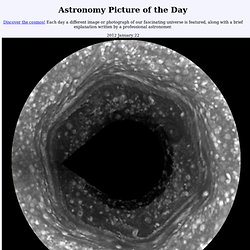
Each day a different image or photograph of our fascinating universe is featured, along with a brief explanation written by a professional astronomer. 2012 January 22 Saturn's Hexagon Comes to Light Image Credit: Cassini Imaging Team, SSI, JPL, ESA, NASA Explanation: Believe it or not, this is the North Pole of Saturn. It is unclear how an unusual hexagonal cloud system that surrounds Saturn's north pole was created, keeps its shape, or how long it will last. Tomorrow's picture: ground or sky? Authors & editors: Robert Nemiroff (MTU) & Jerry Bonnell (UMCP)NASA Official: Phillip Newman Specific rights apply.NASA Web Privacy Policy and Important NoticesA service of:ASD at NASA / GSFC& Michigan Tech. 2011 January 16 - Zodiacal Light and the False Dawn.
2011 December 26 - A Raging Storm System on Saturn. Discover the cosmos!
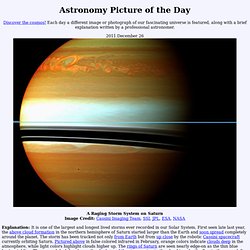
Each day a different image or photograph of our fascinating universe is featured, along with a brief explanation written by a professional astronomer. 2011 December 26 A Raging Storm System on Saturn Image Credit: Cassini Imaging Team, SSI, JPL, ESA, NASA Explanation: It is one of the largest and longest lived storms ever recorded in our Solar System. First seen late last year, the above cloud formation in the northern hemisphere of Saturn started larger than the Earth and soon spread completely around the planet. Fun Quiz: Celestial or Cellular -- can you tell the difference? Authors & editors: Robert Nemiroff (MTU) & Jerry Bonnell (UMCP)NASA Official: Phillip Newman Specific rights apply.NASA Web Privacy Policy and Important NoticesA service of:ASD at NASA / GSFC& Michigan Tech. 2011 December 21 - A Horseshoe Einstein Ring from Hubble. Discover the cosmos!
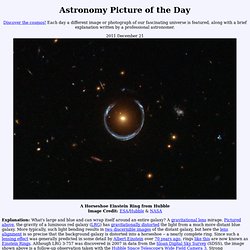
Each day a different image or photograph of our fascinating universe is featured, along with a brief explanation written by a professional astronomer. 2011 December 21 Explanation: What's large and blue and can wrap itself around an entire galaxy? A gravitational lens mirage. Pictured above, the gravity of a luminous red galaxy (LRG) has gravitationally distorted the light from a much more distant blue galaxy. 2011 November 27 - Shuttle Plume Shadow Points to the Moon. Discover the cosmos!

Each day a different image or photograph of our fascinating universe is featured, along with a brief explanation written by a professional astronomer. 2011 November 27 Shuttle Plume Shadow Points to the Moon Image Credit: Pat McCracken, NASA Explanation: Why would the shadow of a space shuttle launch plume point toward the Moon? In early 2001 during a launch of Atlantis, the Sun, Earth, Moon, and rocket were all properly aligned for this photogenic coincidence. 2011 November 26 - Pelican Nebula Close Up. Discover the cosmos! Each day a different image or photograph of our fascinating universe is featured, along with a brief explanation written by a professional astronomer. 2011 November 26 Pelican Nebula Close-up Image Credit & Copyright: Martin Pugh Explanation: The prominent ridge of emission featured in this vivid skyscape is designated IC 5067. Part of a larger emission nebula with a distinctive shape, popularly called The Pelican Nebula, the ridge spans about 10 light-years and follows the curve of the cosmic pelican's head and neck.
Tomorrow's picture: the shadow knows. 2011 November 24 - Caught in the Afterglow. Discover the cosmos! Each day a different image or photograph of our fascinating universe is featured, along with a brief explanation written by a professional astronomer. 2011 November 24 Caught in the Afterglow Illustration Credit: ESO, L. Calçada - Research Team: Sandra Savaglio (MPE) et al. Explanation: In this artist's illustration, two distant galaxies formed about 2 billion years after the big bang are caught in the afterglow of GRB090323, a gamma-ray burst seen across the Universe. 2011 November 20 - W5: Pillars of Star Formation. Discover the cosmos! Each day a different image or photograph of our fascinating universe is featured, along with a brief explanation written by a professional astronomer. 2011 November 20 W5: Pillars of Star Formation Image Credit & Copyright: Lori Allen, Xavier Koenig (Harvard-Smithsonian CfA) et al., JPL-Caltech, NASA.
2011 November 17 - Pleiades to Hyades. Discover the cosmos! Each day a different image or photograph of our fascinating universe is featured, along with a brief explanation written by a professional astronomer. 2011 November 17 Pleiades to Hyades Image Credit & Copyright: Rogelio Bernal Andreo Explanation: This cosmic vista stretches almost 20 degrees across the gentle constellation Taurus. It begins at the Pleiades and ends at the Hyades, two of the best known star clusters in planet Earth's sky. Tomorrow's picture: the colorful side Authors & editors: Robert Nemiroff (MTU) & Jerry Bonnell (UMCP)NASA Official: Phillip Newman Specific rights apply.NASA Web Privacy Policy and Important NoticesA service of:ASD at NASA / GSFC& Michigan Tech.
2011 November 16 - NGC 7822 in Cepheus. Discover the cosmos! Each day a different image or photograph of our fascinating universe is featured, along with a brief explanation written by a professional astronomer. 2011 November 16 NGC 7822 in Cepheus Image Credit & Copyright: Manuel Fernández Suarez Explanation: Hot, young stars and cosmic pillars of gas and dust seem to crowd into NGC 7822. At the edge of a giant molecular cloud toward the northern constellation Cepheus, the glowing star forming region lies about 3,000 light-years away. Tomorrow's picture: across the sky.
2011 November 15 - Orange Sun Scintillating. Discover the cosmos! 2011 November 7 - Star Forming Region S106. Discover the cosmos! 2011 November 6 - Orange Sun Oozing. 2011 November 2 - NGC 7380: The Wizard Nebula. 2011 October 30 - White Rock Fingers on Mars. 2011 October 26 - In Through and Beyond Saturns Rings. Discover the cosmos! 2011 October 24 - HH 222: The Waterfall Nebula. Discover the cosmos! 2011 October 23 - Jupiter's Clouds from New Horizons. 2011 October 21 - Clouds of Perseus. 2011 October 16 - A Picturesque Venus Transit. 2007 November 25 - An Iridescent Cloud Over Colorado.
Discover the cosmos! Astronomy Picture of the Day. 2002 January 14 - Sun Halo at Winter Solstice. 2008 February 14 - Long Stem Rosette. 2002 January 9 - Blue Flash. August 23, 1999 - Sundogs over the VLA.