
Sea-Ice Brinicles As Spires of Life. What's cooler than being cool?

Brine-cold. When salt-rich water leaks out of sea ice, it sinks into the sea and can occasionally create an eerie finger of ice called a brinicle. New research explains how these strange fingers of ice form and how the salty water within sea ice could have been a prime environment in which life may have evolved. The study, published in the American Chemical Society's journal Langmuir, suggests that brinicles form in the same way as hydrothermal vents, except in reverse.
Study backs 'hobbit' island dwarfism theory. 17 April 2013Last updated at 00:55 GMT By Pallab Ghosh Science correspondent, BBC News How an ancient human species may have shrunk as a result of island dwarfism A diminutive species of human whose remains were found on the Indonesian island of Flores could have shrunk as a result of island dwarfism as it adapted to its environment.

A study of the remains of the creature, nicknamed the "hobbit", shows that it is possible for it to have been a dwarf version of an early human species. The hobbit co-existed with our species until 12,000 years ago. The research has been published in the Royal Society's Proceedings B Journal. Science & Environment - The wilder side of sex. Humans may look down upon certain sexual interests as odd or gross, though chances are that animals indulge in a spot of similar behaviour too.

Science & Environment - A friendly bug that feasts on plastic. Technology - When good milk turns bad. Every year, millions of dollars of milk is poured away because it cannot be kept fresh.

Technology - Rats: Scratch and sniff landmine detection. Meet the giant Africa rats with a remarkable skill, which allows them to safely clear large areas filled with deadly landmines.

“Zombie” Worms Mate Inside Whale Bones. In modern pop culture, zombies are everywhere, from TV shows like The Walking Dead to books like World War Z.

But when it comes to the creepy factor, Osedax worms—nicknamed “zombie worms”—beat out even the goriest movies. A recent study reveals that these faceless, mouthless worms enjoy making sweet, sweet love inside decomposing whale skeletons that have fallen to the bottom of the ocean floor. An adult female bone-eating worm. Is Shrinking Sea Ice Behind Chilly Spring? First it was the fault of Punxsutawney Phil, the groundhog who mistakenly forecasted a quick end to winter. Now climate scientists are saying that Arctic sea ice—or the lack of it—is a driving force behind the Northern Hemisphere's unseasonably cold spring. As Northern Hemisphere temperatures remain below normal more than a week into the official start of spring, a team of meteorologists and climate scientists are pointing to recent research that suggests sea ice cover is a likely culprit.
Recent imaging from the U.S. National Snow and Ice Data Center showed a historic minimum in Arctic ice cover last fall, and current data reveals that sea ice cover—which recently reached its maximum for the year—is at its sixth lowest extent in the satellite record. (Related: "Arctic Sea Ice Hits Record Low—Extreme Weather to Come? ") We Didn’t Domesticate Dogs. They Domesticated Us. In the story of how the dog came in from the cold and onto our sofas, we tend to give ourselves a little too much credit.
The most common assumption is that some hunter-gatherer with a soft spot for cuteness found some wolf puppies and adopted them. Over time, these tamed wolves would have shown their prowess at hunting, so humans kept them around the campfire until they evolved into dogs. (See "How to Build a Dog. ") But when we look back at our relationship with wolves throughout history, this doesn't really make sense. For one thing, the wolf was domesticated at a time when modern humans were not very tolerant of carnivorous competitors. The hunting hypothesis, that humans used wolves to hunt, doesn't hold up either. Humans have a long history of eradicating wolves, rather than trying to adopt them.
Buried Mars River Channel Reveals Evidence of Relatively Recent Megaflooding. Scientists have known for some time about the existence of the Marte Vallis channel system.

But the new radar research has doubled the estimated depth of the massive flow and identified the headwaters and floodplain of the river. Both had been covered by lava from a volcanic eruption no more than 500 million years ago. The megaflood and volcano are considered especially significant because they occurred so recently, in geological terms, suggesting that Mars may well remain a geologically active planet today. ( Learn about Martian geology .)
Curiosity Finds Evidence For a Habitable Ancient Mars. Failure to Hunt Rabbits Part of Neanderthals' Demise? Neanderthal large eyes 'caused their demise' 12 March 2013Last updated at 20:50 ET By Pallab Ghosh Science correspondent, BBC News The eyes have it: The Neanderthal skull (L) has larger eye sockets compared with a modern human skull (R).
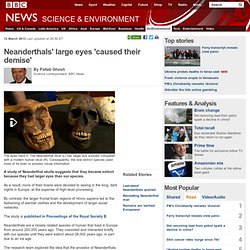
Consequently, the now extinct species used more of its brain to process visual information A study of Neanderthal skulls suggests that they became extinct because they had larger eyes than our species. The Giant Camels of the Prehistoric High Arctic. Daylight Saving Time 2013: When Does It Start? And Why? With daylight saving time (also called daylight savings time) happening this weekend, clock confusion is once again ticking away, giving rise to various questions: Why do we spring forward? Does daylight saving time really save energy? Is it bad for your health? Here are answers from experts. When Will Daylight Savings Begin in 2013? For most Americans, daylight saving time 2013 will begin 2 a.m. on Sunday, March 10, when most states will spring forward an hour. The federal government doesn't require U.S. states or territories to observe daylight saving time, which is why residents of Arizona (except for residents of the Navajo Indian Reservation), Hawaii, Puerto Rico, the Virgin Islands, American Samoa, Guam, and the Northern Marianas Islands won't need to change their clocks this weekend.
Science & Environment - Antarctica: Engine of ocean life. Antarctica is the coldest, driest and windiest continent on Earth.

Science & Environment - Sending postcards for aliens. Our space correspondent contemplates the latest effort to preserve humanity’s long-term legacy by sending images into space.
