
The Hitchhiker's Guide to the Galaxy. The Picture of Dorian Gray. Novel by Oscar Wilde The Picture of Dorian Gray is a Gothic and philosophical novel by Oscar Wilde, first published complete in the July 1890 issue of Lippincott's Monthly Magazine.[1][2] Fearing the story was indecent, the magazine's editor deleted roughly five hundred words before publication without Wilde's knowledge.
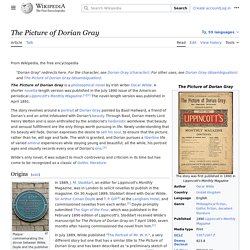
Despite that censorship, The Picture of Dorian Gray offended the moral sensibilities of British book reviewers, some of whom said that Oscar Wilde merited prosecution for violating the laws guarding public morality. In response, Wilde aggressively defended his novel and art in correspondence with the British press, although he personally made excisions of some of the most controversial material when revising and lengthening the story for book publication the following year.
The Picture of Dorian Gray is the only novel written by Wilde. Plot[edit] Summary[edit] Under Lord Henry's hedonistic influence, Dorian fully explores his sensuality. Characters[edit] Allusions[edit] American Gods. On the Road. On the Road is a novel by American writer Jack Kerouac.
On the Road is based on the travels of Kerouac and his friends across America. It is considered a defining work of the postwar Beat and Counterculture generations, with its protagonists living life against a backdrop of jazz, poetry and drug use. The idea for On the Road formed during the late 1940s. It was to be Kerouac's second novel, and it underwent several drafts before he completed it in April 1951. It was first published by Viking Press in 1957. Origins[edit] Many aspects go into understanding the context of On the Road, and they must be viewed cohesively in order to appreciate why the book was as relevant and pertinent as it was. Kerouac biography[edit] Kerouac was born in a French-Canadian neighborhood of Lowell, Massachusetts, and learned English at age six.
Many of the events depicted in the book are the experiences that shaped both its content and production. Historical context[edit] Beat Generation summary[edit] J. In Search of Lost Time. The novel began to take shape in 1909.

Proust continued to work on it until his final illness in the autumn of 1922 forced him to break off. Proust established the structure early on, but even after volumes were initially finished he kept adding new material and edited one volume after another for publication. The last three of the seven volumes contain oversights and fragmentary or unpolished passages as they existed in draft form at the death of the author; the publication of these parts was overseen by his brother Robert.
Initial publication[edit] The novel was initially published in seven volumes: Swann's Way (Du côté de chez Swann, sometimes translated as The Way by Swann's) (1913) was rejected by a number of publishers, including Fasquelle, Ollendorf, and the Nouvelle Revue Française (NRF). Synopsis[edit] The novel recounts the experiences of the Narrator while growing up, participating in society, falling in love, and learning about art.
Volume One: Swann's Way[edit] The Master (2012 film) The Master is a 2012 American drama film written, directed, and co-produced by Paul Thomas Anderson and starring Joaquin Phoenix, Philip Seymour Hoffman, and Amy Adams.

It tells the story of Freddie Quell (Phoenix), a World War II veteran struggling to adjust to a post-war society who meets Lancaster Dodd (Hoffman), a leader of a religious movement known as "The Cause," who sees something in Quell and accepts him into the movement. Freddie takes a liking to "The Cause" and begins traveling with Dodd along the East Coast to spread the teachings. Initially the film was set up with Universal but fell through due to problems with the scripts and the budget. It was first publicly shown on August 3, 2012, at the American Cinematheque in 70 mm and screened in various other cities in the format prior to its official premiere. The film officially premiered on September 1, 2012, at the Venice Film Festival where it won the FIPRESCI Award for Best Film.