
Civil rights movement. The African-American Civil Rights Movement or 1960s Civil Rights Movement encompasses social movements in the United States whose goals were to end racial segregation and discrimination against black Americans and to secure legal recognition and federal protection of the citizenship rights enumerated in the Constitution and federal law.
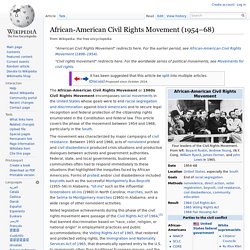
This article covers the phase of the movement between 1954 and 1968, particularly in the South. A wave of inner city riots in black communities from 1964 through 1970 undercut support from the white community. The emergence of the Black Power movement, which lasted from about 1966 to 1975, challenged the established black leadership for its cooperative attitude and its nonviolence, and instead demanded political and economic self-sufficiency. During the same time as African Americans were being disenfranchised, white Democrats imposed racial segregation by law.
Violence against blacks increased, with numerous lynchings through the turn of the century.
Seattle Civil Rights & Labor History Project. Civil and political rights. Civil and political rights form the original and main part of international human rights.[4] They comprise the first portion of the 1948 Universal Declaration of Human Rights (with economic, social and cultural rights comprising the second portion).

The theory of three generations of human rights considers this group of rights to be "first-generation rights", and the theory of negative and positive rights considers them to be generally negative rights. The phrase "civil rights" is a translation of Latin ius civis (rights of a citizen). Roman citizens could be either free (libertas) or servile (servitus), but they all had rights in law.[5] After the Edict of the Milan in 313, these rights included the freedom of religion.[6] Roman legal doctrine was lost during the Middle Ages, but claims of universal rights could still be made based on religious doctrine. In the 1860s, Americans adapted this usage to newly freed blacks.