
Italy’s new prime minister: The full Monti. Technocrats: Minds like machines. Eurozone debt web: Who owes what to whom? The circle below shows the gross external, or foreign, debt of some of the main players in the eurozone as well as other big world economies.
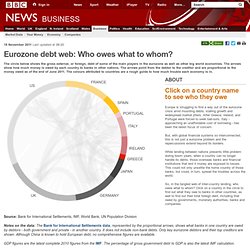
The arrows show how much money is owed by each country to banks in other nations. The arrows point from the debtor to the creditor and are proportional to the money owed as of the end of June 2011. The colours attributed to countries are a rough guide to how much trouble each economy is in. Click on a country name to see who they owe Europe is struggling to find a way out of the eurozone crisis amid mounting debts, stalling growth and widespread market jitters. But, with global financial systems so interconnected, this is not just a eurozone problem and the repercussions extend beyond its borders. While lending between nations presents little problem during boom years, when a country can no longer handle its debts, those overseas banks and financial institutions that lent it money are exposed to losses.
GDP: €1.8 tn Foreign debt: €4.2 tn. In defence of Europe's technocrats. Leafing through the British press over the last week, you can't but notice the increased sightings of a rare political subspecies: the "technocrat".
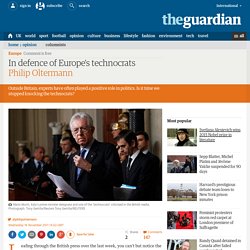
Prominent technocrats include the Italian prime minister designate, Mario Monti, and the Greek PM, Lucas Papademos, who have been parachuted into the top job, the papers say, in order to act out diktats of their "paymasters" in Germany and France. In the Telegraph, Christopher Booker has revealed that "EU architects never meant it to be a democracy": technocracy was always the plan. In the same paper, Charles Moore has proclaimed that "left and right should agree that this is not the time for technocrats and Frankfurters", but real democrats. And largely they do. On these pages, there have been a number of comment pieces and editorials pointing out Europe's "democratic deficit", questioning whether the "rise of the technocrats" is wise ("economics is not engineering") or even effective.
UBS on Euro: “no modern monetary unions have broken up without some form of authoritarian government, or civil war” Charlemagne: In the Brussels bunker. The proper diagnosis: Profligacy is not the problem. MISDIAGNOSIS is not, in itself, malpractice.
Everyone, be they doctors or central bankers or politicians, makes mistakes. But when the misdiagnosis involves ignoring some symptoms and persisting in treatments that aren't working, it is not so easily excused. And that is what is going on with the euro, where a stress on demanding austerity has eclipsed the need to boost confidence. Germany, the European Central Bank (ECB) and many others diagnose today's mess as stemming primarily from profligacy on the periphery. “It is an indisputable fact”, Wolfgang Schäuble, Germany's finance minister, recently wrote in the Financial Times, that “excessive state spending has led to unsustainable levels of debt and deficits that now threaten our economic welfare.”
If profligacy is the problem, the argument goes, austerity is the solution, with public thrift serving to rebuild investor confidence. This medicine is harsh. This is because the profligacy diagnosis is incomplete, and thus misleading. The costs of break-up: After the fall. Bagehot: English for Schadenfreude.