
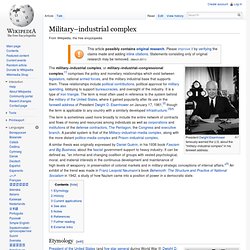
Military–industrial complex. President Dwight Eisenhower famously warned the U.S. about the "military–industrial complex" in his farewell address.
The term is sometimes used more broadly to include the entire network of contracts and flows of money and resources among individuals as well as corporations and institutions of the defense contractors, The Pentagon, the Congress and executive branch. A parallel system is that of the Military–industrial–media complex, along with the more distant politico-media complex and Prison–industrial complex. A similar thesis was originally expressed by Daniel Guérin, in his 1936 book Fascism and Big Business, about the fascist government support to heavy industry. It can be defined as, "an informal and changing coalition of groups with vested psychological, moral, and material interests in the continuous development and maintenance of high levels of weaponry, in preservation of colonial markets and in military-strategic conceptions of internal affairs. Etymology[edit] History[edit]
Iron triangle (US politics) Iron Triangle diagram In United States politics, the iron triangle comprises the policy-making relationship among the congressional committees, the bureaucracy, and interest groups.[1] Central to the concept of an iron triangle is the assumption that bureaucratic agencies, as political entities, seek to create and consolidate their own power base.

In this view an agency's power is determined by its constituency, not by its consumers. (For these purposes, "constituents" are politically active members sharing a common interest or goal; consumers are the expected recipients of goods or services provided by a governmental bureaucracy and are often identified in an agency's written goals or mission statement.) Apparent bureaucratic dysfunction may be attributable to the alliances formed between the agency and its constituency. The need of a bureaucracy for a constituency sometimes leads to an agency's cultivation of a particular clientele. Gordon Adams. History of military technology. The military funding of science has had a powerful transformative effect on the practice and products of scientific research since the early 20th century.
Particularly since World War I, advanced science-based technologies have been viewed as essential elements of a successful military. World War I is often called "the chemists’ war", both for the extensive use of poison gas and the importance of nitrates and advanced high explosives. Poison gas, beginning in 1915 with chlorine from the powerful German dye industry, was used extensively by the Germans and the British ; over the course of the war, scientists on both sides raced to develop more and more potent chemicals and devise countermeasures against the newest enemy gases.[1] Physicists also contributed to the war effort, developing wireless communication technologies and sound-based methods of detecting U-boats, resulting in the first tenuous long-term connections between academic science and the military.[2] World War II[edit]
Military science. Military science is the theory, method, and practice of producing military capability in a manner consistent with national defense policy.

[citation needed] Military science serves to identify the strategic, political, economic, psychological, social, operational, technological, and tactical elements necessary to sustain relative advantage of military force; and to increase the likelihood and favorable outcomes of victory in peace or during a war. Military scientists include theorists, researchers, experimental scientists, applied scientists, designers, engineers, test technicians, and other military personnel. In military history, military science had been used during the period of Industrial Revolution as a general term to refer to all matters of military theory and technology application as a single academic discipline, including that of the deployment and employment of troops in peacetime or in battle.
History[edit] CLASS IN TELEPHONY: ENLISTED MEN, U. Military organization[edit]