Richard Dawkins, Rowan Williams, Anthony Kenny: "Human Beings & Ultimate Origin" Debate. Doctrines of Meister Eckhart. Untitled. The Galilean Library. Wittgenstein’s Ethics and the Value of the Mystical « DIALECTIC. Douglas Duhaime Although Ludwig Wittgenstein (1889-1951) famously declared that “ethics cannot be put into words,” ethical issues continue to pose perennial problems for philosophy, and Wittgenstein’s writings on ethics continue to earn philosophy’s interest and accolades (2005 p.183).

In what follows, I outline Wittgenstein’s writings on ethics and briefly discuss the value his approach lends to the mystical objects and experiences in life. In his “Lecture on Ethics” (1929), Wittgenstein informs us that he means many things by the word “ethics,” including: the enquiry into what is good, valuable, or important; the enquiry into the meaning of life; the inquiry into that which makes life worth living; and the enquiry into the right way of living (P.5).
He then shows how each of these expressions is used in two different senses: the trivial (or relative) sense, and the ethical (or absolute) sense. Evija Trofimova: Kautrības paradokss. Par kautrību nav viegli rakstīt.

Pievēršot sev uzmanību, tā liek rakstītājam kautrēties. Kas ir kautrība? Vai mani vienmēr pavadošā spriedze, kas liek man būt pilsoņu karā pašam ar sevi, turot važās nost no cilvēkiem, sarunām un pieredzēm, ko patiesībā vēlos piedzīvot? Negaidīts, bet patiess manis slavinājuma mirklis, kad es nolaižu acis, muļķīgi smaidu, atgaiņājos un nosarkstu? Tikums – kā Viktorijas laika sabiedrībā, kur spontāni izsauktais sārtums vaigos kopsavelk visus tā laika morālos uzskatus, rakstura pieticību un nevainību? Noams Čomskis par izšķirošajiem jautājumiem žurnālam Rīgas Laiks. Monomyth. Joseph Campbell's monomyth, or the hero's journey, is a basic pattern that its proponents argue is found in many narratives from around the world.
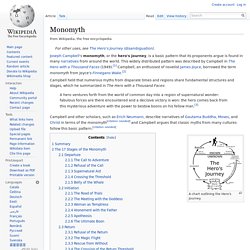
This widely distributed pattern was described by Campbell in The Hero with a Thousand Faces (1949).[1] Campbell, an enthusiast of novelist James Joyce, borrowed the term monomyth from Joyce's Finnegans Wake.[2] Campbell held that numerous myths from disparate times and regions share fundamental structures and stages, which he summarized in The Hero with a Thousand Faces: A hero ventures forth from the world of common day into a region of supernatural wonder: fabulous forces are there encountered and a decisive victory is won: the hero comes back from this mysterious adventure with the power to bestow boons on his fellow man.[3] A chart outlining the Hero's Journey.
Summary[edit] Utility monster. The utility monster is a thought experiment in the study of ethics created by philosopher Robert Nozick in 1974 as a criticism of utilitarianism.
The thought experiment[edit] A hypothetical being is proposed who receives much more utility from each unit of a resource he consumes as anyone else does. For instance, eating a cookie might bring only one unit of pleasure to an ordinary person but could bring 100 units of pleasure to a utility monster. If the utility monster can get so much pleasure from each unit of resources, it follows from utilitarianism that the distribution of resources should acknowledge this.
Thomas Nagel. Thomas Nagel (/ˈneɪɡəl/; born July 4, 1937) is an American philosopher, currently University Professor of Philosophy and Law at New York University, where he has taught since 1980.
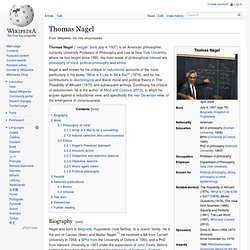
His main areas of philosophical interest are philosophy of mind, political philosophy and ethics. Nagel is well known for his critique of reductionist accounts of the mind, particularly in his essay "What Is it Like to Be a Bat? " (1974), and for his contributions to deontological and liberal moral and political theory in The Possibility of Altruism (1970) and subsequent writings.
Continuing his critique of reductionism, he is the author of Mind and Cosmos (2012), in which he argues against a reductionist view, and specifically the neo-Darwinian view, of the emergence of consciousness. Biography[edit] Nagel was born in Belgrade, Yugoslavia (now Serbia), to a Jewish family. Work[edit] Nagel began to publish philosophy at the age of twenty-two; his career now spans fifty years of publication.
Alvin Plantinga. Alvin Carl Plantinga (/ˈplæntɪŋɡə/;[1] born November 15, 1932) is an American analytic philosopher, the John A.
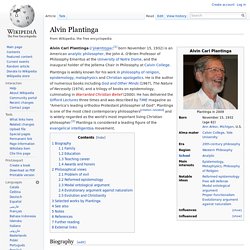
O'Brien Professor of Philosophy Emeritus at the University of Notre Dame, and the inaugural holder of the Jellema Chair in Philosophy at Calvin College. Plantinga is widely known for his work in philosophy of religion, epistemology, metaphysics and Christian apologetics. He is the author of numerous books including God and Other Minds (1967), The Nature of Necessity (1974), and a trilogy of books on epistemology, culminating in Warranted Christian Belief (2000). He has delivered the Gifford Lectures three times and was described by TIME magazine as "America's leading orthodox Protestant philosopher of God". Plantinga is one of the most cited contemporary philosophers[citation needed] and is widely regarded as the world’s most important living Christian philosopher.[2] Plantinga is considered a leading figure of the evangelical intelligentsia movement.
Biography[edit] Slavoj Zizek. Materialism and Theology. 2007 6/8. Stīmpanka subkultūra - Teorija - Teksti. Karl Jaspers. 1.
Career Jaspers was born in the North German town of Oldenburg in 1883. His family milieu was strongly influenced by the political culture of North German liberalism, and he often referred to the climate of early liberal democratic thought as a formative aspect of his education. Moreover, although he claimed not have been influenced by any specifically ecclesiastical faith, his thought was also formed by the spirit of North German Protestantism, and his philosophical outlook can in many respects be placed in the religiously inflected tradition of Kant and Kierkegaard. His education was extremely diverse and broad-ranging. While he was working as a psychiatrist in Heidelberg, Jaspers came into contact with Max Weber, and also with the other intellectuals who were grouped around Weber, including Ernst Bloch, Emil Lask, Georg Simmel, and Lukács. In 1937 Jaspers was removed from his professorship, and he surely felt himself a marked man until the end of World War II. 2. 3. 4.
Aztec philosophy. Aztec philosophy was the school of philosophy developed by the Aztec Empire.