
Switzerland temporarily nuclear-free. In August, the fifth of five nuclear plants in Switzerland went off-line, but only for two days.
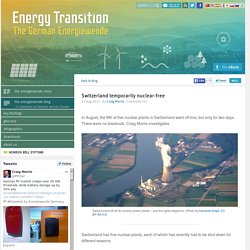
There were no blackouts. Craig Morris investigates. Switzerland has five nuclear plants, each of which has recently had to be shut down for different reasons: Leibstadt (1,245 megawatts) and Mühleberg (355 megawatts) are undergoing scheduled maintenance. Is Germany reliant on foreign nuclear power? It’s back again – the claim that Germany will rely on foreign base load, especially nuclear, in its energy transition.
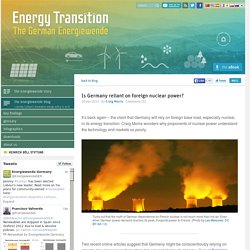
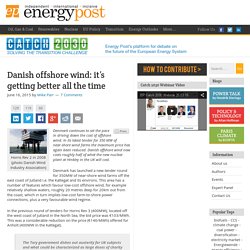
Craig Morris wonders why proponents of nuclear power understand the technology and markets so poorly. Turns out that the myth of German dependence on French nuclear is not much more than hot air: Even when German power demand reaches its peak, it exports power to France. (Photo by Les Meloures, CC BY-SA 1.0) Two recent online articles suggest that Germany might be conscientiously relying on imports of nuclear power from abroad to prevent blackouts at home. Over at Breaking Energy, Roman Kilisek writes: Is Germany reliant on foreign nuclear power? Frankrijk is steunoperatie voor kernenergie begonnen. Stefan de Bruijn sur Twitter : "Senaat in zeer ruime meerderheid voor wet #Windenergie op zee. Alleen PVV tegen. De komende jaren krijgt Nederland 4450 MW capaciteit op zee" Danish offshore wind: getting better all the time. Horns Rev 2 in 2008 (photo Danish Wind Industry Association)
Frankrijk begint steunoperatie voor kernenergie. Jan Willem Zwang sur Twitter : "Frans #Areva maakt 5 miljard verlies met #kernenergie Gek dat we #pvv en #vvd daar niet over horen #windenergie. Basiskennis kernenergie in 18 argumenten. De discussie over berging van radioactief afval in zoutkoepels of kleilagen komt weer op gang.
Niet omdat de Nederlandse regering dat zo graag wil, maar omdat de Europese Unie dat eist. De Europese Unie heeft namelijk in 2011 in een richtlijn bepaald dat elke lidstaat een Nationaal Programma voor eindberging van radioactief afval moet maken; daarbij is inspraak van de burgers een vereiste. Volgens een TNO-rapport van juli 2014 zijn van de Nederlandse kleilagen die in Zuidwest-Friesland het meest geschikt voor de eindberging van kernafval. Wind and solar generation half the cost of nuclear.
New-build wind and solar energy systems can generate electricity for up to 50 per cent cheaper than new nuclear power plants, a German study has found.
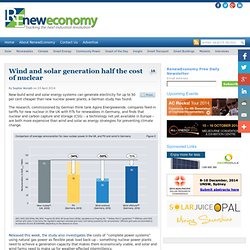
The research, commissioned by German think tank Agora Energiewende, compares feed-in tariffs for new nuclear in the UK with FiTs for renewables in Germany, and finds that nuclear and carbon capture and storage (CSS) – a technology not yet available in Europe – are both more expensive than wind and solar as energy strategies for preventing climate change. Released this week, the study also investigates the costs of “complete power systems” using natural gas power as flexible peak load back-up – something nuclear power plants need to achieve a generation capacity that makes them economically viable, and solar and wind farms need to make up for weather-affected intermittency.
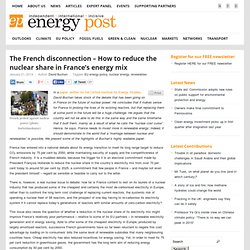
Wind and solar generation half the cost of nuclear. The French disconnection – How to reduce the nuclear share in France’s energy mix. French protest against nuclear power (photo: Sortirdnucleaire)
Nuclear energy verdict: Costly, slow and very high maintenance. The story we published on Friday comparing the costs of new nuclear, now that they have been defined by contract signed by the UK Government for the construction of the $24 billion Hinkley C facility – with clean energy alternatives such as wind and solar, certainly generated a lot of interest, and comment.

Since then, we have received an analysis from Deutsche Bank, which makes some other observations about the cost of nuclear, the comparisons with gas, the price of abatement, and the cost of upkeep for France’s existing fleet. The first point made by Deutsche is that this deal underlines the fact that nuclear is not cheap, but really, really expensive – a point that should not be forgotten in Australia, where there is still a push for nuclear in some quarters despite the abundant alternatives (in particular solar) that are not available to the UK.
As we have noted in the other article, the £92.50/MWh strike price is nearly double the current average cost of generation in the UK. Dave Toke's green energy blog: Hinkley C to be paid more than twice as much as German solar pv arrays. Looming large over the UK Government's EU state aid application for Hinkley C is the charge that this deal will distort the EU's internal market, in particular to undercut solar pv arrays in Germany over 10 MW in size.
Such arrays are no longer eligible to receive premium prices under the German feed-in tariff system. Such plant will only receive the wholesale electricity price, which is less than half the rates to be paid to Hinkley C. Radiation Level Spikes At Fukushima Daiichi Nuclear Disaster Site. Health Published on September 6th, 2013 | by James Ayre The slow death-march of the Fukushima nuclear disaster continues onwards — new reports have revealed that radiation levels over eighteen times higher than any previously reported at the crippled Fukushima Daiichi plant were recently registered at one of the plant’s water storage tanks.
The extremely high radiation levels have once again brought the Fukushima disaster to the public’s attention, but as you can no doubt guess, regardless of whether the disaster is in the news or not, the situation is not improving, and the prospect of getting the disaster under control anytime soon is looking more and more impossible. The nuclear power plant’s operator — Tokyo Electric Power (TEPCO) — reported that radiation levels were so high near the bottom of the tank — measured at 1,800 millisieverts an hour — that if a human was exposed to them that they would be dead within four hours. Business Green has more: UK's nuclear clean-up programme to cost billions more than expected. The public body charged with overseeing the dismantling of Britain's network of atomic power and research stations will reveal on Monday that its estimates for the lifetime cost of the programme has risen by billions of pounds.
Despite this, the Nuclear Decommissioning Authority (NDA) will say in its annual report that it is getting to grips with the clean-up problem because the rate of cost growth is slowing year-on-year. Yet the soaring costs will alarm industry critics at a time when the government is trying to encourage construction of a new generation of atomic power plants while plans to construct a permanent home for high-level radioactive waste are stalled. Feed-in Tariffs For Nuclear, Anyone? Feed-in tariffs are often referred to as a startup mechanism for a fledgling technology (renewables), and it is assumed that they will be done away with at some point.
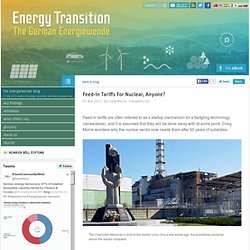
Craig Morris wonders why the nuclear sector now needs them after 50 years of subsidies. T.co / Twitter. Japan likely to reverse nuclear energy phase-out. As the country nears the two-year anniversary of the second-worst nuclear accident in history, the protests continue every Friday night outside the official residence of the prime minister of Japan. The demonstrations are very Japanese in their nature; more colorful than confrontational and polite instead of provocative. But it seems likely that these people, drawn from all walks of life in this post-nuclear disaster nation, are to be disappointed in their campaign to have the government adhere to its predecessor's promise to do away with Japan's reliance on nuclear energy by the latter half of the 2030s. Shinzo Abe became the country's new prime minister on December 26.
Productie kernenergie groeit niet meer - Groen. Doofpotaffaire bij nucleaire waakhond VS - Groen. China in talks to build UK nuclear power plants. China is poised to make a dramatic intervention in Britain's energy future by offering to invest billions of pounds in building a series of new nuclear power stations. Officials from China's nuclear industry have been in high-level talks with ministers and officials at the Department of Energy and Climate Change (DECC) this week about a plan that could eventually involve up to five different reactors being built at a total cost of £35bn. Alition makes U-turn on nuclear energy subsidies. Ministers are planning to subsidise nuclear power through electricity bills – despite their promises not to, a secret document seen by the Guardian reveals. The leaked document clearly lays out plans to use "contracts for difference" for nuclear energy, which would allow nuclear operators to reap higher prices for their energy than fossil fuel power stations.
The plans will further inflame rows over energy policy and cause a political furore for the Liberal Democrats, who fought the general election firmly opposing an expansion of nuclear power. Nuclear: a toxic investment. And then there was one. Well, we are not there yet, but there is no doubt the comments from the GDF Suez boss that his NuGen consortium wants more financial concessions to build atomic plants in Britain is not a casual warning but a threat that it could pull out, leaving EDF the only company willing to build new reactors.
The great atomic renaissance is certainly unravelling. Critics always said it did not make financial sense, and indeed it seems it is basic economics that is undermining the project rather than environmental worries. When the German-based utilities RWE and E.ON said last month that they were scrapping their involvement in new atomic plants at Wylfa in Wales and Oldbury in Gloucestershire, things looked rocky for the government. GDF – formerly Gaz de France – said at the time it was proceeding as usual with its plans to build a facility close to the Sellafield site in Cumbria. Stop the nuclear industry welfare programme. The US is facing a $15 trillion national debt, and there is no shortage of opinions about how to move toward deficit reduction in the federal budget.
One topic you will not hear discussed very often on Capitol Hill is the idea of ending one of the oldest American welfare programmes – the extraordinary amount of corporate welfare going to the nuclear energy industry. Many in Congress talk of getting "big government off the back of private industry". Here's an industry we'd like to get off the backs of the taxpayers. As, respectively, a senator who is the longest-serving independent in Congress and the president of an independent and non-partisan budget watchdog organisation, we do not necessarily agree on everything when it comes to energy and budget policy in the US.
Letters: Renewed push for nuclear power. With one giant leap they are free! Ministers 'misled MPs over need for nuclear power stations' If MPs had been presented with an accurate picture of the evidence for and against new reactors, the government's plans might have been challenged, according to the report. Report: Japan kept secret about scary nuclear scenario. By msnbc.com staff The Japanese government kept secret for months a worst-case scenario report predicting a massive release of radioactive materials for a year at the earthquake-crippled Fukushima Daiichi power plant, goverment sources told the Kyodo news agency. The report, shown first to just a small group of policy makers in late March, said a hydrogen explosion would tear through the No. 1 reactor's containment vessel and force all workers to flee lethal radiation levels. It said residents within 105 miles of the plant would be forced to evacuate. A voluntary evacuation zone would have included Tokyo, about 140 miles away.
There would be no time to carry out needed evacuations, sources said, and officials did not want to spur anxiety, according to the Kyodo article published by the Japan Times. "The content was so shocking that we decided to treat it as if it didn't exist," a senior government official said. More from msnbc.com and NBC News: Is the nuclear phase-out a financially viable option for France? by EU Energy Policy Blog.
Fukushima investigation reveals failings. Japan's response to the nuclear crisis that followed the tsunami in March was confused and riddled with problems , a report has revealed. UK taxpayers face extra £250m bill for nuclear waste clean-up. Siemens Stunner: Global Energy Giant Quits Nuclear Industry — “The Chapter is Closed for Us” By Stephen Lacey on September 19, 2011 at 10:05 am. After Fukushima: nuclear dirty tricks. Hinkley C – Somerset's nuclear money pit? Why the UK must choose renewables over nuclear: an answer to Monbiot. City presses Centrica to cancel plans for building nuclear power plants. EDF admits French nuclear reactor delayed but says UK projects on target.
Nuclear Industry Must Be Transparent on Uranium Mining, Carbon Output Before New Plants. Revealed: British government's plan to play down Fukushima. Dozens of countries queue up to go nuclear - tech - 24 June 2011. AP Bombshell: U.S. Nuclear Regulators “Repeatedly” Weaken Safety Rules or are “Simply Failing to Enforce Them” Are We Coming to the End of the Atomic Age? Kernenergie voor Nederland overbodig en duur > Energie > Energievisie. The climate change threat to nuclear power - tech - 24 May 2011. Japan nuclear plant confirms meltdown of two more reactors. Japan scraps plan for 14 new nuclear plants « Climate Progress. Is Nuclear Renewable? - Michael Eckhart, President of American Council On Renewable Energy Says NO!
Zweedse kernreactor stilgelegd - dinsdag 22 januari 2008 - DePer. Kernenergie duur volgens nieuwe inzichten. Climate Progress » Blog Archive » Nuclear Pork — Enough is Enoug.