
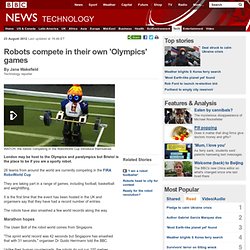
Man versus machine: deep blue. Researchers build robots that learn. Robots that learn. Robots compete in their own 'Olympics' games. 23 August 2012Last updated at 18:49 ET By Jane Wakefield Technology reporter.
Robots help sick kids go to school. Children too sick to go to school are still getting an education--thanks to robots in the classroom that transmit lessons back to the student.
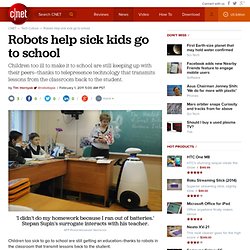
Stepan Supin, 12, of Moscow has been battling leukemia for two years, and his immune system is so weak he can't leave home. However, telepresence technology allows him to go to school via remote-controlled robot. The R.BOT 100 was developed by Moscow's 3Detection Labs several years ago, and it's been helping Stepan study history, geography, and languages since September. Toyota creates robots to help disabled persons. By Latif Salman on 09/24/2012 Technology is increasingly becoming incorporated into every single aspect of human life.
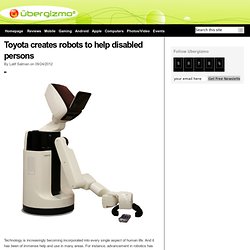
And it has been of immense help and use in many areas. For instance, advancement in robotics has enabled us to speed up the manufacturing and other industrial processes. Moreover, robots can also assist humans in an individual capacity. Bee brains help to make robots smarter. 2 October 2012Last updated at 06:45 ET Studying how bees sense the world could help robots become more autonomous Honey bee brains could soon be helping robots act more independently.
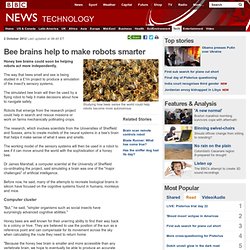
The way that bees smell and see is being studied in a £1m project to produce a simulation of the insect's sensory systems. What Robots Are Used Today? Computer History. John Kopplin © 2002 Just a few years after Pascal, the German Gottfried Wilhelm Leibniz (co-inventor with Newton of calculus) managed to build a four-function (addition, subtraction, multiplication, and division) calculator that he called the stepped reckoner because, instead of gears, it employed fluted drums having ten flutes arranged around their circumference in a stair-step fashion.
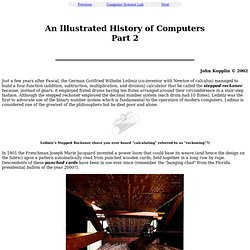
Although the stepped reckoner employed the decimal number system (each drum had 10 flutes), Leibniz was the first to advocate use of the binary number system which is fundamental to the operation of modern computers. Leibniz is considered one of the greatest of the philosophers but he died poor and alone. Leibniz's Stepped Reckoner (have you ever heard "calculating" referred to as "reckoning"?) Jacquard's Loom showing the threads and the punched cards By selecting particular cards for Jacquard's loom you defined the woven pattern [photo © 2002 IEEE] A close-up of a Jacquard card. Difference engine. A difference engine is an automatic mechanical calculator designed to tabulate polynomial functions.
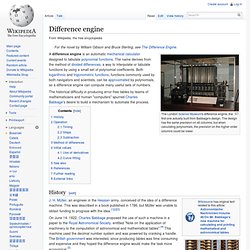
The name derives from the method of divided differences, a way to interpolate or tabulate functions by using a small set of polynomial coefficients. Both logarithmic and trigonometric functions, functions commonly used by both navigators and scientists, can be approximated by polynomials, so a difference engine can compute many useful sets of numbers.
Analytical Engine. Trial model of a part of the Analytical Engine, built by Babbage, as displayed at the Science Museum (London)[1] The Analytical Engine was a proposed mechanical general-purpose computer designed by English mathematician Charles Babbage.[2] It was first described in 1837 as the successor to Babbage's Difference engine, a design for a mechanical computer.
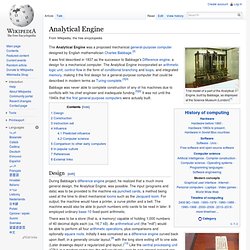
The Analytical Engine incorporated an arithmetic logic unit, control flow in the form of conditional branching and loops, and integrated memory, making it the first design for a general-purpose computer that could be described in modern terms as Turing-complete.[3][4] Babbage was never able to complete construction of any of his machines due to conflicts with his chief engineer and inadequate funding.[5][6] It was not until the 1940s that the first general-purpose computers were actually built. Design[edit] Two types of punched cards used to program the machine. Construction[edit] Instruction set[edit] Calculator. A modern scientific calculator with a dot matrix LCD display An electronic calculator is a small, portable electronic device used to perform both basic and complex operations of arithmetic.
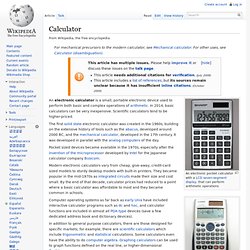
In 2014, basic calculators can be very inexpensive. Scientific calculators tend to be higher-priced. Pocket sized devices became available in the 1970s, especially after the invention of the microprocessor developed by Intel for the Japanese calculator company Busicom. Modern electronic calculators vary from cheap, give-away, credit-card sized models to sturdy desktop models with built-in printers. In addition to general purpose calculators, there are those designed for specific markets; for example, there are scientific calculators which include trigonometric and statistical calculations. Nissan’s Robots: They’re Really Fish. CHIBA, Japan -- If we can get drivers to behave like smelt, we can start cutting gas.

That was one of the messages from Nissan at Ceatec, the large technology trade show taking place this week outside of Tokyo. Fish swimming in schools maintain a relatively constant distance with the fish in front of it and any swimming on the side. As a result, they don't bash into each other and move along at an orderly pace. Nissan's Robot Car Finds Its Own Parking Spots. Search. RoboCup: Robots play football to develop artificial intelligence. Robot in Citroen advert now used for laser cancer treatment. FANUC Robotics Painting and Dispensing Industrial Robots.
Robot. The branch of technology that deals with the design, construction, operation, and application of robots,[2] as well as computer systems for their control, sensory feedback, and information processing is robotics.
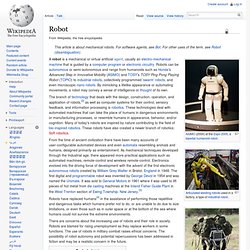
These technologies deal with automated machines that can take the place of humans in dangerous environments or manufacturing processes, or resemble humans in appearance, behavior, and/or cognition. Many of today's robots are inspired by nature contributing to the field of bio-inspired robotics. These robots have also created a newer branch of robotics: Soft robotics. Robots have replaced humans[4] in the assistance of performing those repetitive and dangerous tasks which humans prefer not to do, or are unable to do due to size limitations, or even those such as in outer space or at the bottom of the sea where humans could not survive the extreme environments.
There are concerns about the increasing use of robots and their role in society. Summary History Early beginnings. Robotics Synonyms, Robotics Antonyms. Relevance Relevance ranks synonyms and suggests the best matches based on how closely a synonym’s sense matches the sense you selected. Complexity Complexity sorts synonyms based on their difficulty. Adjust it higher to choose from words that are more complex. Length. Robotics: About the Exhibition. If you think robots are mainly the stuff of space movies, think again.
Right now, all over the world, robots are on the move. They’re painting cars at Ford plants, assembling Milano cookies for Pepperidge Farms, walking into live volcanoes, driving trains in Paris, and defusing bombs in Northern Ireland. As they grow tougher, nimbler, and smarter, today’s robots are doing more and more things we can’t –or don’t want to–do. Robots have been with us for less than 50 years, but the idea of inanimate creations to do our bidding is much, much older. The ancient Greek poet Homer described maidens of gold, metallic helpers for the Hephaistos, the Greek god of the forge. History of robots. The history of robots has its origins in the ancient world. The modern concept began to be developed with the onset of the Industrial Revolution which allowed for the use of complex mechanics and the subsequent introduction of electricity.
This made it possible to power machines with small compact motors. In the early 20th century, the modern formulation of a humanoid machine was developed. Today, it is now possible to envisage human sized robots with the capacity for near human thoughts and movement. The first uses of modern robots were in factories as industrial robots – simple fixed machines capable of manufacturing tasks which allowed production without the need for human assistance. Ancient mythology[edit]
History of Robotics - Timeline, AI, Industrial, Toy Robots, Robotic Arm, Technology. 25 Great Moments In Robotics History - Forbes.com. Stephen Cameron. Robot Timeline. There are currently 527 robots listed chronologically here.