
Why Thought Suppression is Counter-Productive. How pushing a thought out of consciousness can bring it back with a vengeance. It sometimes feels like our minds are not on the same team as us. I want to go to sleep, but it wants to keep me awake rerunning events from my childhood. Thought suppression. When an individual tries to suppress thoughts under a high cognitive load, the frequency of those thoughts increases and becomes more accessible than before.[3][4] Evidence shows that people can prevent their thoughts from being translated into behavior when self-monitoring is high; this does not apply to automatic behaviors, though (e.g., the skinhead scenario), and may result in latent, unconscious actions.[5] This phenomenon is made paradoxically worse by increasing the amount of distractions a person has, although the experiments in this area can be criticized for using impersonal concurrent tasks, which may or may not properly reflect natural processes or individual differences.
Ironic process theory[6] is one cognitive model that can explain the paradoxical effect seen above. However, given the mixed evidence and commensurate with the latest research, it is suggested that such a model needs to account for individual differences. Empirical work[edit] Dunning–Kruger effect. Cognitive bias about one's own skill The Dunning–Kruger effect is a hypothetical cognitive bias stating that people with low ability at a task overestimate their own ability, and that people with high ability at a task underestimate their own ability.
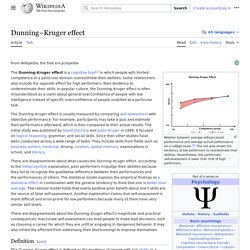
As described by social psychologists David Dunning and Justin Kruger, the bias results from an internal illusion in people of low ability and from an external misperception in people of high ability; that is, "the miscalibration of the incompetent stems from an error about the self, whereas the miscalibration of the highly competent stems from an error about others".[1] It is related to the cognitive bias of illusory superiority and comes from people's inability to recognize their lack of ability.
Without the self-awareness of metacognition, people cannot objectively evaluate their level of competence. Original study[edit] Later studies[edit]