pearltrees html popular pearltrees search

TED

Henry Markram builds a brain in a supercomputer | Video on TED.c http://www.ted.com/talks/henry_markram_supercomputing_the_brain_s_secrets.html New talks are released daily. Be the first to know!

New talks are released daily. Be the first to know! Robert Wright on optimism | Video on TED.com http://www.ted.com/talks/robert_wright_on_optimism.html

http://blog.ted.com/2009/08/27/celebrating_the_3/ Today, TED.com releases its 500th TEDTalk : perennial favorite Hans Rosling’s latest data-bubble presentation from TED@State. Since April 2007, the TED.com site has selected the best talks and performances from TED and partner conferences around the world and made them available to everyone online, for free. In keeping with TED’s mission to spread ideas, these talks have been reposted, shared among friends and shown in classrooms from middle schools to colleges. Reaching 500 TEDTalks is an amazing milestone, and one that was not entirely expected. The experiment of putting talks online has blossomed into a thriving web community of fans and friends of TED , in ways that no one could have predicted. Blog: Celebrating the 500th TEDTalk!

Chris Anderson (Wired) | Profile on TED.com (He is not, however, to be confused with the curator of TED, who has the same name.) He's perhaps most famous for coining the term "the long tail," a whiteboard favorite that describes the business strategy of pursuing many little fish (versus a few big fish) , as typified by both Amazon and Netflix. Anderson first introduced the term in an article written for WIRED in 2004; the book-length version, The Long Tail: Why the Future of Business Is Selling Less of More , became a bestseller. He maintains a blog, The Long Tail , which he updates with impressive regularity. Before Chris Anderson took over as editor of WIRED, he spent seven years at The Economist, where he worked as editor of both the technology and business sections. http://www.ted.com/speakers/chris_anderson_wired.html

http://www.ted.com/themes/technology_history_and_destiny.html Technology, History and Destiny | Video channel on TED.com Philosopher Nick Bostrom wonders whether we ought to take steps to alter our fundamental nature to solve humanity's intrinsic problems: death and extinction. (It has been shown to work, after all: author Steven Johnson 's tour of one of history's deadliest epidemics underscores the life-saving power of new technology -- in this case, a map.) And strategic planner Thomas Barnett talks about what we might do with technology developed to destroy: the deadly efficient innovations of war. Email to a friend » Inventor-cum-prognosticator Ray Kurzweil argues that a future beyond "mere" humanity may not be as far in the future as we think. Adventurer Bill Stone , meanwhile, sees humanity's destiny tied to robotics, space exploration and the quest to find life elsewhere in the universe.

In articles for the Wall Street Journal and the New York Times, among others, he has celebrated scientific breakthroughs, and at the Long Now Foundation , where he serves on the board, he champions projects that look 10,000 years into the future. One such project is the Rosetta Project , which will catalogue more than 1,000 languages on a disks to be placed nearby the 10,000 Year Clock. Kelly's newest book What Technology Wants asks what appears to be his life's core question: "How should I think about new technology when it comes along?" http://www.ted.com/speakers/kevin_kelly.html Kevin Kelly | Profile on TED.com

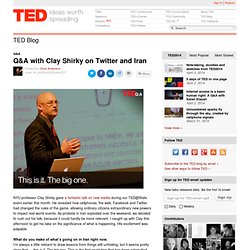
Blog: Q&A with Clay Shirky on Twitter and Iran http://blog.ted.com/2009/06/16/qa_with_clay_sh/ NYU professor Clay Shirky gave a fantastic talk on new media during our TED@State event earlier this month. He revealed how cellphones, the web, Facebook and Twitter had changed the rules of the game, allowing ordinary citizens extraordinary new powers to impact real-world events. As protests in Iran exploded over the weekend, we decided to rush out his talk, because it could hardly be more relevant. I caught up with Clay this afternoon to get his take on the significance of what is happening. HIs excitement was palpable.
Why you should listen to him: Eric Giler heads WiTricity, a startup with a product straight out of science fiction: wireless electricity , beamed from a base station to your electrical devices. The technology was developed by an MIT team led by theoretical physicist Marin Soljačić (who won a MacArthur "genius"grant last year). Now, WiTricity is one of several startups developing tech to safely transmit power through the air -- and potentially untether our electronic age. As the CEO of MIT-inspired WiTricity, Eric Giler has a plan to beam electric power through the air to wirelessly power your laptop or recharge your car. Eric Giler | Profile on TED.com http://www.ted.com/speakers/eric_giler.html

http://www.ted.com/speakers/alain_de_botton.html “Let’s say you went to Harvard or Oxford or Cambridge, and you said, ‘I’ve come here because I’m in search of morality, guidance and consolation; I want to know how to live,’ — they would show you the way to the insane asylum.” “When you look at the Moon, you think, ‘I’m really small. What are my problems?’ It sets things into perspective. We should all look at the Moon a bit more often.” “The secular world is full of holes. Alain de Botton | Profile on TED.com

Paola Antonelli | Profile on TED.com Ever mindful that the majority of visitors to MOMA are attracted by artists such as Picasso and Matisse, Antonelli works to ensure that if they do stumble across a design-related show, they'll be both entertained and enlightened. Her latest book is Exit to Tomorrow: World's Fair Architecture, Design, Fashion 1933-2005 . "Paola Antonelli’s goal is to insistently promote design’s understanding, until its positive influence on the world is fully acknowledged." http://www.ted.com/speakers/paola_antonelli.html

http://www.ted.com/speakers/david_merrill.html Speakers: David Merrill David Merrill is a grad student in the Fluid Interfaces Group at MIT's Media Lab. He and his fellow students in this group work on new technologies that give us more and better abilities to do things we want to do . His main interest now is the Siftables project, the subject of his TEDTalk, on which he works with Jeevan Kalanithi . In another field of inquiry, Merrill is looking at ways to access digital information in the wider world , when we are away from a traditional computer .

Evan Williams helps the world answer the question "What are you doing?" Twitter , the tiny, free world-changing app Williams helped launch, has become a vital connector of people and communities (as well as a fantastic way to keep up with Shaq and Demi Moore ). Before Williams worked on Twitter, he was part of a previous revolution in mass communication, Blogger , while working at Google. He left Google in 2004 to launch the podcasting service Odeo , and Twitter spun out from this in 2006 as a side project based on an idea of Jack Dorsey's . http://www.ted.com/speakers/evan_williams.html TED Speakers: Evan Williams

Speakers: Jonathan Harris http://www.ted.com/speakers/jonathan_harris.html "Jonathan Harris [is] a New York artist and storyteller working primarily on the Internet. His work involves the exploration and understanding of humans, on a global scale, through the artifacts they leave behind on the Web." Edge.org His projects are both intensely personal (the " We Feel Fine " project, made with Sep Kanvar , which scans the world's blogs to collect snapshots of the writers' feelings) and entirely global (the new " Universe ," which turns current events into constellations of words ). But their effect is the same -- to show off a world that resonates with shared emotions, concerns, problems, triumphs and troubles . Email to a friend »

"TEDTalks takes conference podcasting to a whole new level. TED is going out of its way to make it as easy as possible for anyone interested to access the speeches, by making them available in five different formats." -- Huffington Post "The two best talks I have ever seen ... in all the conferences I went to were Al Gore's on the future of our planet, and Hans Rosling's on globalization and how we should welcome it. About TED | What people say | What bloggers say http://www.ted.com/pages/view/id/44

http://www.ted.com/speakers/joann_kuchera_morin.html Composer JoAnn Kuchera-Morin works on the Allosphere, one of the largest scientific and artistic instruments in the world. Based at UCSB, the Allosphere and its 3D immersive theater maps complex data in time and space . Kuchera-Morin founded the Center for Research in Electronic Art Technology (CREATE) and has been the director since its birth in 1986. In 2000 she began work on a Digital Media Center within the California NanoSystems Institute at Santa Barbara . Speakers: JoAnn Kuchera-Morin

Speakers: Gregory Stock

TED Speakers: Nicholas Negroponte

Hans Rosling | Profile on TED.com

Speakers: Jeff Han

Pattie Maes | Profile on TED.com

Barry Schwartz | Profile on TED.com

The Rise of Collaboration | Video channel on TED.com

TED: Ideas worth spreading

Speakers: Jeff Bezos

Speakers: James Surowiecki

Speakers: Yochai Benkler

TED Conference's Photostream

Speakers: Richard Baraniuk

Speakers: Clay Shirky

Speakers: Charles Leadbeater

TED Blog

Speakers: Howard Rheingold

Speakers: Stefan Sagmeister