
MintyCam (Altoids Candy tin) Pinhole Camera. Here are a few sample images I've taken with my MintyCams over the years.
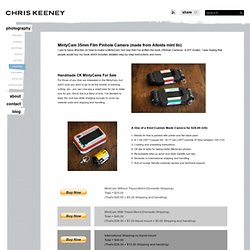
I'll try and update this page with new photos in the future. The picture above is a double exposure using the MintyCam first then shooting the same film through an underwater camera. Fujichrome Provia 100F film. Color photograph of a historic church in Massachusetts created with a MintyCam pinhole camera by Chris Keeney MintyCam pinhole portrait submitted by Bonnie who bought a camera from me and then kindly sent me this test photograph Here's another test photograph created by Bonnie who recently purchased a MintyCam from me. Top ten DIY photography tips. On the day the digital camera was invented, the photographer died.
Go on to the street these days and the only thing a digital camera tells you about a person is the size of their bank balance. As an alternative-lifestyle statement, SLR ownership is now right up there with owning a Coldplay CD. In these troubled times, when SLRs are no longer a badge of actual photography skills, you need something to distinguish yourself from the crowd. We're going to tell you how to stand out from the Jessops jockeys with ten DIY tips for distinctive looking -- and almost free -- photography hardware. Sellotape at the ready: let's go! 1. Some 'professional' photographers will tell you that you need to buy a tripod to steady your shots. The principle is simple. You can see the likely insertion point in the diagram above (1).
If you've got the length right, you should be able to pull up lightly on the camera to produce tension in the strings. Through the Viewfinder Method Makes Your Digital Pics Look Analog. If people need a hobby and want to go to this much trouble, go for it.
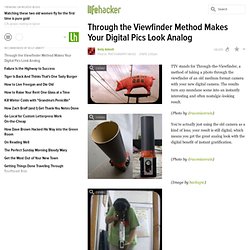
But these in no way resemble customary shots from medium format cameras, and so are not "vintage" in any sense of the word. I suspect the notion that these kinds of shots are "vintage" comes from people who don't know any better but who imagine this is what film shots used to look like. Back in the "vintage" days, these kinds of shots would be regarded as the work of a photographer with very poor skills and/or a camera in a significant state of disrepair. But people who don't know any better like to romanticize I suppose. A better term than "vintage" would be "stylized", since vintage implies some sort of representative historical accuracy (which these examples don't provide), but style is a matter of personal taste which people are free to enjoy or not.
DIY - Create Your Own Bokeh. Bokeh is an adaptation from a a Japanese word meaning blur.
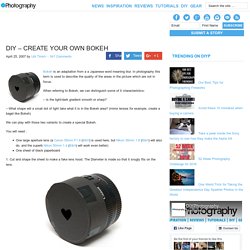
In photography this term is used to describe the quality of the areas in the picture which are not in focus. When referring to Bokeh, we can distinguish some of it characteristics: – Is the light/dark gradient smooth or sharp? – What shape will a small dot of light take what it is in the Bokeh area? (mirror lenses for example, create a bagel like Bokeh) We can play with those two variants to create a special Bokeh. You will need : One large aperture lens (a Canon 50mm F1.8 (B&H) is used here, but Nikon 50mm 1.8 (B&H) will also do, and the superb Nikon 50mm 1.4 (B&H) will work even better)One sheet of black paperboard 1. 2. 3.
Here are two shots to demonstrate this technique – one with a bare lens and the other with the hearted hood. Here are the parameters for the example shown above: Lens – Canon 50mm F1.8“Lens hood” Diameter: 70mm (2.75 inch)Hole diameter: 15mm (0.6inch) How to Make a DIY Ring Flash [Tutorial] Don’t have the budget to buy yourself a Ring Flash?
![How to Make a DIY Ring Flash [Tutorial]](http://cdn.pearltrees.com/s/pic/th/tutorial-digital-photography-81788362)
Today one of our forum members Manzin (see some of his work here) shares a tutorial on how he created his own DIY Ring Flash. You like Ring Flashes but you can’t pay the price? I have a solution for you, and it doesn’t involve stealing one from a store! Make your own for a very very cheap price, about 20 euros. The only thing is that you need to already have a cobra flash.