
A Model for Repairing National Debt. The more than 500 point drop in the stock market on Thursday shows that neither the public nor investors think lawmakers in Washington have developed a process or the details necessary to solve the national debt crisis.

This is despite agreement to raise the debt ceiling by $2.4 trillion on Tuesday. Unless Congress, now at a record low 14% public approval rating, finds a better way to deal with partisan conflict than it has in the past year, the country risks lapsing back into the kind of recession, or worse, that we had in 2008, the last time the stock market dropped that much: 5% in the last week, 11% in two weeks.
But the problem is fixable, mostly by learning from the mistakes of the past year: 1. Pick A Dispassionate Panel. Unless the panel can do its work well between now and Nov. 23, when its proposals are due, the country will be right back into a heated and likely dysfunctional debate on spending cuts. Basic Overview of Budget Deficit Debates. Balanced budget debate.

Why Government Spending Does Not Stimulate Economic Growth: Answering the Critics. John Maynard Keynes. John Maynard Keynes, 1st Baron Keynes,[1] CB, FBA (/ˈkeɪnz/ KAYNZ; 5 June 1883 – 21 April 1946) was a British economist whose ideas have fundamentally affected the theory and practice of modern macroeconomics, and informed the economic policies of governments.
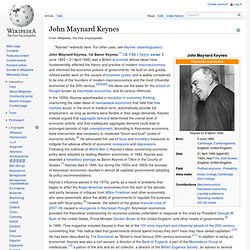
He built on and greatly refined earlier work on the causes of business cycles, and is widely considered to be one of the founders of modern macroeconomics and the most influential economist of the 20th century.[2][3][4][5] His ideas are the basis for the school of thought known as Keynesian economics, and its various offshoots. In 1999, Time magazine included Keynes in their list of the 100 most important and influential people of the 20th century, commenting that: "His radical idea that governments should spend money they don't have may have saved capitalism. "[10] He has been described by The Economist as "Britain's most famous 20th-century economist. Early life and education[edit] King's College, Cambridge. Career[edit] Keynesian Economics. "At research seminars, people don't take Keynesian theorising seriously anymore; the audience starts to whisper and giggle to one another.
" So declared Robert Lucas of the University of Chicago, writing in 1980. At the time, Lucas was arguably the world's most influential macroeconomist; the influence of John Maynard Keynes, the British economist whose theory of recessions dominated economic policy for a generation after the Second World War, seemed to be virtually at an end. Keynes: The Return of the Master by Robert Skidelsky But Keynes, it turns out, is having the last giggle.
Lucas's "rational expectations" theory of booms and slumps has shown itself to be completely useless in the current world crisis. Conservative Policy Research and Analysis. 'We've got to spend our way out of this recession' The U.S. government must spend its way out of the recession, the Democrats' third-ranking House leader stressed Monday.

Rep. James Clyburn (D-S.C.), the House majority whip, said that trying to find greater savings in the budget, which was released by President Barack Obama this morning, wouldn't help alleviate the recession. "We've got to make some decisions here as to what's in the best interests of our country going forward," Clyburn said during an appearance on Fox News. "And I think the best interest is to invest in education, control these deficits, while at the same time trying to get people back to work. " "We're not going to save our way out of this recession," the majority whip added. Obama's budget, which was unveiled Monday morning, calls for $3.8 trillion in spending for 2010, but is projected to cause a $1.27 deficit. The Greatest Economic Myth of the Century.
My candidate for “greatest economic myth of the century” was popularized by British economist John Maynard Keynes in the 1930s.

He thought that massive government spending would halt recessions and lead to prosperity. The myth here is that government spending, i.e. the extracting of dollars from taxpayers and then handing them out to key groups by politicians, helps the economy as a whole. Keynes worded his theory this way: “To dig holes in the ground, paid for out of savings, will increase not only employment, but the real national dividend of useful goods and services.” Keynes’s idea that government spending, even just digging holes, will lead to prosperity was discredited shortly after he announced it in 1935 during the Great Depression. Burton W. Folsom, Jr. Burton W.

Folsom, Jr. (born 1947 in Nebraska) is an American historian and author who holds the Charles F. Kline chair in history and management at Hillsdale College. Biography[edit] Hillsdale College. Hillsdale College is a co-educational liberal arts college in Hillsdale, Michigan, United States.National Review has described Hillsdale as a "citadel of American conservatism.

Keynesian Economics. John Maynard Keynes.