
HyperPhysics Concepts. About HyperPhysics Rationale for Development HyperPhysics is an exploration environment for concepts in physics which employs concept maps and other linking strategies to facilitate smooth navigation.

For the most part, it is laid out in small segments or "cards", true to its original development in HyperCard. The entire environment is interconnected with thousands of links, reminiscent of a neural network. The bottom bar of each card contains links to major concept maps for divisions of physics, plus a "go back" feature to allow you to retrace the path of an exploration.
Part of the intent for this exploration environment is to provide many opportunities for numerical exploration in the form of active formuli and standard problems implemented in Javascript. New content for HyperPhysics will be posted as it is developed. A resource that was initiated as a resource for local high school physics teachers whom I had taught has expanded into an intensively used website worldwide.
Quantum electrodynamics. In particle physics, quantum electrodynamics (QED) is the relativistic quantum field theory of electrodynamics.
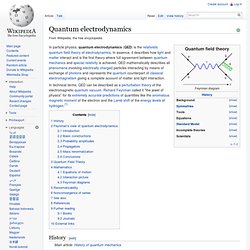
In essence, it describes how light and matter interact and is the first theory where full agreement between quantum mechanics and special relativity is achieved. QED mathematically describes all phenomena involving electrically charged particles interacting by means of exchange of photons and represents the quantum counterpart of classical electromagnetism giving a complete account of matter and light interaction. Renormalization group. In theoretical physics, the renormalization group (RG) refers to a mathematical apparatus that allows systematic investigation of the changes of a physical system as viewed at different distance scales.

In particle physics, it reflects the changes in the underlying force laws (codified in a quantum field theory) as the energy scale at which physical processes occur varies, energy/momentum and resolution distance scales being effectively conjugate under the uncertainty principle (cf. Compton wavelength). A change in scale is called a "scale transformation". The renormalization group is intimately related to "scale invariance" and "conformal invariance", symmetries in which a system appears the same at all scales (so-called self-similarity). (However, note that scale transformations are included in conformal transformations, in general: the latter including additional symmetry generators associated with special conformal transformations.)
History[edit] Murray Gell-Mann and Francis E. . . . Compton scattering. Compton scattering is an inelastic scattering of a photon by a free charged particle, usually an electron.

Photoelectric effect. The photoelectric effect is the observation that many metals emit electrons when light shines upon them.
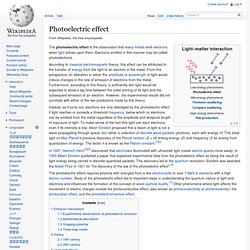
Electrons emitted in this manner may be called photoelectrons. According to classical electromagnetic theory, this effect can be attributed to the transfer of energy from the light to an electron in the metal. From this perspective, an alteration in either the amplitude or wavelength of light would induce changes in the rate of emission of electrons from the metal. Furthermore, according to this theory, a sufficiently dim light would be expected to show a lag time between the initial shining of its light and the subsequent emission of an electron. However, the experimental results did not correlate with either of the two predictions made by this theory. In 1887, Heinrich Hertz[2][3] discovered that electrodes illuminated with ultraviolet light create electric sparks more easily. Emission mechanism[edit] Pair production. Examples[edit] γ + γ → e− + e+ In nuclear physics, this occurs when a high-energy photon interacts with a nucleus.

The energy of this photon can be converted into mass through Einstein’s equation, E=mc2; where E is energy, m is mass and c is the speed of light. The photon must have enough energy to create the mass of an electron plus a positron. The rest mass of an electron is 9.11 × 10⁻³¹ kg (0.511 MeV), the same as a positron. Photon–nucleus interaction[edit] There are different processes how an electron-positron pair can be produced. With. Fundamental Force. Fundamental interactions, also called fundamental forces or interactive forces, are modeled in fundamental physics as patterns of relations in physical systems, evolving over time, that appear not reducible to relations among entities more basic.
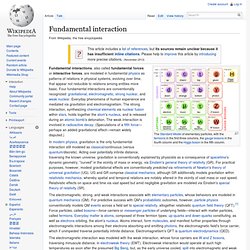
Four fundamental interactions are conventionally recognized: gravitational, electromagnetic, strong nuclear, and weak nuclear. Everyday phenomena of human experience are mediated via gravitation and electromagnetism. The strong interaction, synthesizing chemical elements via nuclear fusion within stars, holds together the atom's nucleus, and is released during an atomic bomb's detonation. The weak interaction is involved in radioactive decay. (Speculations of a fifth force—perhaps an added gravitational effect—remain widely disputed.) In modern physics, gravitation is the only fundamental interaction still modeled as classical/continuous (versus quantum/discrete).
List of particles. This is a list of the different types of particles found or believed to exist in the whole of the universe.

For individual lists of the different particles, see the individual pages given below. Elementary particles[edit] Fermions[edit] Fermions are one of the two fundamental classes of particles, the other being bosons. Fermion particles are described by Fermi–Dirac statistics and have quantum numbers described by the Pauli exclusion principle. Fermions have half-integer spin; for all known elementary fermions this is 1⁄2. HyperPhysics.