
Study of Global Online Behavior. The largest ever global research project into people's online activities has released its findings.

The TNS Digital Life research involved 50,000 interviews with individuals in 46 countries, covering almost 90% of the world's online population. The study aimed to uncover how the world's online behavior may be shifting, in terms of both consumption and communication. And among the findings were that online consumers in emerging, rapid growth markets are more engaged than those in mature markets, with Egypt and China, for example, having much higher levels of digital engagement than Japan, Denmark or Finland.
The Global Rise of Social Networks In these rapid growth markets, blogging and social networking are becoming increasingly popular: 88% of online users in China and 51% of those in Brazil have their own blog, as compared to only 32% in the U.S. The report points to the adoption of mobile technologies as fueling these trends. Internet Statistics & Social Media Usage ... Internet Timeline. ARPA (Advanced Research Projects Agency) goes online in December, connecting four major U.S. universities.
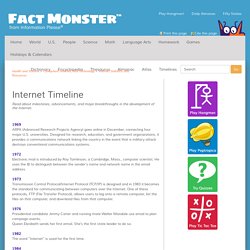
Designed for research, education, and government organizations, it provides a communications network linking the country in the event that a military attack destroys conventional communications systems. Electronic mail is introduced by Ray Tomlinson, a Cambridge, Mass., computer scientist. He uses the @ to distinguish between the sender's name and network name in the email address. Transmission Control Protocol/Internet Protocol (TCP/IP) is designed and in 1983 it becomes the standard for communicating between computers over the Internet. One of these protocols, FTP (File Transfer Protocol), allows users to log onto a remote computer, list the files on that computer, and download files from that computer. Presidential candidate Jimmy Carter and running mate Walter Mondale use email to plan campaign events. Queen Elizabeth sends her first email. The term “weblog” is coined. Morgan Stanley - Institutional Services. Mary Meekers View of The World In 50 Slides. Every year at the Web 2.0 Summit, Morgan Stanley Internet analyst Mary Meeker gives her view of the world, the Web, and the technology industry by quickly going through about 50 slides that illustrate the major trends she is tracking.

Last year, she zeroed in on the China Bubble. This year, she talks about the root causes of the current economic downturn, the outlook for Web businesses, and where she still sees major growth (mobile and emerging markets). She singles out the mobile industry as the one where both the most opportunity will be found and disruption will occur over the next five years. Moreover, she suggests that the U.S. is poised to lead the transition in mobile to a Web-centric model. (I totally agree). Meeker’s full presentation, which she gave yesterday, is in the video embedded above and her full slide deck is below (thank you, Henry Blodget, for uploading them). A few slides in particular stuck out for me.
Internet Traffic Begins to Bypass the U.S. Pew Internet & American Life Project. Methodology By Kristen Purcell and Michael Dimock About the News Interest Index Data for this report were gathered as part of the Pew Research Center’s News Interest Index.

The News Interest Index is a weekly survey conducted by the Pew Research Center for the People & the Press aimed at gauging the public’s interest in and reaction to major news events. This project has been undertaken in conjunction with the Project for Excellence in Journalism’s News Coverage Index, an ongoing content analysis of the news. Results for this survey are based on telephone interviews conducted March 17-20 among a national sample of 1,004 adults 18 years of age or older living in the continental United States (673 respondents were interviewed on a landline telephone, and 331 were interviewed on a cell phone, including 144 who had no landline telephone). Sample sizes and sampling errors for other subgroups are available upon request. Questions The topline is available to download as a PDF here. Internet for Everyone: Internet For Everyone.