
Hispanics, the New Italians. Songs Of The Civil Rights Movement. Martin Luther King Jr. waves from the Lincoln Memorial on the Mall in Washington, D.C. during the March on Washington.
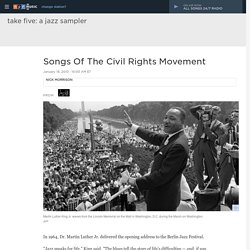
AFP hide caption toggle caption Martin Luther King Jr. waves from the Lincoln Memorial on the Mall in Washington, D.C. during the March on Washington. In 1964, Dr. Martin Luther Jr. delivered the opening address to the Berlin Jazz Festival. "Jazz speaks for life," King said. King was born in 1929. What follows are jazz and jazz/blues versions of some of the songs that sustained the civil-rights movement in the 1960s (and beyond) through the setbacks, the hardships, the failures and the many hard-won successes that have moved America ever closer to racial equality.
Ken Gonzales-Day's "Erased Lynching" At first, “Disguised Bandit” — a life-size reproduction of a century-old postcard by Ken Gonzales-Day — does not suggest anything out of the ordinary.

A sparse tree cuts the center of the photograph. A group of white American soldiers flanks the tree. One man grins. The others stare passively into the camera. But the meaning — and the power — of the image (Slide 3) resides not in what’s visible, but in what’s not: the “disguised bandit” suggested by the inscription at the bottom of the postcard. “Disguised Bandit” is part of Mr. The missing bodies in these photographs serve as a metaphor for the expunging of Latinos, Native Americans and Asians from the history of lynching in America. Ken Gonzales-Day“Water Street Bridge.” While lynchings of African-Americans in the South and elsewhere were often defined by scholars and within popular culture as illegal acts of vigilantism and murder, the killing of Latinos, Native Americans and Asians in the West was often romanticized and idealized. In History, Using Photography to Advance, Question or Alter Ideas About Race.
The portrait for the carte-de-visite of Sojourner Truth, the African-American abolitionist and women’s rights advocate, was taken in Battle Creek, Mich., in the 1860s (Slide 5).

She wears an elegant silk dress and shawl. With one hand resting on her hip, the other on the arm of the chair, her pose is majestic and determined. She stares resolutely into the camera. But it is the object in her lap that remains one of the image’s most revelatory details: an open daguerreotype of her grandson James Caldwell, a soldier during the Civil War. To see the full article, subscribe here. Courtesy of the Library of CongressSusie King Taylor, 1902. Augustus Washington, Courtesy of the Library of CongressUrias Africanus McGill, a Baltimore-born merchant, in Liberia. 1854. Henry P. Courtesy of the Library of CongressTwo brothers in arms, 1860s. Harlem Renaissance. The Great Migration The end of the American Civil War in 1865 ushered in an era of increased education and employment opportunities for black Americans.

This created the first black middle class in America, and its members began expecting the same lifestyle afforded to white Americans. But in 1896, racial equality was delivered a crushing blow when the Plessy v. Ferguson Supreme Court case declared racial segregation to be constitutionally acceptable. This created even harsher conditions for African-Americans, particularly in some Southern states that sought to minimize the equality that former slaves and their descendants might aspire toward. As a result, blacks began to head to the Northern United States by the millions.
Harlem: The Black Mecca Housing executives planned to create neighborhoods in Harlem designed specifically for white workers who wanted to commute into the city. The Harlem Renaissance Black historian, sociologist, and Harvard scholar, W. Culture Comes Together.