
TLP Library. Teaching and learning packages (TLPs) are self-contained, interactive resources, each focusing on one area of Materials Science.
Analysis of Deformation Processes This TLP builds upon the introduction to yield criteria covered in the Stress analysis and Mohr's circle TLP and introduces a range of methods commonly used to study metal forming processes. Introduction To Anisotropy It is common in basic analysis to treat bulk materials as isotropic - their properties are independent of the direction in which they are measured. However the atomic scale structure can result in properties that vary with direction.
Atomic Force Microscopy. A blog and resource site about laser plastic welding by LPKF Laser & Electronics. LPKF Laser Plastic Welding. Laser Plastic Welding 101 - Part 1. Stepseal V® : prevents pressure trap in hydraulic cylinders: Trelleborg Sealing Solutions. METAL 2012.
Kawasaki Steel 21st Century Foundation/Index. Granta: CES Selector materials selection software. Untitled Document. Elastic Properties and Young Modulus for some Materials. Roeder's Manufacturing Class. July 2011. And now a word from the government!
In honor of the 4th of July celebration here in the US I am taking a break from our discussion about "less is more" to focus on major initiatives to move the cause of green manufacturing forward - these from the government. The discussion on "less is more" will continue with part 3 next time. We've heard a lot about some of the major corporations and the initiatives they've taken to enhance the sustainability of their organizations and influence their supply chain. One of the first that comes to mind is Walmart and their efforts to insure the products they sell, and their operations delivering them, are "more efficient, last longer and perform better. " There are many more players in this field and a simple glance at Environmental Leader or GreenBiz website will give a great introduction and allow you to track their progress. But the story here is on government initiatives. Deepdrawing.pdf (application/pdf 物件) Soft-feel grain surface treatment.
This technology gives hard-surface plastics a soft and moist feel at a much lower cost even than "soft-feel" paint by imposing a "grain" or texturing onto the surface.

It has application in automotive interiors, household utensils, electronics, mobile phones, and other locations where a hard plastic surface would benefit from feeling softer. The science is based on the study of the fingerprint. The more surface area of the fingertip that touches a surface, the more the brain interprets that sensation as "soft" and "moist. " The soft-feel gain surface treatment consists of a precise series of tiny bumps and larger bumps designed to increase the area of the surface in contact with the finger tip.
Because the plastic remains a hard surface despite its soft feel, it remains durable and easy to clean. Ultra Light Metal-like Material. Strong, Light, and Stretchy Materials. Dragon skin bulletproof vest repels AK-47 rounds. Tixotropic textile. The fabric is made from tixotropic yarn.
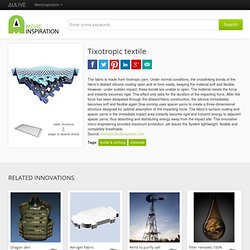
Under normal conditions, the crosslinking bonds of the fabric's dilatant silicone coating open and re-form easily, keeping the material soft and flexible. However, under sudden impact, these bonds are unable to open. The material resists the force and instantly becomes rigid. This effect only lasts for the duration of the impacting force. After the force has been dissipated through the dilatant/fabric construction, the silicone immediately becomes soft and flexible again.Dow corning uses spacer yarns to create a three-dimensional structure designed for optimal absorption of the impacting force. 第4章 挠性件传动. 钢丝绳精密传动机构的分析与实验研究. 7-14b交叉帶輪.wmv. Att_frict.pdf (application/pdf 物件) Belt friction. In practice, the theoretical tension acting on the belt or rope calculated by the belt friction equation can be compared to the maximum tension the belt can support.
This helps a designer of such a rig to know how many times the belt or rope must be wrapped around the pulley to prevent it from slipping. Mountain climbers and sailing crews demonstrate a standard knowledge of belt friction when accomplishing basic tasks. Equation[edit] Belt Tension Theory: Factors. 微型钢丝绳传动绳槽匹配及设计方法研究. 新型钢丝绳精密传动的设计研究. Patent US4796478 - Non-linear rotary drive apparatus - Google Patents. 1.
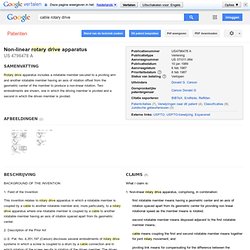
Field of the Invention This invention relates to rotary drive apparatus in which a rotatable member is coupled by a cable to another rotatable member and, more particularly, to a rotary drive apparatus where one rotatable member is coupled by a cable to another rotatable member having an axis of rotation spaced apart from its geometric center. 2. Description of the Prior Art. Patent US5105672 - Rotary drive apparatus having one member with smooth outer peripheral surface - Google Patents. FIG. 1 is a top view of rotary drive apparatus 10 of the present invention.
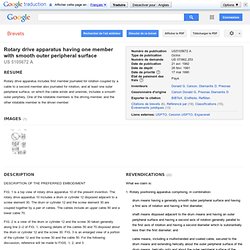
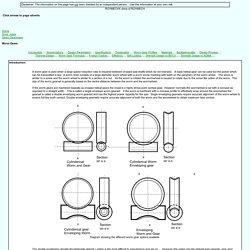
The rotary drive apparatus 10 includes a drum or cylinder 12 disposed adjacent to a screw element 30. The drum or cylinder 12 and the screw element 30 are coupled together by a pair of cables. The cables include an upper cable 50 and a lower cable 70. Worm Gears. Introduction A worm gear is used when a large speed reduction ratio is required between crossed axis shafts which do not intersect.
Theo Jansen Mechanism. How does Theo Jansen Mechanism Work?
Here is a flash animation of Theo Jansen mechanism which is a very interesting linkage systems. This ingenious mechanism is very good example of four bar mechanism described before. In this mechanism 4 four bar arranged such that a rotation movement is converted to walking pattern of a four legged animal. You can see videos of this mechanism in action by doing google search and entering key word "Theo Jansen" 【人與車科技展】通快日本提出利用沖壓和雷射焊接來替代點焊的接合法. From Flange to Butt Joint: Lasers in Auto Production (EuroPhotonics. Dr.
Rüdiger Brockmann and Peter Kaupp, Trumpf Laser-und-Systemtechnik New concepts in the design and construction of structural elements such as beams, sills and car doors that include the use of profiles, single-sided laser joining processes and interlocking connectors save weight, time, costs and installation space. These new concepts lead to simpler construction techniques such as using butt joints instead of overlapping flange connections, and joining that doesn’t require special clamping devices. Welding Zinc Coated Steels: New Joint Design and Strategy with Scanner Technology « Laser Insights. By: Klaus Loeffler, Dr. Tim Hesse, Peter Kaupp TRUMPF Laser und Systemtechnik GmbH, Ditzingen, GermanyTRUMPF Werkzeugmaschinen GmbH, Ditzingen, Germany The existing problems of weld defects in welding zinc coated steels in a overlap situation are present in the automotive industry. Overlap joints are the most common type of joint geometry used in the automotive industry.
超音波塑膠接合技術資料-Alex. 超声波熔接工艺. 1109ILS04f4.jpg(JPEG 圖片,400x316 像素)
The Ultimate Online Reference for Engineers. Engineers Edge - Design, Engineering & Manufacturing Solutions. Popular Mechanics. Free 3D CAD with Motion Simulation : AR-CAD freeCAD. 颜氏创造性机构设计_二_机构的一般化. G_1_18.PDF (application/pdf 物件) HomePage. 貳. 機構設計教學網站. Innergie Magic Cable Trio – Pure Magic. Google 搜尋 圖片的結果. Google 搜尋 圖片的結果. Door hinges, profiles, pin hinges — the EMKA blog. Hinge cover mechanism for folding casings with lift function - Nokia Corporation. The present invention relates to a hinge cover mechanism for electric devices having foldable casing also called “folding casings” and in particular the present invention relates to hinge cover mechanisms of hinge mechanisms for aforesaid electric devices offering advantageous characteristics for protecting the hinge mechanism, electrical conductor means passing through the subject hinge mechanism and for providing lift and inclination functionality.
The advantages of a design of electronic devices with folding casings is well known especially in the field of mobile and portable electronic devices, respectively. The advantages refer primarily to the usability of such electronic devices that are conventionally formed of two casing halves, which are pivoted by a hinge mechanism adjoining the two casing halves with each other. A flexible material in the form of a strip, flap etc. may allow realization of the hinge mechanism itself. U.S. Double Acting Spring Hinges - Double Acting Barrel Hinges. 208. Double-Action Spring Butts. If it is desired that a door shall swing in both directions, it should be hung with double-action spring hinges.
A door pivoted top and bottom near one edge would, of course, swing both ways, but as it is considerable trouble to close a door that does not have a stop, so that it will stay at the proper place, a spring is a practical necessity on all "fly" doors, both to close them and to keep them in the proper position when not being operated. Double-action hinges are especially desirable on pantry doors opening into the dining room, and on vestibule doors in public buildings. They are sometimes used on outside doors of buildings of a semi-public character, but as a double-action door cannot be made tight, nor cannot be so well locked, it is better to use ordinary butts with an overhead door check on such doors. Fig. 347.
Promotional Dual Hinge, Buy Dual Hinge Promotional Products and Items from Dual Hinge Manufacturers and Suppliers at Alibaba. 360° lockable hinge - Versare Solutions, Inc. This invention relates to a hinge, and more particularly, to a three point pivoting 360° articulable pinchless hinge. Hinges are well known for connecting members that are to rotate or pivot with respect to each other.
Lesson21_Tolerance_analysis_chunk_1.avi. Working Model 免費研習營(時間1/10(二), 地點:修平科技大學) - 迪威科技,Alibre Design,Nastran,Working Model,Interactive Physics,footmill,GrafiCalc. Gas spring. 英國廣播公司 - 製造技術全集 (六) - 熱處理 - (中文版) Advanced Tolerancing Techniques. Inflating steel. Chapter 1. Introduction to Mechanisms. Web-Based Mechanism Design and Analysis.