
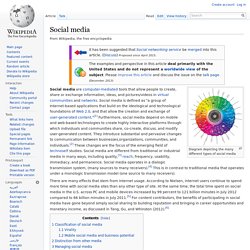
Social media. Diagram depicting the many different types of social media There are many effects that stem from internet usage.
According to Nielsen, internet users continue to spend more time with social media sites than any other type of site. At the same time, the total time spent on social media in the U.S. across PC and mobile devices increased by 99 percent to 121 billion minutes in July 2012 compared to 66 billion minutes in July 2011.[5] For content contributors, the benefits of participating in social media have gone beyond simply social sharing to building reputation and bringing in career opportunities and monetary income, as discussed in Tang, Gu, and Whinston (2012).[6]
How To Develop a Social Media Marketing Strategy That Works. Having a marketing strategy is good, but having a marketing strategy that works is great!

10 Blended Social Media Marketing Strategies A Company Might Want To Consider. We have been talking a lot lately about… talking.

When we should be doing a lot more… doing. So the thought for this post, interestingly enough, bubbled up from a client request, that I should supply a document that mapped out the ways that you can blend social media into your marketing mix. So what I’ve done is supplied the tool or the platform, how I used it, what was the time suck and what were the results. Hopefully this will shed a little light on what the heck we’re doing and why we talk about it so much. 1) Twitter. Time suck rating: Depending on how much you want to monitor and participate. Use case: Created structured conversations around hashtag to create community, market under the radar, build credibility and lead source. 2) Search is not going away soon. Time suck rating: Extensive. 9/10 Use case: Created reputation management program built on all elements of search using Flickr micro-websites, robust white hat SEO tactics and product specific blog sites.
Share this Post. Develop a Social Media Strategy in 7 Steps. Social Media Marketing: Strategy to Commerce. For companies trying to make sense of social media and online marketing, it’s important to take a step back from all the “TwitFaceBlogTubeIn” mania for a second and look at the nature of how these things are going to work for the overall business.

There are many questions that need answers: ”Should we develop a strategy first before engaging?” , ”Should we experiment and develop a strategy as we go?” Social Media Marketing Strategy Help. Article by Tanzz Mohd As an internet marketer, you are spoilt for choice when it comes to the methods that you can employ to advertise. There are scores of them and each one has its own set of pros and cons. But it’s important that you have an overall picture of the marketing environment because it helps you categorize the options available and understand the strengths and pitfalls of each before you draw out your marketing strategy.
Let’s examine the two major areas namely, Search engines and Social media. Search EnginesSearch engines are unarguably the primary marketing avenue due to their sheer global reach. SEO (Search Engine Optimization)These are the organic results based on the user’s search keywords and is based on a number of factors both on your site as well as off your site. PPC (Pay Per Click)The faster way to get on top of search engine listings is to use sponsored advertising in which you pay for your Ads. About the Author An avid internet marketing student and a mentor. Help With Your Social Media Marketing Strategy. Creating A Social Media Marketing Plan. Social Media Marketing Beginner’s Guide. 5 Advanced Social Media Marketing Strategies for Small Businesses. Samir Balwani is an emerging technology strategist at Morpheus Media, a firm specializing in Social Marketing, SEM, and SEO.
You can follow him on Twitter @samirbalwani and get his newsletter. Social Media Marketing Plan. The question is no longer should we be doing social media, it's are we doing it right?

- Eric Qualmann, Author of Socialnomics Are you ready to engage in the online conversation? The Social Media Marketing Blog. 10 Small Business Social Media Marketing Tips. Ross Kimbarovsky is the co-founder of crowdSPRING, a community of 43,000+ graphic designers that helps small businesses from around the world with graphic design needs.
You can follow Ross on Twitter @rosskimbarovsky and @crowdSPRING. Capacity - especially to plan and execute effective marketing strategies - is a big challenge for every small business. 5 Social Aggregators To Keep You Updated. With all the social media sites available to us now, it’s very easy to go into social media overload.

There’s no possible way that one can keep up with even 10 sites, let alone the hundreds that are created each month. In order to keep up with the social media phenomenon, there are numerous aggregation sites & applications popping up on a regular basis. It seems like most people are now using FriendFeed to stay updated with things but what about the other social aggregators out there that are less publicized?
Do you use any of them? I’ve joined my fair share of social aggregators but these are the 5 that stand out to me as far as being the most useful & beneficial. Socialthing! Socialthing is the social aggregator with the least features & only supports 13 sites (so far) but it seems to be growing more in popularity. Whenever there are new updates for you to view, a message will show at the top letting you know that new updates are available. Social media marketing. Social media marketing is the process of gaining website traffic or attention through social media sites.[1] Social media marketing programs usually center on efforts to create content that attracts attention and encourages readers to share it across their social networks.
The resulting electronic word of mouth (eWoM) refers to any statement consumers share via the Internet (e.g., web sites, social networks, instant messages, news feeds) about an event, product, service, brand or company.[2] When the underlying message spreads from user to user and presumably resonates because it appears to come from a trusted, third-party source, as opposed to the brand or company itself,[3] this form of marketing results in earned media rather than paid media.[4]