Radiation infographic. First Safecast mobile recon. Posted on April 24, 2011 20:40 by sean 15 Comments Last week a team from Keio University took one of our geiger counters for a drive.
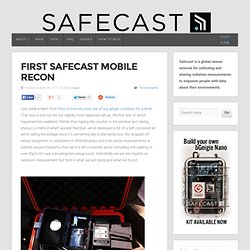
That was a test run for our slightly more elaborate set up, the first test of which happened this weekend. Rather than taping the counter to the window and taking photos (a method which worked fine btw) we’ve developed a bit of a self contained kit we’re calling the bGeigie since it’s something like a little bento box. We dropped off sensor equipment to volunteers in effected areas and took some measurements at schools around Koriyama that we’re a bit concerned about (including one reading of over 50µSv/hr near a kindergarten playground).
Help me help Safecast help people in Japan. This morning, my friend Sean Bonner e-mailed me this: As you may or may not know I’ve spent the vast majority of the last month either in Tokyo or working with people in Japan on project I helped start called Safecast.
Actually we just changed the name to Safecast, until last week it was called RDTN. We realized that the only information on radiation levels was coming from groups we couldn’t really trust, and decided we could do something better. Safecast has a goal of distributing geiger counters to people in Japan and creating an open data sensor network so anyone can access the information we gather with these devices. Overcoming Radiation Pt 1 « Granny Woman Ozark Herbs. This spring’s gardening and herbal workshops are overshadowed by radiation streaming out of Japan.
Overshadowed by the callous disregard for life demonstrated by governments and corporations telling us its not harmful, hiding the facts not only from us, but each other!! The EPA’s clever side-step…just increase the “safe level” of radioisotopes several thousand times (see here). Its got to be “safe” so long as we aren’t immediately keeling over on exposure, right? Is that all they can do? Overcoming Radiation Pt 2 – Miso « Granny Woman Ozark Herbs. Miso belongs to the highest class of medicines, those which prevent disease and strengthen the body through continued usage. — Dr.
Shinichiro Akizuki, Director, St. Francis Hospital, Nagasaki When Hiroshima was destroyed by nuclear bombs, a physician named Tatuichirou Akizuki, was treating 70 tuberculosis patients at St. Francis hospital only a mile from the epicenter. Neither he, nor his staff of 20, nor his patients suffered the effects of the radiation. After Japanese Quake, a Mayor Must Make Fateful Choice. 2:46: Aftershocks: Stories from the Japan Earthquake eBook: The quakebook community, Our Man in Abiko. Japan, one month on. Japan Raises Radiation Disaster Alert to Highest Level, Matching Chernobyl.
Japan raised the severity rating of its nuclear crisis to the highest, matching the 1986 Chernobyl disaster, after increasing radiation prompted the government to widen the evacuation zone and aftershocks rocked the country.
Japan’s Nuclear and Industrial Safety Agency yesterday raised the rating to 7. The accident at the Fukushima Dai-Ichi plant previously was rated a 5 on the global scale, the same as the 1979 partial meltdown at Three Mile Island in Pennsylvania. The stricken plant, about 220 kilometers (135 miles) north of Tokyo, is leaking radiation in Japan’s worst civilian nuclear disaster after a magnitude-9 quake and tsunami on March 11. The station, which has withstood hundreds of aftershocks, may spew more contamination than Chernobyl before the crisis is contained, operator Tokyo Electric Power Co. said.
Fukushima has so far released about 10 percent as much radiation as Chernobyl, Japan’s nuclear safety agency said in a statement. Briton helps rebuild Japan. Our man in abiko. Japan earthquake: Town that stood up to the tsunami. Sendai Tsunami through Western eyes. Soupsoup: tricorder: THERE ARE TIMES WHERE I. Austinkleon: “From Sticks to Clouds: A visual. Soupsoup: Designing Careers That Don’t Yet. Newyorker: An inside look at the creative. Why Bad Journalism Has Driven Me To Desperate Ends. In retrospect, I should have had this idea before, but I guess today I just hit critical mass (not sure if it’s appropriate to use a nuclear energy turn of phrase here): one too many pieces of bad journalism.
So I decided to start a wiki Bad Journalism Wall of Shame and invite some of the other people who were frustrated with some of the shoddy, alarmist, and shockingly wrong journalism we’ve seen since last Friday’s Tohoku quake. I take everything I read with a grain of salt these days, and have for many years. When I read an article or see a television report that makes sensational claims, I try to fact check on my own, because I no longer trust most journalists to have done it for me. There are several major areas that journalists particularly suck at: Science reporting. This is not new information. The worst offenders are the 24-hour news networks. But no news source gets off scot free. Journalists are important. Hideaki Akaiwa. Hideaki Akaiwa On the afternoon of Friday, March 11th, Hideaki Akaiwa was at his job, dully trudging out the final bitter minutes of his work week in his office just outside the port city of Ishinomaki in Japan's Miyagi Prefecture.
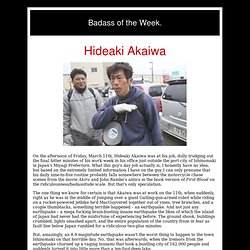
What this guy's day job actually is, I honestly have no idea, but based on the extremely limited information I have on the guy I can only presume that his daily nine-to-five routine probably falls somewhere between the motorcycle chase scenes from the movie Akira and John Rambo's antics in the book version of First Blood on the ridiculousness/badassitude scale. Emotional Care for Children After Disaster « OperationSAFE. History Is on Japan's Side. Horizon Christian Fellowship. Net Sees Earthquake Damage, Routes Around It. Japan: Triumph of the spirit - Asia, World. There had been a recent death at the dojo where I trained.
One student, an older man, with a typically genki attitude – a uniquely Japanese concept meaning enthusiasm, fun, liveliness – had, during training, been thrown repeatedly on to the mat for an hour. He complained of a headache but continued. Finally, he was unable to stand – and minutes later he was dead, from a brain haemorrhage. Geigercrowd, crowdsourced radiation data. Some Perspective On The Japan Earthquake: MicroISV on a Shoestring. [日本の方へ:読者が日本語版を翻訳してくださいました。
ご参照してください。] I run a small software business in central Japan. Over the years, I’ve worked both in the local Japanese government (as a translator) and in Japanese industry (as a systems engineer), and have some minor knowledge of how things are done here. English-language reporting on the matter has been so bad that my mother is worried for my safety, so in the interests of clearing the air I thought I would write up a bit of what I know.