
Himalayan glaciers continue to retreat. Evidence from scientists trekking in the Himalayas has provided further evidence of global warming.
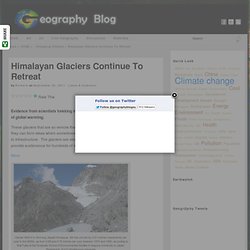
These glaciers that are so remote they are often known by code letters. As they melt they can form lakes which sometimes burst causing death, loss of fields and damage to infrastructure. The glaciers are also the source of Asias great rivers which provide sustenance for hundreds of millions. More Glacier AX010 in Shorong, Nepali Himalayas. Show. Water resources in the Himalaya. Water Disputes In South Asia: Can Region Come Together? – Analysis : CLIMATE HIMALAYA.
Several factors drive water disputes in South Asia.
To solve the problems, it is critical to involve even China. Solutions must foster the sharing of water resources through increasing dialogue and building mutual trust. SOUTH ASIA is mired in disputes over water resources despite possessing three large rivers – the Ganges, Brahmaputra and Indus and their tributaries. The disputes emanate from the transboundary nature of these rivers which disregard man-made political and geographical boundaries. The tussle for water resources amongst India, Pakistan, Bangladesh and Nepal is now getting complicated with China’s entry into the calculus.
South Asia’s water: Unquenchable thirst. Impact of water resources in Himalaya Reagion. A country by country assessment of water resources in the Himalaya region.
Many thanks to Danny O’Callaghan for info. Background water information China Precipitation varies greatly from 2000mm to 25mm and is seasonal in all areas. China has 21% of world’s population, 6% freshwater and 9% of farmland. Drought affects 13% of farmland. Only 82% of rural pop have access to improved drinking resources. Water shortages are concentrated in the north, where irrigation demands are high (it produces most of grain production). South suffers from summer flooding. Half of all cities suffer from water shortages. Most rivers are polluted, especially around cities, although rural areas have high nitrate pollution as well.
Groundwater reserves are being depleted,especially in North. Summary – China is already suffering from water shortages. India Variable rainfall with high reliance on monsoon. Reliance on rainfall and glacial meltwater in dry season. Water Scarcity in Himalayas. A report by an Indian based Strategic Foresight Group has said that there is a major catastrophe in the making.
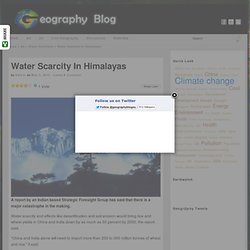
Water scarcity and effects like desertification and soil erosion would bring rice and wheat yields in China and India down by as much as 50 percent by 2050, the report said. “China and India alone will need to import more than 200 to 300 million tonnes of wheat and rice,” it said. “This will create havoc in the global food market … for people everywhere, because the prices will go up substantially,” Waslekar said. Water depletion in the river basins would displace millions of people in the four countries by 2050, he said. “We are looking towards a disaster of more than 100 million migrants,” he said, “and conflicts within and between countries.” Diamer Bhasha Dam. About Bhasha Dam General The President of Pakistan during his national address on 17th January 2006 announced the decision of Government to construct 5 multi-purpose storages in the country during next 10 -12 years.
Himalaya – Tehri Dam, India. Kashmir and the politics of water - Kashmir: The forgotten conflict. The Indus River originates in the Tibetan plateau, making its 3,200km journey southwards along the entire length of Pakistan, before emptying into the Arabian Sea.
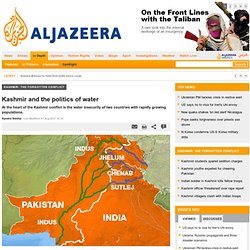
The river basin is divided between Pakistan, which has about 60 per cent of the catchment area, India with about 20 per cent, Afghanistan with 5 per cent and around 15 per cent in Tibet. The two major riparians, Pakistan and India have extensively dammed the Indus River to provide for irrigation and hydro-electricity. [A riparian zone is defined as the area of interface between land and a river or stream.]
The Indus has five main tributaries. The Jhelum, the largest of these, originates in the Valley of Kashmir. As a result, if the Line of Control (LoC) between India and Pakistan in Kashmir, were to move from being a defacto to a recognised international border, India would permanently become the upper riparian and Pakistan the lower riparian of the Indus River and all of its tributaries. Indian, Pakistani and Chinese border disputes: Fantasy frontiers. South-Asian territorial claims Current boundariesPakistan’s claimChina’s claimIndia’s claim Disputed borders are both a cause and a symptom of tensions between big neighbours in South Asia.
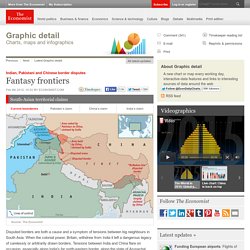
When the colonial power, Britain, withdrew from India it left a dangerous legacy of carelessly or arbitrarily drawn borders. Tensions between India and China flare on occasion, especially along India's far north-eastern border, along the state of Arunachal Pradesh. In recent years Chinese officials have taken to calling part of the same area “South Tibet”, to Indian fury, as that seems to imply a Chinese claim to the territory. Most contentious of all, however, are the borders in Kashmir, where Pakistan, India and China all have competing claims. While Kashmir's Hindu rulers prevaricated, hoping somehow to become an independent country, Pakistan's leaders decided to force the issue.
The interactive map above allows you to view the various territorial claims from each country's perspective.