
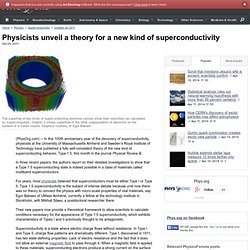
Physicists unveil a theory for a new kind of superconductivity. (PhysOrg.com) -- In this 100th anniversary year of the discovery of superconductivity, physicists at the University of Massachusetts Amherst and Sweden’s Royal Institute of Technology have published a fully self-consistent theory of the new kind of superconducting behavior, Type 1.5, this month in the journal Physical Review B.
Historical Collections. 400 Free Online Courses from Top Universities. Advertisment Take online courses from the world’s top universities for free.
Below, you will find 1,700 free online courses from universities like Yale, MIT, Harvard, Oxford and more. Our site also features collections of Online Certificate Programs and Online Degree & Mini-Degree Programs. Note: This page includes a lot of Massive Open Online Courses (MOOCs). If you want to enroll in a free version of a MOOC, please select the “Full Course, No Certificate” (edX) or “Audit” (Coursera) option. A voice for the Electric Universe. Solar System Scope. Holographic dark information energy. Cruz deWilde: Career Portfolio. Human Physiology - Neurons & the Nervous System. The human nervous system consists of billions of nerve cells (or neurons)plus supporting (neuroglial) cells.

Neurons are able to respond to stimuli (such as touch, sound, light, and so on), conduct impulses, and communicate with each other (and with other types of cells like muscle cells). Nervous system The nucleus of a neuron is located in the cell body. Extending out from the cell body are processes called dendrites and axons. These processes vary in number & relative length but always serve to conduct impulses (with dendrites conducting impulses toward the cell body and axons conducting impulses away from the cell body). Neurons can respond to stimuli and conduct impulses because a membrane potential is established across the cell membrane. Air on the Dirac Strings. Hail the first sound ‘lasers’
Life's asymmetry may come from space. Processes taking place in outer space, and not on Earth, are likely to have led to the biological molecules found exclusively in either a left-handed or right-handed form.
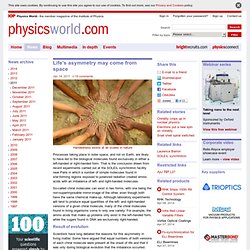
That is the conclusion drawn from recent experiments carried out at the SOLEIL synchrotron facility near Paris in which a number of simple molecules found in star-forming regions exposed to polarized radiation created amino acids with an imbalance of left- and right-handed molecules. So-called chiral molecules can exist in two forms, with one being the non-superimposable mirror-image of the other, even though both have the same chemical make-up. Although laboratory experiments will tend to produce equal quantities of the left- and right-handed versions of a given chiral molecule, many of the chiral molecules found in living organisms come in only one variety.
For example, the amino acids that make up proteins only exist in the left-handed form, while the sugars found in DNA are exclusively right-handed. Physicists craft Luneburg lens from silicon. Physicists in the UK have created a Luneburg lens – a lens able to focus light from all directions equally well – on a silicon chip.
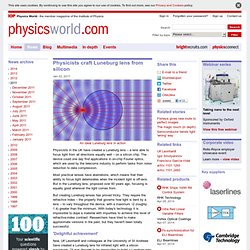
The device could one day find applications in on-chip Fourier optics, which are used by the telecoms industry to perform tasks from noise reduction to data compression. Most practical lenses have aberrations, which means that their ability to focus light deteriorates when the incident light is off-axis. But in the Luneburg lens, proposed over 60 years ago, focusing is equally good wherever the light comes from. But creating Luneburg lenses has proved tricky. Brightest bubble bursting yet. Physicists in the US claim to have broken the record for the brightness of light generated by “sonoluminescence”, the imploding of a bubble when it is blasted with sound waves.
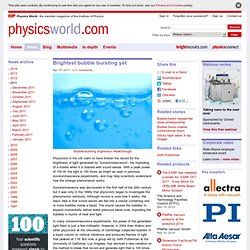
With a peak power of 100 W, the light is 100 times as bright as seen in previous sonoluminescence experiments, and may help scientists understand how the strange phenomenon works. Sonoluminesence was discovered in the first half of the 20th century but it was only in the 1990s that physicists began to investigate the phenomenon seriously. Although no-one is sure how it works, the basic idea is that sound waves are fed into a vessel containing one or more bubbles inside a liquid. Wave Structure of Matter (WSM) - Articles - The Wave Structure of Matter (WSM) and the Origin of the Natural Laws. Milo Wolff, M.I.T (retired) 1125 Third Street, Manhattan Beach, CA 90266 Milo.Wolff@QuantumMatter.com I.
Introduction II. History of the Wave Structure of Matter III. The New York Times > Magazine > Thermoacoustic Freezer, The. Published: December 12, 2004.
Fusion Reactors. As of 2008, the United States Department of Energy (DOE) and other U.S. federal agencies have spent approximately 18 billion dollars on energy devices using the fusion reaction between deuterium and tritium (D-T Fusion, below left).

In this reaction the hydrogen isotope, deuterium (with one “extra” neutron) collides with the hydrogen isotope, tritium (with two “extra” neutrons), to form an alpha particle (a helium nucleus) and a neutron. This is a nuclear reaction: between them, the new alpha and the neutron possess 17.6 MeV (million electron volts) of energy. "crazy engine" stirling Low Temperature Difference Engine. Burning Salt Water on YouTube, Inventor Waits for Prime Time. Just over a year agoseveral media outlets reported that John Kanzius, an amateur inventor from Erie, Pa., had discovered a seemingly impossible phenomenon: a way to burn salt water by exposing it to radio waves.

Videos of the experiment became YouTube sensations, though they garnered as many critical comments as favorable ones. Now that the initial fervor has waned, we checked in with Kanzius, a collaborator and some critics to see how the technique has progressed, or if it's just another example of Web-propelled junk science. Kanzius' concept is simple: expose salt water to 13.56 MHz radio waves and light a match. Ultrasonic Cavitation (hielscher.com) Laser + Balloon + Fire Inside It = Awesome! * webcam video * *, 2011 * IMG * Janna Levin: Il suono dell'universo. Planets Take Shape In Embryonic Gas Clouds. Gravity satellite yields 'Potato Earth' view. 31 March 2011Last updated at 11:27 ET By Jonathan Amos Science correspondent, BBC News, Munich It looks like a giant potato in space, and yet the information in this model is the sharpest view we have of how gravity varies across the Earth.
Quantum explanation for how we smell gets new support. (PhysOrg.com) -- Since 1996, when biophysicist Luca Turin first suggested that quantum mechanics may help explain how we smell various odors, the idea has met with controversy. In the past 15 years, some studies have found evidence supporting the theory, while other studies have found problems with it. Now Turin - who is currently at MIT and the Fleming Biomedical Sciences Research Centre in Vari, Greece - along with his colleagues, has published a study that provides further evidence for the vibration theory of smell, and may make the theory a bit less controversial. In the traditional “lock and key” model of smell, odorant molecules of different shapes and sizes fit into different receptors, similar to the current understanding of how drugs affect the body. Turning Mediocre Products into Awesome Products. Corinna Cortes. Københavnske dataloger kaprer dansk Google-es. Én af topmedarbejderne hos søgemaskinegiganten Google, Corinna Cortes, tiltræder i dag som adjungeret professor på Datalogisk Institut ved Københavns Universitet.
Plantevenlig LED testet i Danmark og klar til verdensmarkedet. Cruz deWilde: Career Portfolio. In the late 1600’s, Sir Isaac Newton got bonked on the head by an apple and surmised that every point of mass is attracted to every other point of mass with a strength that diminishes as the inverse of the square of the distance that separates them. The predictive accuracy of his equation was so consistent for so long, that his theory became law, despite the fact that he never managed to explain how gravity works.
And it wasn’t until the dawn of Quantum Mechanics that we found out that gravity doesn’t always work. Today, our current collection of laws and theories representing some of humanity’s best efforts to describe the universe might be affectionately described as a large, codependent, dysfunctional family that lives by the mantra 'Often wrong, but never in doubt.' The Law of Gravity is the family patriarch that younger theories such as Relativity, Big Bang, and Quantum Mechanics are still forced to respect, even as they rebel against him.
Musical Tesla Coils Play Intro, 2001: A Space Odyssey, et al @ Penguicon 2008 (8a1) Tesla Coils - Arc Attack - Doctor Who Theme Song - Makers Faire 2010 - San Mateo - No. 1. Massive black hole challenges conventional theories. Astronomers have been astonished to find a supermassive black hole in the center of a tiny low-mass galaxy, suggesting that such black holes can form before their host galaxies. The dwarf galaxy known as Henize 2-10 is undergoing a violent burst of star formation, and is believed to be similar in many ways to infant galaxies in the early universe. Turning Gravity Inside Out. Goethe, Faust - Part I Prologue - A new English translation. » Can you make electricity by squeezing water through holes in the breeze? Peter Donnelly: How juries are fooled by statistics Sphere Sculptures Across the Globe. Cosmogenesis. Spark in spiral magnetic field