
Businessinsider. Docs · Kaizena · Give Great Feedback. eQuizShow - Free Online Quiz Show Templates. English/Language Arts. Creating Quizzes Using Google Forms. Ten Takeaway Tips for Teaching Critical Thinking. Suggestions from educators at KIPP King Collegiate High School on how to help develop and assess critical-thinking skills in your students.
Ideally, teaching kids how to think critically becomes an integral part of your approach, no matter what subject you teach. But if you're just getting started, here are some concrete ways you can begin leveraging your students' critical-thinking skills in the classroom and beyond. 1. Questions, questions, questions. Questioning is at the heart of critical thinking, so you want to create an environment where intellectual curiosity is fostered and questions are encouraged. In the beginning stages, you may be doing most of the asking to show your students the types of questions that will lead to higher-level thinking and understanding.
Educational Hip-Hop. Playlist - Gogol Bordello's "ten greatest duets" feat Nick Cave, Iggy Pop, Serge Gainsbourg & more. The 25 Best Websites for Literature Lovers. iAnnotate – Disrupting the Sound of Silence. If you didn’t notice, the iAnnotate app has had a major update.
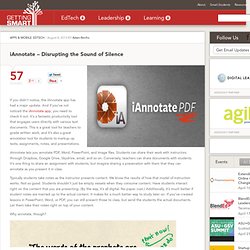
And if you’ve not noticed the iAnnotate app, you need to check it out. It’s a fantastic productivity tool that engages users directly with various text documents. This is a great tool for teachers to grade written work, and it’s also a great annotation tool for students to markup up texts, assignments, notes, and presentations. iAnnotate lets you annotate PDF, Word, PowerPoint, and image files.
Using Google Drive for Online Discussions of Primary Sources. This same information is included at the end of my slideshow on Teaching With Technology and Primary Sources, but I wanted to share it as a separate post as well just in case people had trouble accessing the linked document at the end of the slideshow.
One of my favorite ways to use the commenting feature in Google Documents is to host online discussions around a shared article. Doing this isn’t a radical departure from having a classroom discussion about an article that you’ve printed and distributed to your students, but there are some advantages to hosting your discussion in Google Documents. The first advantage is that your students can participate in the discussion from anywhere at any time they are connected to the Internet. Students absent from your classroom can still participate and can read others’ comments. The second advantage is that your students can have a digital archive of the ideas shared by you and their classmates. 2.
How To Cite An App. How To Cite An App in APA Style After seeing the correct way to cite a tweet last year, it brought to mind the need to cite increasingly diverse media forms.
No longer books, periodicals, and mere websites, information is becoming increasingly refracted from more nuanced media forms. Macbeth: An In depth Analysis. As of July 1, 2013 ThinkQuest has been discontinued.
Scientific Writing Web Resource - Duke University. Few topics engender such heated debates as that of active vs. passive voice.
This argument is relevant to writing in general, but I think it's particularly so to scientific writing. DefinitionCharacteristics. Intro materials. Google Docs for Teachers 2012. Professor Word - Identify SAT & ACT Vocabulary Words on Any Webpage. Professor Word is a promising new service that should help students learn new SAT and ACT vocabulary words.
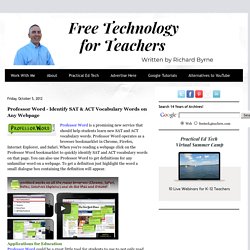
Professor Word operates as a browser bookmarklet in Chrome, Firefox, Internet Explorer, and Safari. When you're reading a webpage click on the Professor Word bookmarklet to quickly identify SAT and ACT vocabulary words on that page. Free Flash Jeopardy Review Game. The Instant Jeopardy Review Game has been designed and dramatically improved to make it the perfect review game for a wide variety of classroom uses. This tool is a fun and interactive way to review content in your classroom, meeting, conference, or other group setting.
The new and improved version of the Jeopardy Review Game includes the following features: Simple insertion of pictures on Question and/or Answer slides Full support for symbols, such as exponents and wingdings style fonts Better support for foreign language Question and/or Answer slides Simpler visual editing process Embed anything in your question slides, even Youtube videos, flash objects, etc. Simple scorekeeping system Works on portable devices such as smartphones, iPad, and iPod Touch! SMART Board Resources.
library.thinkquest.org/2888/ Lit & Language Games. ManyBooks.net - Free eBooks for your iPad, smartphone, or eBook. Writing. Word Clouds Cyberman. Five close reading strategies to support the Common Core. Three Questioning Strategies for Any Lesson. Teachers know—questions play a different role, depending on when they're used. Ten Takeaway Tips for Teaching Critical Thinking. A quick overview of the Hero’s Journey » Jordan McCollum. Planning out a novel?
Be sure to join my newsletter for a FREE plotting/revision roadmap, and check out the full series on plotting novels in a free PDF! Over the last two weeks, we’ve looked at two plotting methods. One helped us parse our story into parts, the other helped us grow it from an idea. Web English Teacher. Literary Terms.