
Why Build CENDARI? STORYCENTER. DHi - Digital Humanities Initiative. Mapping the Republic of Letters. Omeka. Plusieurs millions de documents à portée de main. Annotorious - Image Annotation for the Web. The Differences between Digital History and Digital Humanities. Libro: “Ciencias Sociales y Humanidades Digitales: técnicas, herramientas y experiencias de e-Research e investigación en colaboración”
Crowdmap las Cruzadas. CrowdMapTheCrusades (formerly Crowdsourcing the Crusades @MapFirstCrusade) is a proof-of-concept transcription and mapping project.
It will generate and publish maps of the place names mentioned in ‘the Song of the First Crusade’, an Old French text attributed to Baudri of Bourgueil. It will help to establish interdisciplinary collaboration between literary scholars and historians, particularly in areas where the exact locations of places are most difficult to determine with certainty. The project will focus on a version of the poem in a 13th century manuscript, Hatton 77, which is in the Bodleian Library, Oxford. It has not yet been edited or transcribed in full. DH Crowdscribe. Welcome - Manual de Periodismo de Datos. Examinar Tech para Maestros. Comparative Constitutions Project.
Welcome - Manual de Periodismo de Datos. Ngram Viewer. Analítica de acceso al Archivo oscuro dominio. Timeliner - Haga Plazos y TimeMaps rápido! - Conocimiento de la Fundación Open Labs. Textus. Mapping the world’s writing systems. Also see this. Conocimiento Abierto Fundación Blog. CKAN is a powerful, open source, open data management platform, used by governments and organizations around the world to make large collections of data accessible, including the UK and US government open data portals.
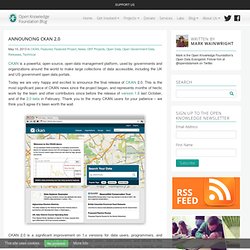
Today we are very happy and excited to announce the final release of CKAN 2.0. This is the most significant piece of CKAN news since the project began, and represents months of hectic work by the team and other contributors since before the release of version 1.8 last October, and of the 2.0 beta in February. Thank you to the many CKAN users for your patience – we think you’ll agree it’s been worth the wait. CKAN 2.0 is a significant improvement on 1.x versions for data users, programmers, and publishers. Enormous thanks are due to the many users, data publishers, and others in the data community, who have submitted comments, code contributions and bug reports, and helped to get CKAN to where it is. Summary. Froide - Freedom Of Information Software. Open Source!
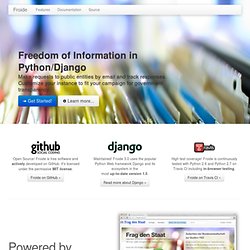
Froide is free software and actively developed on GitHub. It's licensed under the permissive MIT license. Froide on GitHub » Maintained! Ocupar Archivo. Una web de citas, una comunidad de estudiosos. Mapping the Republic of Letters. Spatial History Project. The Spatial History Project at Stanford University, a part of the Center for Spatial and Textual Analysis (CESTA), is made possible by the generous funding of the Vice Provost for Undergraduate Education (VPUE), DoResearch, The Andrew W.
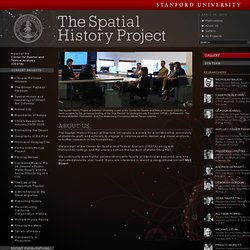
Mellon Foundation, and The Wallenberg Foundation Media Places Initiative. The Spatial History Project at Stanford University is a place for a collaborative community of students, staff, and scholars to engage in creative spatial, textual and visual analysis to further research in the humanities. We are part of the Center for Spatial and Textual Analysis (CESTA) along with Humanities+Design and the Literary Lab on the top floor of Wallenberg Hall. We continually seek fruitful collaborations with faculty at Stanford and beyond, and hire motivated students year round.
If you are interested in learning more, please contact Matt Bryant. DHi: Iniciativa de Humanidades Digitales. El nacional biblioteca en línea de la historia local. AnnotationStudio. The DM Project. The DM project is pleased to announce that it has been awarded a Digital Humanities Implementation Grant for 2013-14 by the National Endowment for the Humanities.
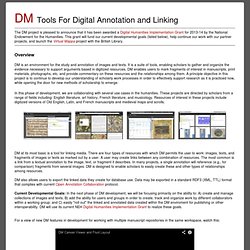
This grant will fund our current developmental goals (listed below), help continue our work with our partner projects, and launch the Virtual Mappa project with the British Library. Overview DM is an environment for the study and annotation of images and texts. It is a suite of tools, enabling scholars to gather and organize the evidence necessary to support arguments based in digitized resources. DM enables users to mark fragments of interest in manuscripts, print materials, photographs, etc. and provide commentary on these resources and the relationships among them.
In this phase of development, we are collaborating with several use cases in the humanities. DM at its most basic is a tool for linking media. DM also allows users to export the linked data they create for database use. Use Cases Funding History Contact. Lugares históricos - Todos los Lugares Históricos de los Estados Unidos y Canadá. E-Diasporas Atlas - Home.
Visualización avanzada para las Humanidades: A Thousand Words. Purpose Visualization uses computers to find patterns and make connections that normally cannot be seen.
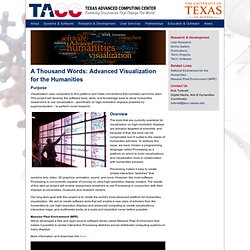
This project will develop the software tools, skills, and knowledge base to allow humanities researchers to use visualization - specifically on high-resolution displays powered by supercomputers – to perform novel research. Overview. A Ensayo Literario Digital por Will Self. ISIDORE - Accès aux données et services numériques de SHS.
Introducing Digital Humanities. NINES. Greenstone Digital Library Software. Opciones de código abierto para la educación. By Mark Johnson on 13 January 2013 , last updated 3 January 2014 Introduction This document presents options for open source software for use in the education sector.
Some of these may have uses outside of education, but they are presented here in the context of their specific benefits to educational establishments, or their use in the course of teaching and learning. @ Nengard # opensource - Delicious.
Inicio. ¡Bienvenidos a COMHISTORIA!
About. DHCommons, an initiative of centerNet, is an online hub focused on matching digital humanities projects seeking assistance with scholars interested in project collaboration.
This hub responds to a pressing and demonstrable need for a project-collaborator matching service that will allow scholars interested in DH to enter the field by joining an existing project as well as make existing projects more sustainable by drawing in new, well-matched participants. Additionally, DHCommons helps break down the siloization of an emerging field by connecting collaborators across institutions, a particularly acute need for solo practitioners and those without access to a digital humanities center. TAPoR. Going Digital «William J. Turkel. Digital History Project. La CUNY Digital Humanities Guía de recursos - CUNY Commons Académico. From CUNY Academic Commons Welcome to the CUNY Digital Humanities Resource Guide, a collaboratively produced introduction to the field of Digital Humanities.
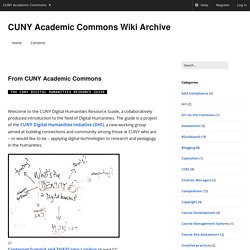
The guide is a project of the CUNY Digital Humanities Initiative (DHI), a new working group aimed at building connections and community among those at CUNY who are – or would like to be – applying digital technologies to research and pedagogy in the humanities. Introduction Using This Guide. Perspectives: December 2012. Investigación, Hostelería, Viajes, Media. INKE. (Nuevo) Humanista Grupo de Discusión. Presentación - Humanidades Digitales Hispánicas. El futuro de las instituciones de aprendizaje en la era digital »Acerca de este proyecto. This is the first draft and the first phase of “The Future of Learning Institutions in a Digital Age,” a contribution to the Occasional Paper Series on Digital Media and Learning sponsored by the John D. and Catherine T.
MacArthur Foundation. We are posting all of the drafts of “The Future of Learning Institutions” on this collaborative website sponsored by the Institute for the Future of the Book. We want strongly to encourage feedback, responses, additional bibliography, and commentary from as many readers as possible. We would also like to hear about experiments in which others are engaging to help transform education to make it as exciting and interactive as the forms of learning available to youth outside of the classroom today.
Recopilación de enlaces sobre bibliotecas y TICs. Hoy voy a hacer un pequeño resumen de algunos de los espacios dedicados a bibliotecas, lectura y TICs en enseñanza. Cultural Institute. Como reacción al pasado. "I have never seen students this engaged. They write more than the assignments require; everyone, shy or not, participates vigorously in the debates. They read important texts with real understanding, making complex arguments and ideas their own. " —Larry Carver, Director of the Liberal Arts Honors Programs, University of Texas at Austin Pioneered by historian Mark C.
Carnes, Reacting to the Past (RTTP) has been implemented at over 300 colleges and universities in the U.S. and abroad. Proyectos de digitalización para investigación digital. Research to Action - Making research accessible. Test-tapor.mcmaster.ca. Nuevas tecnologías, ¿nuevas humanidades? » Ernesto Priani - Sed fugitare decet simulacra. Digital Humanities. Tooling Up for Digital Humanities. eHumanities - Real Academia Holandesa de Artes y Ciencias.
World Wide Web Foundation. El Instituto de Tecnología Avanzada en las Humanidades. SNAC. Archivo Visual de Santiago. Acerca de www.netarchive.dk. Since 2005 the collection and preservation of the Danish part of the internet is included in the Danish Legal Deposit Law. The task is undertaken by the two legal deposit libraries in Denmark, State and University Library and The Royal Library. Netarchive.dk cannot be accessed by the general public.The archive is only accessible to researchers who have requested and been granted special permission to use the collection for specific research purposes. This website, Netarkivet.dk, is designed to inform researchers, website owners, and other interested parties about the Danish web archive. Centre for Internet Research. The Sound of Many Hands Clapping: Teaching the Digital Humanities through Virtual Research Environment (VREs)
Abstract At the core of the work done within the digital humanities is a difficult interdisciplinary relationship between the at times divergent cognate fields of computer science and the humanities. BANQUE mapping. La organización de su biblioteca personal de investigación y compilación de bibliografías: Yo era un refusenik EndNote, pero ahora soy un converso Mendeley. A key aspect of scholarship is how you create a personal research library, find and access your sources when needed, and cite them accurately and comprehensively. Patrick Dunleavy explains how the (relatively new) software Mendeley has transformed his previous time-consuming practice in just a few days, and solved numerous other problems of accessing literature and sources wherever he is.
Mendeley can offer all academics and PhDs massive productivity gains. Until a few days ago the way I organized my research library was a bit chaotic, and doing references and bibliographies was always a huge chore that often took days at a time. Según experto, investigación universitaria está atrasada 30 años - Noticias de Salud, Educación, Turismo, Ciencia, Ecología y Vida de hoy. La investigación universitaria en Colombia se encuentra rezagada entre 20 y 30 años respecto de países como Brasil, México, Argentina y Chile y es uno de los que menos recursos gastan en ciencia y tecnología en la región, según el investigador José Joaquín Brunner, quien estuvo en el país invitado por la Universidad Jorge Tadeo Lozano. Así es la brecha tecnológica en la educación de América Latina. Bienvenido a la página web de e-Investigación del Sur - e-Investigación del Sur.
Investigación Correo electrónico: Métodos, estrategias y cuestiones. E-Research: Methods, Strategies and Issues. XTF. Enseñanza Digital Humanties: métodos digitales opcionales PhD Asunto: Cursos. I have started teaching in a PhD coursework subject here at the University of Melbourne; the first year that this type of subject have been offered in PhD research here. Detalles del curso - Clio I Cableado - Otoño 2012. Course Description. La atalaya del Nuevo Mundo. The future European Association for Digital Humanities. 4Humanities. La economía de la atención: la economía natural de la Red. Economía de la atención - VS Pedia. «En la biblioteca de Alejandría, lo valioso son los ojos que te miran».- Pepe Cervera.
Bienvenidos al Proyecto Ciencia de Oxford e-Social. Digital Social Research. A blog by sociologist Deborah Lupton. Digital Sociología (con imagen) · · DALupton Storify. - Artículo del Futuro. Open Knowledge Foundation. The Digital Scholar: How Technology Is Transforming Scholarly Practice. Estamos en vivo! Mordeduras de Ciencias Sociales Podcasts. Un espacio para explorar, compartir y dar forma a los problemas que enfrentan los científicos sociales. Peter Suber, "Introduction to Open Access for Librarians" Ampliar el acceso a las publicaciones de investigación - la Red de Investigación de Información. 4Humanities. La Campaña de Ciencias Sociales. A space to explore, share and shape the issues facing social scientists.