
How to Do Pranayam. Steps Bhastrika Pranayam: Bellows Breath <img alt="Image titled Do Pranayam Step 1" src=" width="728" height="546" class="whcdn" onload="WH.performance.clearMarks('image1_rendered'); WH.performance.mark('image1_rendered');">1Breathe in deeply through your nostrils.
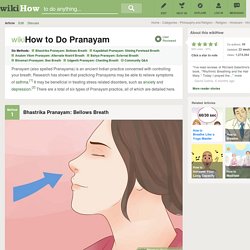
First, feel the diaphragm move down, allowing the lungs to expand and forcing the abdomen out; then feel your chest expand with your collar bones rising last. <img alt="Image titled Do Pranayam Step 2" src=" width="728" height="546" class="whcdn">2Breath out quickly through your nostrils. Feel your collar bones dropping, chest deflating, and abdomen shrinking as the lungs collapse. <img alt="Image titled Do Pranayam Step 4" src=" width="728" height="546" class="whcdn">4With practice, speed up your breathing.
Kapalbhati Pranayam: Shining Forehead Breath. How to Be a Karma Yogi (Religion of Love) Edited by Nils Horn, Kercyn, Flickety, Eric and 18 others Karma Yoga is based on the teachings of the Bhagavad Gita, a sacred Sanskrit scripture of Hinduism.

The word "Karma" is derived from the Sanskrit Kri, meaning "to do". Krishna advocates selfless action as the ideal path to realize the Truth (enlightenment, a life in the light). Bhakti Yoga is love to God and to the spiritual Master. Karma Yoga is doing good to the whole world, to love the whole world and all beings. In the remainder of this article, you will learn how to start on the path of being a Karma Yogi, practicing the religion of love. Ad Steps 1Live in inner peace and act with love for the {*style:<a href=' of all beings. 6Practice daily your positive qualities. Tips Warnings There is a danger along the path of unconditional, all-encompassing love.
How to Do the Ten Ethic Principles of Patanjali (Yoga Sutra) Edited by Nils Horn, Zack, Jack Herrick, Lois Wade and 6 others Patañjali is the compiler of the Yoga Sutras, an important collection of aphorisms on Yoga practice.

In recent decades the Yoga Sutra has become quite popular worldwide for the precepts regarding practice of Raja Yoga and its philosophical basis. The Yoga Sutras codifies the royal or best (raja) yoga practices, presenting these as a eight-limbed system (ashtanga). The focus is on the mind; the second sutra defines Yoga - it is the cessation of all mental fluctuations, all wandering thoughts cease and the mind is focused on a single thought (ekagrata). The eight limbs or the Ashtanga Yoga propounded here are yama and niyama (the ten ethics) asana (posture), pranayama (breath-control), pratyahara (sense-withdrawal), dharana (meditation, concentration), dhyana (meditation, peace) and samadhi (happiness, oneness).
Ad Steps 1Practice non-violence (ahimsa). Tips Warnings Don´t be dogmatic. How to Be a Yogi.