
Coelacanth (Latimeria chalumnae) The Bloop: A Mysterious Sound from the Deep Ocean. Nassim Haramein - Black Whole. Zeno's paradoxes. Zeno's arguments are perhaps the first examples of a method of proof called reductio ad absurdum also known as proof by contradiction.
They are also credited as a source of the dialectic method used by Socrates.[3] Some mathematicians and historians, such as Carl Boyer, hold that Zeno's paradoxes are simply mathematical problems, for which modern calculus provides a mathematical solution.[4] Some philosophers, however, say that Zeno's paradoxes and their variations (see Thomson's lamp) remain relevant metaphysical problems.[5][6][7] Banach–Tarski paradox. Can a ball be decomposed into a finite number of point sets and reassembled into two balls identical to the original?
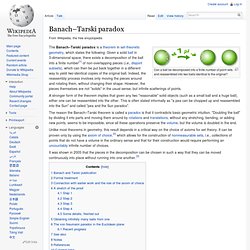
A stronger form of the theorem implies that given any two "reasonable" solid objects (such as a small ball and a huge ball), either one can be reassembled into the other. This is often stated informally as "a pea can be chopped up and reassembled into the Sun" and called "pea and the Sun paradox". Unlike most theorems in geometry, this result depends in a critical way on the choice of axioms for set theory. It can be proven only by using the axiom of choice,[2] which allows for the construction of nonmeasurable sets, i.e., collections of points that do not have a volume in the ordinary sense and that for their construction would require performing an uncountably infinite number of choices.
It was shown in 2005 that the pieces in the decomposition can be chosen in such a way that they can be moved continuously into place without running into one another.[3] Documentary Storm - Stream Full Documentaries. Pr. Brian Cox - A Night with the Stars [BBC, Full Lecture] BBC.Natural World.s29e03.Andrea Queen Of Mantas .HDTV.720p.x264.AC3. Made in Romania - WILD CARPATHIA FULL documentary subtitrat in romana. Particle physics, high energy physics, news and resources.