
Infographic design by Recker House for the Neue... 20 Powerful Infographic Design Kits. Infograpics have become so popular these days and as a result more and more high quality infographic design kits are made available to help designers.
Infographics can be used very effectively to present complex data in a nice visual and powerful way. It is done using hand-picked design elements that relate to the data they represent e.g. demographic data can be effectively illustrated using small carefully colored human icons as overlay on a simplified map. Online marketers love infographics for their ability to go viral on social networks and often they are offered as easy to embed code making it fast and simple for e.g. bloggers to share them in posts… very useful value oriented way to build links and online presence. Infograpics designs are also used commercially in information products. Cool Infographic Designs.
5 Infographics on Web Accessibility for Designers. When you are designing a site you have a hundred little details to keep in mind.

But it isn’t all about concept design and launch. It is also about making sure whatever you create has the maximum web accessibility possible for your users. Which is a whole other set of guidelines you have to follow, apart from the design process itself. Don’t get caught making common pitfalls. Check out these five excellent infographics on web accessibility from top designers in the game. Web Accessibility for Designers View Larger WebAim is a Utah State University based organization dedicated to creating an accessible online world for people with disabilities.
Accessibility Challenges In Email Design View Larger Addressing a challenge often skirted over by design blogs, this typographic uses a retro infromation pamphlet look to talk about the different kinds of disability you will encounter (Visual, Physical and Cognitive/Neurological), and provide helpful statistics on each. Curio. I occasionally have a look at the keywords people have entered in Google that lead them to this site, and so I notice that someone searched for a comparison between Curio and Circus Ponies Notebook.
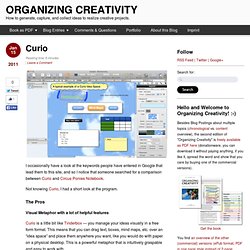
Not knowing Curio, I had a short look at the program. The Pros Visual Metaphor with a lot of helpful features Curio is a little bit like Tinderbox — you manage your ideas visually in a free form format. This means that you can drag text, boxes, mind maps, etc. over an “idea space” and place them anywhere you want, like you would do with paper on a physical desktop. Curio - Mind Mapping, Brainstorming, and Project Management Software for Mac OS X. The Real World You have work projects and home projects, school classes to manage and book reports to research, vacations to plan and novels to write, web sites to design and lab results to organize.

You currently use a collection of notebooks, your office whiteboard, scraps of sticky notes, oodles of browser bookmarks, and multiple documents scattered around your hard disk. Curio 7 Professional Overview. Blog « ThinkX Intellectual Capital. There’s a mandate in the corporate world that’s been called the Innovation Imperative.
In just about any major organization, people hear it several times a day: Innovate or Die. It’s assumed that people will know what being innovative actually means. And how to do it. So employees are routinely herded into innovation sessions, where they’re expected to generate new thinking about products or services, corporate structures, or production processes. More often than not, they walk out of those sessions having accomplished very little. Imagine someone saying to you, “Ok, go run the marathon.” And yet, that’s exactly the approach most organizations take when they ask people to put their brains into high gear and think differently. Whether you want to produce high quality running or high quality thinking, you have to learn how. Think Better: An Innovator’s Guide to Productive Thinking « ThinkX Intellectual Capital.
Think you think as well as you can?
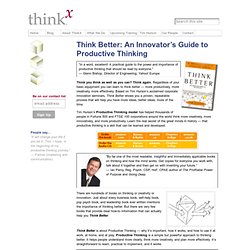
Think again. Hurson's Productive Thinking Model - Problem-Solving Tools from MindTools. Solving Problems Creatively © iStockphotoRawpixel A creative approach to solving problems.
Creativity is incredibly important in problem-solving – if you're not creative, you'll struggle to understand the issues surrounding a problem, and you're unlikely to identify the best solutions. Worse still, you might fail to solve the problem altogether! Entraining Part 3: Language « ThinkX Intellectual Capital. In the early days of TV, there was a popular afternoon program called Queen for a Day.
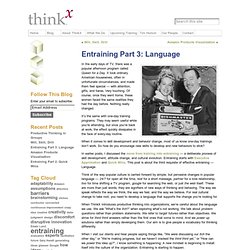
It took ordinary American housewives, often in unfortunate circumstances, and made them feel special — with attention, gifts, and tiaras. Very touching. Of course, once they went home, these women faced the same realities they had the day before. Nothing really changed. Entraining Part 2: Quick Wins « ThinkX Intellectual Capital. Last week, I wrote about the great corporate training myth — the misguided belief that you can get people to change their behaviors as a result of a one-day (if that!)
“training” session: What we do need are practical approaches that entrain new skills and new behaviors in people so they actually stick — and make a difference. Entraining is a process of skill development, attitude change, and cultural evolution.In my field — creativity and innovation —entraining productive new skills and behaviors requires five things. How to Change Your Life (dirtSimple.org) Can people really change?

We tend to assume that circumstances change easily and often, but that people change rarely, slowly, and with great difficulty. But these assumptions are wrong. The truth is that people can change easily and instantly. The real problem is that they also change back just as easily! Having Trouble Getting Started On Your Goals? In this short video, I explain -- and demonstrate! "On My Own With Lyrics" By Ashes Remain - HD. 80 20. By Celes on Jan 9, 2009 | ShareThis Email This Post. Achieve More With Less In Life Using 80/20 Principle. Get Your Big Rocks In First. By Celes on Feb 2, 2009 | ShareThis Email This Post For today’s article, I’m going to start off with a timeless story which exemplifies the big idea I’m going to share. I’ve condensed the original story into its key essence, so please read it before continuing on. A life in 5 years.
January eighth. A tuesday. The day I got the results from my 150 day experiment. Why You Should Not Resist 80/20 Principle. By Celes on Jan 10, 2009 | ShareThis Email This Post This is part-2 of a 3-part series on achieving more with less in your life using the 80/20 principle. Some people have written off the 80/20 rule, because of misunderstandings of the rule itself. Below are examples of what the 80/20 is NOT about: 80/20 is NOT about extremism. My initial resistance toward 80/20. Apply 80/20 to Your Life Now in 3 Simple Steps. By Celes on Jan 11, 2009 | ShareThis Email This Post This is the last part of a 3-part series on achieving more with less in your life using the 80/20 principle.
If you look closely, 80/20 can be seen in action all around your life, your career, relationships, health, habits, goal achievement, productivity, emotions, and even daily life. Many people are already applying the 80/20 principle without even realizing it. How To Make A Drastic Change In Life — Amanda Christian. How To Be Productive: 8 Habits of Highly Productive People. 7 Little Habits That Can Change Your Life, and How to Form Them. How to Establish New Habits the No-Sweat Way. Engineer Life: Set Up Habit Changes So It’s Hard to Fail. Post written by Leo Babauta. In his excellent ebook about changing habits, blogging friend Scott Young described the process of forming habits as walking home through fresh snow.
Autopilot Achievement: How to Turn Your Goals Into Habits. Managing Yourself: Extreme Productivity. A Campaign Strategy for Your Career. This year’s presidential campaign has subjected us to the usual barrage of negative ads, divisive wedge issues, and minor misstatements amplified beyond all recognition. Executive Summaries. What You Can Learn from Family BusinessNicolas Kachaner, George Stalk, and Alain BlochReprint: R1211H Though the term “family business” may call to mind visions of local mom-and-pop firms, family-controlled companies play a huge role on the global stage. Accelerate! Perhaps the greatest challenge business leaders face today is how to stay competitive amid constant turbulence and disruption. Manage Your Energy, Not Your Time. Steve Wanner is a highly respected 37-year-old partner at Ernst & Young, married with four young children. Overachievement: The New Science of Working Less to Accomplish More by John Eliot - Reviews, Discussion, Bookclubs, Lists.
Amazon. Greg Little (Coppell, TX)'s review of Overachievement: The New Science of Working Less to Accomplish More. John Eliot (psychologist) Overachievement: The New Science Of Working Less To Accomplish More By: John Eliot. Books similar to Overachievement: The New Science of Working Less to Accomplish More.