
עקרון פארטו. Getting Things Done - GTD. Simple Productivity. The Power Of Less. Upload & Share PowerPoint presentations and documents. Time Management. GTD.NET. Getting Things Done Audio Book abridged. Ask Readers: How to get started on Getting Things Done? - Stepcase Lifehack.
The Beginner’s Guide to Zen Habits - A Guided Tour. Post written by Leo Babauta.
Follow me on Twitter. While some of you have been following Zen Habits since its early days (beginning of 2007), many of you are fairly new readers. To help you through the fairly overwhelming archives, I’ve compiled a beginner’s guide. Kind of a Quick Start guide. Zen Habits. Zen Habits is one of the most visited blogs on the Internet with 240,000 subscribers,[1] and Alexa ranks it as 3,732th popular website in the US,[2] and covers simplifying, living frugally, parenting, happiness, motivation, eliminating debt, saving, eating healthily, successfully implementing good habits, and achieving goals.
Babauta also has a blog focused on simplicity called mnmlist.com. He brought attention to The 100 Things Challenge,[7] which is a powerful method of working toward Simple living. The challenge is to reduce personal possessions to 100 items or fewer. There is some wiggle room because collections such as books may be counted as a single list item. Babauta subsequently set the 50 Things Challenge.[8] On November 6, 2007, an e-book called Zen To Done: The Ultimate Simple Productivity System was made available to purchase.[9] It is composed of some of Zen Habits' popular blog posts.
References[edit] External links[edit] The 4-Hour Workweek. The 4-Hour Workweek: Escape 9-5, Live Anywhere, and Join the New Rich (2007) is a self-help book by Timothy Ferriss, an American writer, educational activist and entrepreneur.[1] The book has spent more than four years on the The New York Times Best Seller list, has been translated into 35 languages and has sold more than 1,350,000 copies worldwide.[2][3][4] It focuses on what Ferriss refers to as "lifestyle design" and a repudiation of the traditional "deferred" life plan in which people work grueling hours and take few vacations for decades and save money in order to relax after retirement.
Background[edit] Ferriss developed the ideas present in The 4-Hour Workweek while working 14-hour days at his sports nutrition supplement company, BrainQUICKEN.[5] Frustrated by the overwork and lack of free time, Ferriss took a 3-week sabbatical to Europe. Synopsis[edit] Elimination is about time management, or rather about not managing time. Blog[edit] Reception[edit] Practical advice on personal development, productivity and GTD - Organize IT.
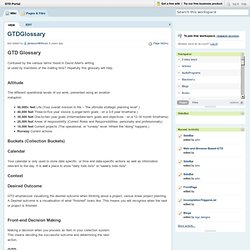
GTD Portal / GTDGlossary. Confused by the various terms found in David Allen's writing.
Getting Things Done. Sometimes the sheer weight of the "In" basket -- whether it is one with paper in it or electronic messages -- is enough to keep us from starting anything.
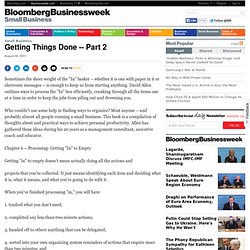
David Allen outlines ways to process the "In" box efficiently, cranking through all the items one at a time in order to keep the jobs from piling out and drowning you. Who couldn't use some help in finding ways to organize? Most anyone -- and probably almost all people running a small business. This book is a compilation of thoughts about and practical ways to achieve personal productivity. Getting Things Done. Who couldn't use some help in finding ways to have more energy, be more relaxed and get a lot more accomplished with much less effort?
Most anyone -- and probably almost all people running a small business. Allen recognizes that there is no single means of perfecting personal organization and productivity, but stresses that there are things we can do to facilitate them. This book is a compilation of thoughts about and practical ways to achieve personal productivity. Allen has gathered these ideas during his 20 years as a management consultant, executive coach and educator. Getting Things Done: The Art of Stress-Free Productivity Summary at WikiSum. Please enable JavaScript to view the <a href=" powered by Disqus.
</a> GTD® and Getting Things Done® are the registered trademarks of David Allen Company. For more than 20 years, David Allen has been a management consultant and executive coach. Allen’s first book Getting Things Done: The Art of Stress-Free Productivity, published in 2001, became a National Bestseller. Allen has been called a personal productivity guru whose work has been featured in Fast Company, Fortune, the Los Angeles Times, The New York Times, The Wall Street Journal, and other publications. תהליך רכישת עסק. מדוע הכרחי לערוך בדיקת נאותות של קניין רוחני (IP Due Diligence) בטרם השקעה. הקוריאנים » עשרת הדיברות במשא-ומתן עם קוריאנים (חלק ב')
INCOTERMS 2000 - Chart of Responsibility. This Chart is designed to provide a basic understanding of Incoterms 2010 Rules and Definitions.
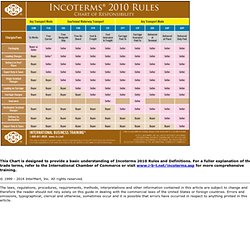
For a fuller explanation of the trade terms, refer to the International Chamber of Commerce or visit www.i-b-t.net/incoterms.asp for more comprehensive training. © 1999 - 2014 InterMart, Inc. All rights reserved. The laws, regulations, procedures, requirements, methods, interpretations and other information contained in this article are subject to change and therefore the reader should not rely solely on this guide in dealing with the commercial laws of the United States or foreign countries. Arbitration. Established in 1923 as ICC’s arbitration body, the International Court of Arbitration pioneered international commercial arbitration as it is known today, initiating and leading the movement that culminated in the adoption of the New York Convention, the most important multilateral treaty on international arbitration.
The Court has also developed resolution mechanisms specifically conceived for business disputes in an international context. טכניקות ורעיונות בניהול - ניהול יעיל - עצות וטיפים למנהלים. Heartsell. Meet the Life Hackers. ClearContext for Microsoft Outlook - make your Inbox useful again. Getting Things Done. The GTD method rests on the idea of moving planned tasks and projects out of the mind by recording them externally and then breaking them into actionable work items.
This allows attention to be focused on taking action on tasks, instead of recalling them.[2] First published in 2001, a revised edition of the book was released in 2015 to reflect the changes in information technology during the preceding decade. Themes[edit] View topic - GTD USERS Start Here. Craig: Thanks for your comments. Getting Things Done - הבלוג של ELearn. Lifehacker, tips and downloads for getting things done.