Liber ThIShARB sub figura CMXIII. Liber II, The Message of the Master Therion. “Do what thou wilt shall be the whole of the Law.”

“There is no Law beyond Do what thou wilt.” “The word of the Law is Θελημα.” Θελημα—Thelema—means Will. The Key to this Message is this word—Will. The first obvious meaning of this Law is confirmed by antithesis; “The word of Sin is Restriction.” Again: “Thou hast no right but to do thy will. Take this carefully; it seems to imply a theory that if every man and every woman did his and her will—the true will—there would be no clashing. From these considerations it should be clear that “Do what thou wilt” does not mean “Do what you like.” Do what thou wilt—then do nothing else. Note further that this will is not only to be pure, that is, single, as explained above, but also “unassuaged of purpose.” But the phrase may also be interpreted as if it read “with purpose unassuaged”—i.e., with tireless energy. Thou must (1) Find out what is thy Will. (2) Do that Will with a) one-pointedness, (b) detachment, (c) peace.
The Libri of Aleister Crowley. Aleister Crowley (Oct. 12, 1875–Dec. 1, 1947) – however one judges him – was a fascinating man who lived an amazing life.
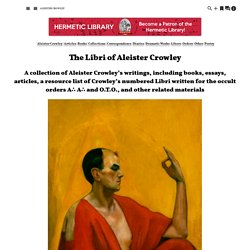
He is best known as being an infamous occultist and the scribe of The Book of the Law, which introduced Thelema to the world. Crowley was an influential member in several occult organizations, including the Golden Dawn, the A∴A∴, and Ordo Templi Orientis. He was a prolific writer and poet, a world traveler, mountaineer, chess master, artist, yogi, social provocateur, drug addict and sexual libertine. The press loved to demonize him and dubbed Crowley “The wickedest man in the world.” — From “Aleister Crowley” on Thelemapedia See also: Θέλημα – Thelema There are so many documents on the site related to the Thelema of Aleister Crowley that it can sometimes be difficult to know where to start, so here are a few first steps. Khaos. The general public is usually familiar mostly with the so called Olympian gods and goddesses along with a few others, but the Greek pantheon includes also other lessed known deities.

Some of them were "lesser know" for even the ancient Greek, as there wasn't proper cult or organized worshipping connected to these deities. One of these is Khaos (Chaos). There's rather little information available in our time about Khaos, considering her part in the birth of the world and other deities in the Greek mythology. The earliest written references on Khaos can be found in the book "Theogony" by Hesiod, who lived in the 700's before common era. In Theogony, Hesiod describes the birth of the world and the Gods, as well as Greek mythology. The word "Khaos" means space, gap, darkness and void, referring to Khaos as that which is between heaven and earth. When the world begun, Khaos was there. There are few mentions of Khaos in addition to her role in the birth of the world. What about Khaos today?