
Gladys C. sur Twitter : "#Science as #Social #Enterprise: Jefferson on protecting the public #commons. INNOV0104_pp13-44_innovations-in-practice_jefferson.pdf. Principles of Biological Anthropology. Sourcemap: Slick App for Tracking the Supply Chain for Your Laptop (or Tuna or Nutella) Science in the Open. The Learning Paradox. The Prozac Yogurt Effect: How Hype Can Affect the Future of Science. Download The Universe. Download the Universe Right Here: A New Site for Science E-Book Reviews. Search for stories by hashtag, add comments from Google+, and other things you didn't know you could do with Storify · storify.
The Science Journalist Online: Shifting Roles and Emerging Practices. Science journalists in the US and UK face unique pressures adapting to the social and participatory nature of online news, to economic conditions that force them to fill a diversity of roles in the newsroom, and to the many hats they must wear if they are to survive as freelancers.
As a consequence, science journalists in writing for online media have shifted away from their traditional role as privileged conveyors of scientific findings to a diversity of roles as curators, conveners, public intellectuals and civic educators, roles that are underwritten by the essential skills of criticism, synthesis and analysis.
These online science journalists have a more collaborative relationship with their audiences and sources and are generally adopting a more critical and interpretative stance towards the scientific community, industry, and policy-oriented organizations. Fahy writes about the study in an article appearing later today at the Columbia Journalism Review. Reading List for Course on Science and Environmental Communication. This semester, students from a diversity of majors at American University are participating in an advanced seminar I am teaching on science and environmental communication.

For the first part of the semester, we are covering core issues and themes. In the process, students will be blogging on related selected topics while finalizing their research paper topic. In the second half of the semester, readings and blogging will focus on specific issues of interest to the students, as determined by a class survey. Topics may include climate and energy; industrial farming and the food system; biomedical and stem cell research; and women’s health and reproductive rights.
Below I have pasted the assigned readings for the first half of the semester with links to the full text of each article if available. Wynne, B. (2009). Brossard, D., & Lewenstein, B. 7 Tools Students Can Use to Manage Group Projects. Any teacher who has assigned group projects to students has at some point had to help those students organize and equitably distribute work.
(Or has had to listen to students complaints about other group members not pulling their weight). Here are some tools that you can have students use to manage their responsibilities when working on group projects. Pegby is a good website for organizing the tasks that you and or your team need to get done. Blogging in the undergraduate science classroom. At ScienceOnline2012, Jason Goldman and John Hawks organized a roundtable discussion of “best practices” for incorporating blogs into undergraduate courses.
Participants discussed their experiences and gathered suggestions from each other; the benefits of blogging were briefly discussed, but seemed frankly evident to the attendees. For example, if you assign students to write publicly, their parents can read what they’ve written, which is an incentive for quality work. This discussion traded ideas to facilitate student blogging.
Here are some of my notes. For some students, blogging is completely foreign – they don’t read blogs or are intimidated and don’t want to speak out. This discussion went well beyond blogging to other social media and gave examples of using Twitter in the classroom or to collect field research. Several other sessions at this conference discussed the benefits of students communicating online about science. 那些年我们一起追得女孩. Safe cycling on Singapore’s roads. Key concept for safer cycling in Singapore: Remember you are invisible to cars.
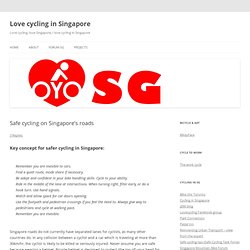
Find a quiet route, mode share if necessary. Be adept and confident in your bike handling skills. The Power of Introverts: A Manifesto for Quiet Brilliance. Do you enjoy having time to yourself, but always feel a little guilty about it?

Then Susan Cain’s “Quiet : The Power of Introverts” is for you. It’s part book, part manifesto. We live in a nation that values its extroverts – the outgoing, the lovers of crowds – but not the quiet types who change the world. She recently answered questions from Mind Matters editor Gareth Cook. Some Help when googling. Literature Reviews - Summarising. Summarising your research Research and literature review can throw up a wealth of information and references from which one could fill a whole essay with quote after quote.
It is notoriously difficult, having gathered the best of this wealth of information to filter it in order of what is essential information, what is peripheral and what is largely irrelevant (Fink, 2005). The secret to successful research and review is hitting upon the salient points, the points that were the foundations or will represent the way forward in your area of study, that are going to become the bench marks of the future. You have already chosen the reference points that will form the basis of your essay and have written your piece. Www.jvank.nl/PP/down/HandoutSysRevn.pdf. Library.stkate.edu/pdf/litreview.pdf. Very Fine Commentary. 9 Useful Tools to Get The Best Experience Out Of GrooveShark. Grooveshark needs no recommendation.
It is the best online music service out there. It is your one-stop music hangout where you can search for, stream, and upload music that can be played immediately or added to a playlist. It also comes with a recommendation engine where you can find the popular songs other people are listening. By default, Grooveshark is only accessible via a browser. A conversation on TED.com: How can the travel and tourism industry catalyze conservation? Translated phrase-list jokes. « previous post | next post » An amusing "Anglo-EU Translation Guide" has been circulating widely in recent weeks.
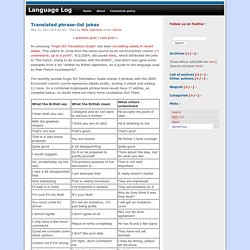
This seems to come from the same source as an old Economist column ("I understand, up to a point", 9/2/2004; discussed here), which attributed the joke to "the Dutch, trying to do business with the British", and which also gave some examples from a list "written by British diplomats, as a guide to the language used by their French counterparts". The recently-posted Anglo-EU Translation Guide shares 3 phrases with the 2004 Economist column (some expressive details aside), lacking 2 others and adding 12 more. Twitter.