
Rio+20: Why ‘sustainability’ must include ecology. Hello there!

If you enjoy the content on PLOS Biologue, consider subscribing for future posts via email or RSS feed. One of the reasons we publish more accessible magazine-like articles in the front section of PLoS Biology is to raise awareness about issues that are important both to practicing scientists and to the wider public. As an open access journal, we can reach communities and organisations that don’t have access to the pay-walled literature, and they in turn can redistribute and reuse these articles without permission from us or the authors. The articles we published yesterday in our front section provide a case in point. In Rio de Janeiro this week, world leaders meet for the Rio+20 UN Conference on Sustainable Development to ”shape how we can reduce poverty, advance social equity and ensure environmental protection”.
Is Homosexuality Natural? Yes. So is male lactation. As Gwenn Seemel points out in her richly illustrated book, Crime Against Nature, the non-human animal kingdom is chock-full of examples that challenge many of our deeply held beliefs about what is "natural" behavior in everything from sexual preference to lifestyle choices to gender roles and even gender identity.

She Wears the Pants (Spotted Hyena) by Gwenn Seemel What really happened when Nemo’s mother died (Clownfish) by Gwenn Seemel. Trichodesmium: Linking intracellular stoichiometry to environmental forcing. E. O. Wilson Biodiversity Foundation. Synaptic neuropeptide release induced by octopamine without Ca2+ entry into the nerve terminal. Author Affiliations Edited by Eve Marder, Brandeis University, Waltham, MA, and approved February 4, 2011 (received for review December 1, 2010) Abstract Synaptic release of neurotransmitters is evoked by activity-dependent Ca2+ entry into the nerve terminal.

However, here it is shown that robust synaptic neuropeptide release from Drosophila motoneurons is evoked in the absence of extracellular Ca2+ by octopamine, the arthropod homolog to norepinephrine. Genetic and pharmacology experiments demonstrate that this surprising peptidergic transmission requires cAMP-dependent protein kinase, with only a minor contribution of exchange protein activated by cAMP (epac). Neuromodulators induce presynaptic signaling to regulate fast neurotransmission triggered by activity-induced Ca2+ entry into the nerve terminal.
With this background in mind, we set out to study regulation of neuropeptide release at the Drosophila neuromuscular junction (NMJ) by octopamine-induced cAMP signaling. Results. Animal Biology. Eebweb.arizona.edu/courses/ecol320/BirkyLectures/Sect13.MendGen2Probability.pdf. Www.pearsonhighered.com/samplechapter/0132241277.pdf. Images.maui090491.multiply.multiplycontent.com/attachment/0/SyxRAQooCI4AAGJwJXc1/Lecture 3 - Mendelian Genetics.pdf?key=maui090491:journal:43&nmid=304876944. The Sea Shore - FSC (Field Studies Council) Chi-squared test There are numerous uses for this test.

Our example shows its use in the simplest way possible. All chi-squared tests are concerned with counts of things (frequencies) that you can put into categories. For example, you might be investigating flower colour and have frequencies of red flowers and white flowers. Or you might be investigating human health and have frequencies of smokers and non-smokers. The test looks at the frequencies you obtained and compares them with the frequencies you might expect given your null hypothesis.
There is no significant difference between the observed and expected frequencies The only difficult part of a chi-squared test is working out what the expected values are. Let us surmise that you have been wandering about on a seashore and you have noticed that a small snail (the flat periwinkle) seems to live only on seaweeds of various kinds. Chi Square Statistics. Types of Data: There are basically two types of random variables and they yield two types of data: numerical and categorical.
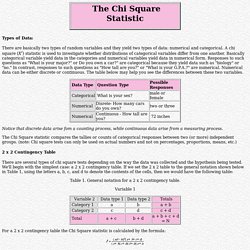
A chi square (X2) statistic is used to investigate whether distributions of categorical variables differ from one another. Basically categorical variable yield data in the categories and numerical variables yield data in numerical form. Responses to such questions as "What is your major? " or Do you own a car? " Notice that discrete data arise fom a counting process, while continuous data arise from a measuring process. The Chi Square statistic compares the tallies or counts of categorical responses between two (or more) independent groups. 2 x 2 Contingency Table There are several types of chi square tests depending on the way the data was collected and the hypothesis being tested.
Ultrastructure of the Cell (Electron Micrographs) Courses.washington.edu/conj/cell/cell.htm. Below are several electron micrographs that will help you review the lab material at home.

But please note that these are just to jog your memory. The questions on the lab quiz will be from the actual electron micrographs and probably won't be the same as those shown below. You will want to develop the skills to recognize the structures in general. As you observe each cell structure, be sure you can recall its general structure and function. When you begin with a micrograph, first look for clues to help you grasp the level of magnification. This first image shows the double walled nuclear envelope and rough endoplasmic reticulum with ribosomes. The next image shows a cell that has very nearly finished dividing into two daughter cells. Now observe a higher power view from the same micrograph that compares microtubules and microfilaments. The next image is hard to visualize because it is a slice that just "grazes" the nuclear envelope.
Www.biologymad.com/resources/Ch 1 - Cells.pdf. Prokaryotic and Eukaryotic Cells. As you have already learned, everything that lives is made up of cells.

And the cells themselves are made up of many different parts – right down to their molecules. In fact, what scientists call “the universal principle of life” is defined as the specific interaction of molecules with one another. Ultrastructure. All living things are made of cells, and cells are the smallest units that can be alive.

Life on Earth is classified into five kingdoms, and they each have their own characteristic kind of cell. However the biggest division is between the cells of the prokaryote kingdom (the bacteria) and those of the other four kingdoms (animals, plants, fungi and protoctista), which are all eukaryotic cells. Prokaryotic cells are smaller and simpler than eukaryotic cells, and do not have a nucleus. Prokaryote = "before carrier bag" i.e. without a nucleus Eukaryote = "good carrier bag" i.e. with a nucleus We'll examine these two kinds of cell in detail, based on structures seen in electron micrographs (photos taken with an electron microscope). Www.as.ysu.edu/~crcooper/3702Ch4(F07).pdf. Cell Notes.