How we change what others think, believe, feel and do. The Six Best Ways to Decrease Your Anxiety. We all know the uncomfortable feeling of anxiety. Our hearts race, our fingers sweat, and our breathing gets shallow and labored. We experience racing thoughts about a perceived threat that we think is too much to handle. That's because our "fight or flight" response has kicked in, resulting in sympathetic arousal and a narrowing of attention and focus on avoiding the threat. We seem to be locked in that state, unable to focus on our daily chores or longer-term goals . As a Cognitive-Behavior Therapist with more than 15 years of experience, I have found a variety of techniques that I can teach my patients with anxiety disorders such as phobias, panic attacks, or chronic worry. 15 Styles of Distorted Thinking.
Dunning–Kruger effect. Cognitive bias about one's own skill The Dunning–Kruger effect is a hypothetical cognitive bias stating that people with low ability at a task overestimate their own ability, and that people with high ability at a task underestimate their own ability.
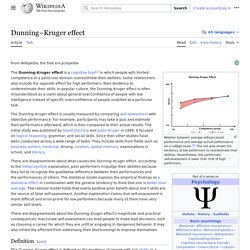
As described by social psychologists David Dunning and Justin Kruger, the bias results from an internal illusion in people of low ability and from an external misperception in people of high ability; that is, "the miscalibration of the incompetent stems from an error about the self, whereas the miscalibration of the highly competent stems from an error about others".[1] It is related to the cognitive bias of illusory superiority and comes from people's inability to recognize their lack of ability.
Without the self-awareness of metacognition, people cannot objectively evaluate their level of competence.