
100 Ways to Teach with Twitter. Center for History and New Media » Research + Tools. Omeka Designed for cultural institutions, enthusiasts, and educators, Omeka is a platform for publishing online collections and exhibitions.
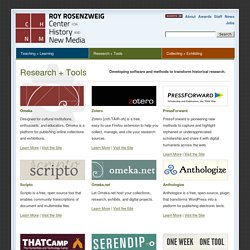
Learn More | Visit the Site Zotero Zotero [zoh-TAIR-oh] is a free, easy-to-use Firefox extension to help you collect, manage, and cite your research sources. Learn More | Visit the Site PressForward PressForward is pioneering new methods to capture and highlight orphaned or underappreciated scholarship and share it with digital humanists across the web. Learn More | Visit the Site Scripto Scripto is a free, open source tool that enables community transcriptions of document and multimedia files. Learn More | Visit the Site Omeka.net Let Omeka.net host your collections, research, exhibits, and digital projects. Learn More | Visit the Site Anthologize Anthologize is a free, open-source, plugin that transforms WordPress into a platform for publishing electronic texts. Learn More | Visit the Site THATCamp Learn More | Visit the Site Serendip-o-matic One Week One Tool.
Can Professors Teach Open Source? At teachingopensource.org, we think so, and we wrote a book to help.

The following excerpt comes from the Foreword of our new textbook, Practical Open Source Software Exploration, which is licensed under Creative Commons BY-SA-3.0. It's a book that works like an open source software project. In other words: patches welcome. In March 2006, David A. Patterson wrote an article entitled "Computer science education in the 21st century. " One might think that such a clarion call, made by someone of such obvious influence, would generate a groundswell of enthusiasm. It's a little more complicated than that. We've spent a lot of time over the past few years talking to computer science professors. Do you use open source software in your classes? For these last two, the follow-up question is, invariably, "why not? " And the answer is, invariably, "because it's hard. " There are good reasons why professors don't teach the practice of open source. So why bother? What is the Future of Teaching?
According to the New York Times Bits blog, a recent study funded by the US Department of Education (PDF) found that on the whole, online learning environments actually led to higher tested performance than face-to-face learning environments.

"On average, students in online learning conditions performed better than those receiving face-to-face instruction," concluded the report's authors in their key findings. The report looked at just under one hundred studies that compared the performance of students in online learning environments (or courses with an online study component) to those who were given strictly face-to-face instruction for the same courses. What they found was that students who completed all or some of their coursework online tested on average in the 59th percentile, compared to the 50th percentile for those who received only classroom instruction, and that the results are statistically significant. Online Education on the Horizon In other words: all things are not equal.