
On Behance. Macropinna microstoma - Google Search. FLRN GIF: Archive. Window Well (12/12) Surface detail on Vimeo. Tesseract - Wikipedia, the free encyclopedia. A generalization of the cube to dimensions greater than three is called a "hypercube", "n-cube" or "measure polytope".[1] The tesseract is the four-dimensional hypercube, or 4-cube.
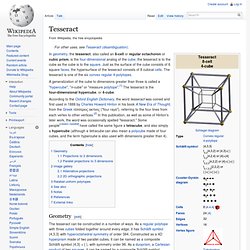
According to the Oxford English Dictionary, the word tesseract was coined and first used in 1888 by Charles Howard Hinton in his book A New Era of Thought, from the Greek τέσσερεις ακτίνες ("four rays"), referring to the four lines from each vertex to other vertices.[2] In this publication, as well as some of Hinton's later work, the word was occasionally spelled "tessaract. " Some people[citation needed] have called the same figure a tetracube, and also simply a hypercube (although a tetracube can also mean a polycube made of four cubes, and the term hypercube is also used with dimensions greater than 4). Geometry[edit] Earth’s Most Stunning Natural Fractal Patterns. IDL TIFF fileFrom sea shells and spiral galaxies to the structure of human lungs, the patterns of chaos are all around us.Fractals are patterns formed from chaotic equations and contain self-similar patterns of complexity increasing with magnification.
If you divide a fractal pattern into parts you get a nearly identical reduced-size copy of the whole.The mathematical beauty of fractals is that infinite complexity is formed with relatively simple equations. By iterating or repeating fractal-generating equations many times, random outputs create beautiful patterns that are unique, yet recognizable.We have pulled together some of the most stunning natural examples we could find of fractals on our planet.Above: Romanesco BroccoliThis variant form of cauliflower is the ultimate fractal vegetable. LOS FRACTALES EN LA NATURALEZA - Google Search. LA NOSTALGIA Y EL RECUERDO: LA BELLEZA DE LOS FRACTALES. Ben-Jacob, el pintor de bacterias. Brillo box.
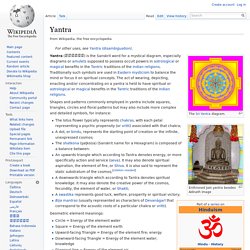
Beautiful/Decay Cult of the Creative Arts. Yantra. Enthroned Jain yantra besides Adinath image Shapes and patterns commonly employed in yantra include squares, triangles, circles and floral patterns but may also include more complex and detailed symbols, for instance: Geometric element meanings: Circle = Energy of the element waterSquare = Energy of the element earthUpward-facing Triangle = Energy of the element fire; energyDownward-facing Triangle = Energy of the element water; knowledgeDiagonal line = Energy of the element airHorizontal line = Energy of the element waterVertical line = Energy of the element firePoint = Energy of the element ether As an astrological device[edit]
Home. Running in Place Art Print by Jazzberry Blue. Imagenes.
Ciencia visual. Down http. Pinterest. Poesia visual.