The Method Case. Openp2pdesign.org. Designing for Growth. PhD thesis - Conoscenza progettuale collaborativa. IDESiGN. 25 MODI PER PIANTARE UN CHIODO - MARI ENZO. Enzo Mari, autobiografia ” 25 modi per piantare un chiodo”
The TRIZ Give Way to the Wind, and Give the Wind Away A Repeatable Process for Improving Sustainable Wind Energy Generation. "ТРИЗ-Конференция - 2007" Список участников и тематика выступлений Author Isak Bukhman, TRIZ Master Abstract Given the fast growing population and the ever increasing consumption of resources it is imperative that breakthrough innovations make alternative energy sources more commercially viable.
Wind turbines represent an attractive source of sustainable and environmentally friendly energy. Using the improvement of Wind Turbine Development as a case study, this presentation focuses on a proven and repeatable process that overcomes common TRIZ deployment challenges by showing a workflow and methodology for how to get started working on a problem with TRIZ, how to compliment TRIZ with Value Methodologies for problem identification, and how to leverage internal and external knowledge sources to accelerate concept identification. Analysing Design Activity (9780471960607): Nigel Cross, Henri Christiaans, Kees Dorst. The R. Buckminster Fuller FAQ: Synergetics. NextPreviousContents 2.
Synergetics In its broadest sense synergetics is Fuller's hypothesized coordinate system of Universe --- both in its physical and metaphysical aspects. Fuller's system of epistemography and mathematical-physics attempts to disclose how Nature actually operates --- her ``operational mathematics.'' Fuller claimed that synergetics could be understood by children (though they probably couldn't comprehend his books on the subject).
From my own study of synergetics, I'm convinced that Bucky did in fact identify the coordinate system used by Nature. Tip to students of synergetics: Build models. Interview with Karim Rashid. Karim Rashid is one of the most prolific designers today. He has over 3000 products in production, countless awards and an ever growing list of collaborations; exhibitions, restaurants, banks, automative and electronic companies to name a few. He is an enigmatic designer with accessible taste. That’s a rare and precious combination. ABC Nightline - IDEO Shopping Cart. ISOform Hexome : Modular Shelter and Housing Solution. ISOphonix in cooperation with ArteCOOP present the ISOform Hexome sustainable shelter and modular housing solution, using an new emission free Structural Insulated Panel (SIP).
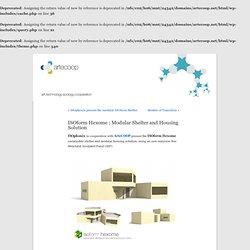
The ISOform Hexome is modular format for housing and shelter using a natural honeycomb design principal. The basic building material is the ISOphonix SIP, built into ISOform Hex units. These units are then combined and stacked in any number of ways to form shelters, houses, communal buildings, even entire communities and towns. The ISOform Hex unit has been designed specifically for application within third world countries to enhance general living standards, and to provide a mechanism for fast deployment in times of emergency, war and natural disasters; lightweight flat-pack design, modular implementation, ease of construction, cost, re-use and re-location are of primary concern.
The basic ISOform Hex unit has a 7.2m diameter footprint, with options for access doorways and various window configurations. Evolutive experience design, innovazione e strategia. EVO – Evolutive Experience Design. L’origine Negli ultimi anni abbiamo applicato costantemente su più di 100 progetti i processi e i metodi dello User Centered Design e dell’ Agile Design; questi permettono la progettazione e la realizzazione di prodotti e servizi digitali di ottima qualità garantendo un controllo sul processo di sviluppo, ma allo stesso tempo li abbiamo trovati sempre troppo lenti o inadatti a creare esperienze digitali che si possano definire di successo.
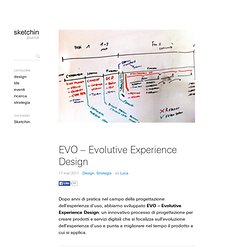
Questi processi e metodi si concentrano sul rilascio di una prima versione di qualità del prodotto o del servizio (il delivery), ignorando le potenzialità che quello stesso prodotto potrebbe avere se si trasformasse secondo le evoluzioni del mercato e i bisogni degli utenti nel tempo. Infatti, oggi, i prodotti e i servizi digitali di successo sono quelli che riescono ad evolvere costantemente l’esperienza offerta nei confronti dell’utilizzatore finale.
«Più smartphone che computer: cambiano i linguaggi digitali» L'ingegnere e psicologo A MILANO «Più smartphone che computer: cambiano i linguaggi digitali» Donald A.
Norman presenta «Vivere con la complessità»: «Dobbiamo essere comprensibili, non semplici» Just Creative Design - Graphic Designer, Logo & Brand Identity Specialist. Living with Complexity: Amazon.it: Donald A. Norman: Libri in altre lingue. Don Norman on 3 ways good design makes you happy. Don Norman Said that a Translational Bridge is Needed Between Design Thinking and Design Doing. Don Norman at IIT Design Research Conference 2010. Table of Contents. Design Patterns. Design Patterns. Design_Methods_ChartComplete.jpg (1600×951) Design methods. This guide is for anyone who wants to understand the methods designers use and try them out for themselves.
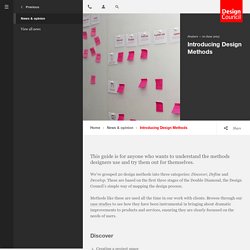
We’ve grouped 20 design methods into three categories: Discover, Define and Develop. These are based on the first three stages of the Double Diamond, the Design Council’s simple way of mapping the design process. Methods like these are used all the time in our work with clients. Browse through our case studies to see how they have been instrumental in bringing about dramatic improvements to products and services, ensuring they are clearly focussed on the needs of users. Discover Creating a project space Observation User diaries Being your users Brainstormin Fast visualization Choosing a sample Quantitative surveys Secondary research Hopes and fears Define Assessment criteria Comparing notes Drivers and hurdles Focus groups Customer journey mapping Develop Character profiles Scenarios Role playing Blueprinting Physical prototyping 1.
What is it? What is it useful for? How can I do it? 2. 3. Service Design - DesignThinkers Weblog - Opus.bath.ac.uk/12286/1/Howard_PHD.pdf. Innovation Pills. C-K Theory Presentation. Open Innovate, Science and Business. Professor John S. Gero. Research Areas Design Cognition Cognitive studies of designing: protocol studies of designing; cognitive studies of design education, role of drawings in designing more Cognitive neuroscience of designing: the behaviour of the brain while designing more.