
Another giant UK ash cloud 'unlikely' in our lifetimes. 12 August 2011Last updated at 13:35 By Hamish Pritchard Science Reporter The study has compiled a record of volcanic ash and debris that stretches back 7,000 years The UK is unlikely to see another giant volcanic ash cloud in this lifetime, according to a new study.

The 2010 cloud cost European businesses more than £2bn and a smaller eruption this spring caused more anxiety. But analysis of a record of such clouds stretching back into prehistory across northern Europe showed big ash clouds of the type seen in 2010 occurred on average only every 56 years. The report has been published in the journal Geology. While some ash clouds were witnessed and recorded by writers and artists through history, no such evidence exists from before AD1600. Fortunately, a detailed 7,000 year record is preserved in peat bogs and lake beds in the form of microscopic layers of volcanic material, including ash, called tephra. 'Pretty resilient' The 2011 Grimsvotn eruption sparked fears of frequent ash disruptions.
Prehistoric Time Line, Geologic Time Scale, Photos, Facts, Maps, and ... Mo se formou UK. By Claire Bates Updated: 15:56 GMT, 30 November 2009 A prehistoric 'super-river' is the reason why Britain became an island and was cut off from Europe.
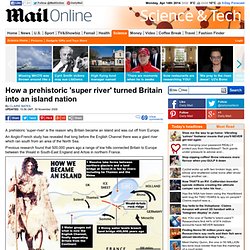
An Anglo-French study has revealed that long before the English Channel there was a giant river which ran south from an area of the North Sea. Previous research found that 500,000 years ago a range of low hills connected Britain to Europe between the Weald in South-East England and Artois in northern France. Enlarge But during a series of ice ages beginning 450,000 years ago huge ice sheets covered much of northern Europe, trapping a portion of the North Sea the size of East Anglia. The great rivers of Europe poured into this lake at the southern end of the North Sea.
To the north it was bordered by glaciers and to the south by the low-lying land mass connecting Britain to France. Glacial water tumbling down from the North Sea drove through the chalky rock separating what would become England and France. The eruption that changed Iceland forever. Volcanic ash has halted all UK flights and many in Europe A volcanic eruption in Iceland is continuing to ground flights in the UK and Europe, but 227 years ago a far more devastating eruption occurred wiping out a fifth of the island's population - as well as tens of thousands across Europe.

On 8 June, 1783, the young country of Iceland - inhabited for less than 1,000 years - had a population of 50,000. In the coming years, as a result of what began that Sunday morning at 9am, 10,000 of those people would die. The Laki eruption is the worst catastrophe in the country's relatively short history. Laki is a volcanic system in the same south-eastern part of Iceland where this week's eruption took place. Back in 1783 it was ripped open with such force that a huge fissure produced scores of boiling craters.