
Ice Robot Comes To Life - By J.A.M.I.E. Bardo Thodol. Révolution Française - La Chute du Roi Louis XVI. Photo Booth: Occupying Wall Street in 1967. “The next target is Wall Street,” an anarchist collective known as Black Mask wrote in its January newsletter, 1967.
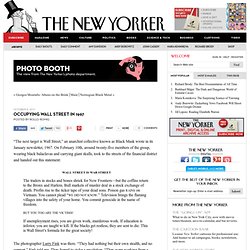
On February 10th, around twenty-five members of the group, wearing black balaclavas and carrying giant skulls, took to the streets of the financial district and handed out this statement: WALL STREET IS WAR STREET The traders in stocks and bones shriek for New Frontiers—but the coffins return to the Bronx and Harlem. Bull markets of murder deal in a stock exchange of death. Oligarchie. Un article de Wikipédia, l'encyclopédie libre.
Une oligarchie (du grec ancien ὀλιγαρχία / oligarkhía, dérivé de ὀλίγος / olígos (« petit », « peu nombreux »), et ἄρχω / árkhô (« commander »)) est une forme de gouvernement où le pouvoir est réservé à un petit groupe de personnes qui forment une classe dominante[1]. On peut distinguer les oligarchies institutionnelles et les oligarchies de fait. Les oligarchies institutionnelles sont les régimes politiques dont les constitutions et les lois ne réservent le pouvoir qu'à une minorité de citoyens.
Les oligarchies de fait sont les sociétés dont le gouvernement est constitutionnellement et démocratiquement ouvert à tous les citoyens mais où en fait ce pouvoir est confisqué par une petite partie de ceux-ci. L'oligarchie dans l'histoire[modifier | modifier le code] Ploutocratie. Un article de Wikipédia, l'encyclopédie libre.
La ploutocratie (du grec ploutos : richesse ; kratos : pouvoir) consiste en un système de gouvernement où l'argent constitue la base principale du pouvoir[1]. Définition[modifier | modifier le code] La ploutocratie est un régime politique où les plus riches sont au pouvoir. C'est un régime proche de l'oligarchie mais qui a pour particularité de sélectionner les rares décideurs sur le seul critère de leur richesse. Oligarchy. Oligarchy (from Greek ὀλιγαρχία (oligarkhía); from ὀλίγος (olígos), meaning "few", and ἄρχω (arkho), meaning "to rule or to command")[1][2][3] is a form of power structure in which power effectively rests with a small number of people.
These people could be distinguished by royalty, wealth, family ties, education, corporate, or military control. Such states are often controlled by a few prominent families who typically pass their influence from one generation to the next, but inheritance is not a necessary condition for the application of this term. Throughout history, oligarchies have been tyrannical (relying on public obedience and/or oppression to exist) or relatively benign. Aristotle pioneered the use of the term as a synonym for rule by the rich,[4] for which the exact term is plutocracy. However, oligarchy is not always a rule by wealth, as oligarchs can simply be a privileged group, and do not have to be connected by bloodlines as in a monarchy. Tabou. Un article de Wikipédia, l'encyclopédie libre.
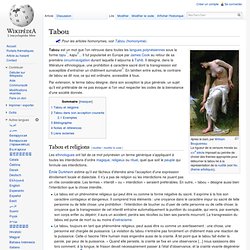
Tabou est un mot que l'on retrouve dans toutes les langues polynésiennes sous la forme tapu[1], kapu[2]... Il fut popularisé en Europe par James Cook au retour de sa première circumnavigation durant laquelle il séjourna à Tahiti. Il désigne, dans la littérature ethnologique, une prohibition à caractère sacré dont la transgression est susceptible d'entraîner un châtiment surnaturel[3]. En tahitien entre autres, le contraire de tabou se dit noa, ce qui est ordinaire, accessible à tous. Par extension, le terme tabou désigne, dans son acception la plus générale, un sujet qu'il est préférable de ne pas évoquer si l'on veut respecter les codes de la bienséance d'une société donnée. Lysistrata. Un article de Wikipédia, l'encyclopédie libre.
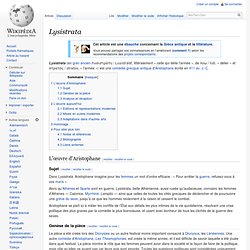
Lysistrata (en grec ancien Λυσιστράτη / Lusistrátê, littéralement « celle qui délie l'armée », de λύω / lúô, « délier » et στρατός / stratos, « l'armée ») est une comédie grecque antique d'Aristophane écrite en 411 av. Lysistrata. Omertà (loi du silence) Un article de Wikipédia, l'encyclopédie libre.
Pour les articles homonymes, voir Omerta. L'omertà est un vocable sicilien propre au champ lexical de la mafia. On le traduit généralement par "loi du silence". La loi du silence est la règle tacite imposée par les mafieux dans le cadre de leurs affaires criminelles [1], cela implique la non-dénonciation de crimes, le faux-témoignage etc. Elle s'impose non seulement aux mafieux eux-mêmes, mais aussi à tous ceux qui seraient susceptibles de témoigner contre eux en justice. Omerta vient de omo qui veut dire « homme » et umirta qui est la contraction de umilita qui veut dire « humilité »[2]. Les mafieux respectent cette loi non-écrite, tacite, car ils sont bien conscients que si l'un d'eux la bafoue pour compromettre un clan ennemi, ce même ennemi est capable d'en faire autant… autrement dit, pour éviter son auto-destruction, la mafia s'impose cette règle qui a été bien respectée jusqu'à présent (à l'exception de quelques repentis).