
The Node Beginner Book » A comprehensive Node.js tutorial. A Beginner’s Tutorial for Node.js : Project 70. I’ve been spending some time learning Node.js.
Since there isn’t a clear definitive guide out there, I decided to put together a some of the best online resources I’ve found. The goal of this tutorial is to bring a beginner fully up to speed with Node. At the end you will understand Node’s eventing model and be able to create a site using the most popular modules and frameworks. It should take about 4 to 5 hours total. Prerequisites: some knowledge of javascript in particular and web programming in general. Background For those of you unfamiliar with it, Node is a server-side javascript framework for building scalable web apps. Getting Started I’ve found that the most important thing for understanding Node is to realize it initially places an additional burden on the programmer.
In Node, the entire server has one single thread, so now your code must play nice. The Basics (1 – 2 hours) Node.js. Node.js is an open source, cross-platform runtime environment for server-side and networking applications.
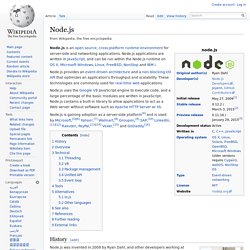
Node.js applications are written in JavaScript, and can be run within the Node.js runtime on OS X, Microsoft Windows, Linux, FreeBSD, NonStop and IBM i. Node.js provides an event-driven architecture and a non-blocking I/O API that optimizes an application's throughput and scalability. These technologies are commonly used for real-time web applications. Node.js is gaining adoption as a server-side platform[4] and is used by Microsoft,[5][6] Yahoo! ,[7] Walmart,[8] Groupon,[9] SAP,[10] LinkedIn,[11][12] Rakuten, PayPal,[13][14] Voxer,[15] and GoDaddy.[16] History[edit]
How it Works. Build an iOS slideshow application for the iPad. Introduction It's no mystery why writing applications for an iOS device, such as the iPad or iPhone, is a very popular activity: The devices are gorgeous and easy to use.
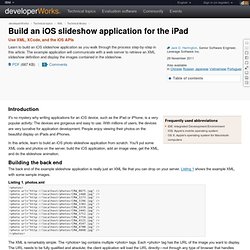
With millions of users, the devices are very lucrative for application development. People enjoy viewing their photos on the beautiful display on iPads and iPhones. In this article, learn to build an iOS photo slideshow application from scratch. The Best Way to Learn PHP. Learning something from scratch is almost always an arduous affair -- you simply have no idea as to where to start, or not to start, to kick things off.
I loathed learning about the idiosyncrasies of C++'s syntax when all I wanted to learn were some darn programming concepts. As I'm sure you can agree, this is a less than ideal situation. This is where the Nettuts+ "The Best Way to Learn" series comes into the picture. This series is intended to be your blueprint, your road map, your plan of action for learning your topic of choice! You don't have to worry about finding the best resources, sorting out the bad ones, and figuring out what to learn next. Today, we're going to figure out the best way to learn PHP. Assignment #1: Disregard the Naysayers. 编程之美 - flyinghearts. Start Using HTML5 WebSockets Today. One of the coolest new features of HTML5 is WebSockets, which let us talk to the server without using AJAX requests.

In this tutorial, we'll review the process of running a WebSocket server in PHP, and then building a client to send and receive messages to it over the WebSocket protocol. What are WebSockets? WebSockets is a technique for two-way communication over one (TCP) socket, a type of PUSH technology. At the moment, it's still being standardized by the W3C; however, the latest versions of Chrome and Safari have support for WebSockets. What do WebSockets Replace? 4.5 Series. CSDN.NET - 全球最大中文IT社区,为IT专业技术人员提供最全面的信息传播和服务平台. Essential Best Practices And Guidelines That Every Web Developer Should Know About. Tutorials are very useful but they are only teach you basic stuff so if you are a newbie, there’s a high probability that you will run into problems because a learning article won’t tell you details about real life scenarios, optimization problems or solutions to common issues.
For all of these you need to read guidelines or “best practices” articles because that’s how you will be able to write efficient code. Best Practices for a Faster Web App with HTML5 Excerpt: 20 Database Design Best Practices. Apache Hadoop Data Processing. Doug Cutting, Cloudera's Chief Architect, helped create Apache Hadoop out of necessity as data from the web exploded, and grew far beyond the ability of traditional systems to handle it.

Hadoop was initially inspired by papers published by Google outlining its approach to handling an avalanche of data, and has since become the de facto standard for storing, processing and analyzing hundreds of terabytes, and even petabytes of data. Apache Hadoop is 100% open source, and pioneered a fundamentally new way of storing and processing data. Instead of relying on expensive, proprietary hardware and different systems to store and process data, Hadoop enables distributed parallel processing of huge amounts of data across inexpensive, industry-standard servers that both store and process the data, and can scale without limits.
Welcome to Apache™ Hadoop™! Chrome Web Store Help. Chrome.* APIs - Google Chrome Extensions - Google Code.