Milky Way

TwitterFacebook
Get flash to fully experience Pearltrees
http://www.enchantedlearning.com/subjects/astronomy/glossary/indexm.shtml#milkyway MESSIER, CHARLES Charles Messier (1730-1817), was a French astronomer who searched the skies for comets. He compiled a list of 103 fuzzy objects (nébuleuse sans étoile, or starless nebulosities) in space in order not to mistake star clusters, galaxies, and nebulae for comets (for which he was searching). The Messier list has been added to and now consisted of 35 galaxies, 30 open clusters, 29 globular clusters, 4 planetary nebulae, 7 diffuse nebulae, and two unconfirmed objects (which were mistaken for nebulae by Messier). For a list of the Messier objects, click here . MESSIER OBJECTS During the late 18th century (1759-1781), the French astronomer Charles Messier made a list of 103 fuzzy objects in space in order not to mistake star clusters, galaxies, and nebulae for comets (for which he was searching).

Zoom Astronomy Glossary: M

Galactic Coordinate System

Galactic Center

Spiral Arms of the Milky Way

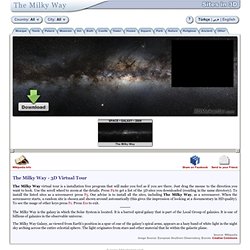
http://www.3dmekanlar.com/en/the-milky-way.html The Milky Way virtual tour is a installation free program that will make you feel as if you are there. Just drag the mouse to the direction you want to look. Use the scroll wheel to zoom at the details. Press F9 to get a list of the 3D sites you downloaded (residing in the same directory).
The Milky Way

The Milky Way is the galaxy that contains our Solar System . [ 11 ] [ 12 ] [ 13 ] [ nb 1 ] This name derives from its appearance as a dim "milky" glowing band arching across the night sky, in which the naked eye cannot distinguish individual stars. The term "Milky Way" is a translation of the Classical Latin via lactea , from the Hellenistic Greek γαλαξίας κύκλος (pr. galaxías kýklos , "milky circle"). [ 14 ] [ 15 ] [ 16 ] The Milky Way appears like a band because it is a disk-shaped structure being viewed from inside. The fact that this faint band of light is made up of stars was proven in 1610 when Galileo Galilei used his telescope to resolve it into individual stars. In the 1920s, observations by astronomer Edwin Hubble showed that the Milky Way is just one of many galaxies. http://en.wikipedia.org/wiki/Milky_Way

Milky Way

Messier Objects in the Milky Way Galaxy

Most of the 70 Messier objects which are not galaxies are part or member of the Milky Way galaxy of some kind; the only probable exception being globular cluster M54 which belongs to the nearest neighbor galaxy, SagDEG . Basically, all the diffuse nebulae and open star clusters as well as supernova remnants trace the spiral arms of our galaxy, while the globular clusters populate the galactic bulge with a strong concentration toward the Galactic center, and the planetary nebulae are somewhat an intermediate object class and occur in both; the four Messier planetaries happen to be situated not far from the disk and situated either within or close to the spiral arms (more acurately, our Local or Orion Arm). Spiral Arms traced by Messier Objects: " +I ", Perseus Arm " 0 ", Local Arm , Orion Arm " -I ", Sagittarius Arm , Sagittarius-Carina Arm Perseus Arm http://messier.seds.org/more/mw_m.html