
Types of solar and lunar eclipses. An eclipse is an astronomical event where one celestial body partially or totally covers another celestial object.
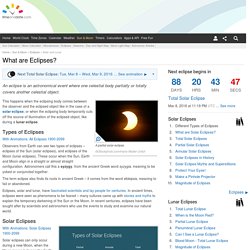
This happens when the eclipsing body comes between the observer and the eclipsed object like in the case of a solar eclipse, or when the eclipsing body temporarily cuts off the source of illumination of the eclipsed object, like during a lunar eclipse. Types of Eclipses With Animations: All Eclipses 1900-2099 Observers from Earth can see two types of eclipses – eclipses of the Sun (solar eclipses), and eclipses of the Moon (lunar eclipses). These occur when the Sun, Earth and Moon align in a straight or almost straight configuration. Eclipse Web Site. Lunar Eclipse Page. Lunar Eclipses: Past and Future The following links give information on all eclipses of the Sun and Moon from 2000 through the current year.
Dates, diagrams, maps and details for 5000 years of lunar eclipses can be found in: Five Millennium Catalog of Lunar Eclipses: -1999 to +3000 The Javascript Lunar Eclipse Explorer lets you calculate the visibility of lunar eclipses from any city for hundreds of years in the past and future: Eclipse.