7 Billion, National Geographic Magazine.
Epoissonq : #démographie #UNstats Plus... En 2019, la population des figurines LEGO aura dépassé celle des humains. The Global Population in 2100. People/ellis/presentations/agu_2010_poster_v2.pdf. Climat et démographie : les pauvres sont-ils responsables du changement climatique ? La pression anthropique sur la planète est évidemment fonction de la démographie de notre espèce.
Nous étions moins de 10 millions au début de la sédentarisation il y a une dizaine de milliers d’années . Nous sommes 7 milliards et filons vers les 8,5 à 9,5 en 2050. La maîtrise de la démographie semble donc clairement la priorité des actions pour réduire cette pression. Améliorer cette maîtrise s’impose, pour des raisons humaines sociales et d’environnement dans les régions où ce n’est pas le cas.
Ian Angus: Ecosocialism vs. Deep Ecology - Ecosocialists Unite (ESU): Ian Angus edits the online journal Climate and Capitalism, edited The Global Fight for Climate Justice, and is co-author, with Simon Butler, of the forthcoming book Too Many People?
Population, Immigration, and the Environmental Crisis. Some people believe that deep ecology is not just compatible with ecosocialism, but rather a way to improve it. That’s a profound misconception that ignores deep ecology’s anti-human core. The following was first posted on the online discussion group that was set up after the founding of the Ecosocialist international Network. 'Dissecting those "overpopulation" numbers', excerpt from "Too Many People?" by Ian Angus and Simon Butler. Too Many People?: Population, Immigration, and the Environmental Crisis.
Robert Neuwirth. Robert Neuwirth Robert Neuwirth is an American journalist, author, and investigative reporter.[1] He wrote Shadow Cities: A Billion Squatters, A New Urban World, a book describing his experiences living in squatter communities in Nairobi, Rio de Janeiro, Istanbul and Mumbai.
His articles have appeared in the New York Times, The Washington Post, Forbes, The Nation, and Newsday.[2] His second book, Stealth of Nations: The Global Rise of the Informal Economy, was published in 2011. Education and career[edit] Neuwirth studied philosophy in college. He began his career as a community organizer.[2] References[edit] External links[edit] Shadow Cities: A Billion Squatters, a New Urban World: Amazon.fr: Robert Neuwirth: Livres anglais et étrangers. Agence de presse DATAS : Un milliard de squatters, le nouveau monde urbain. Stewart Brand proclaims 4 environmental 'heresies' Stewart Brand on squatter cities.
7 billion: What to expect when you’re expanding—a special series. Science took the good bits from its recent special issue on population and squished them into this video for your viewing pleasure.
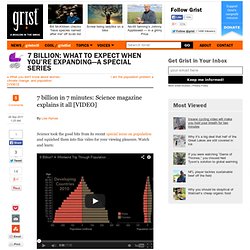
Watch and learn: Or, as seven minutes is an eternity in Twitter-time, you could just check out a few key graphics from the video: This is the latest in a series of GINK videos about population and reproduction (or a lack thereof). What If Experts Are Wrong On World Population Growth? by Carl Haub. 19 Sep 2011: Analysis by carl haub In a mere half-century, the number of people on the planet has soared from 3 billion to 7 billion, placing us squarely in the midst of the most rapid expansion of world population in our 50,000-year history — and placing ever-growing pressure on the Earth and its resources.
But that is the past. What of the future? 7 Billion, National Geographic Magazine. Recherche-iedes.univ-paris1.fr/IMG/pdf/200102AuclairGubryPicouetSandronRelativiserImpactPopulationEnvironnementEtude18.pdf. Paul Ehrlich / Ecology. Paul R. Ehrlich received his Ph.D. from the University of Kansas. Co-founder with Peter H. Scientists must leave the ivory tower and become advocates, or civilization is endangered, Stanford biologist says. Paul Ehrlich summed it up this way: "You often hear people say scientists should not be advocates.
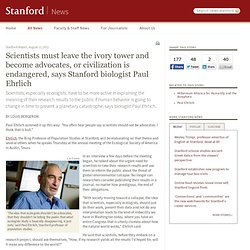
I think that is bull. " Ehrlich, the Bing Professor of Population Studies at Stanford, will be elaborating on that theme and several others when he speaks Thursday at the annual meeting of the Ecological Society of America in Austin, Texas. L.A. Cicero. Raw materials: The revenge of Malthus. Démographie - Population theorists. William R. Catton, Jr. William R.
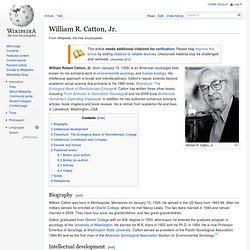
Catton, Jr. William Robert Catton, Jr. (born January 15, 1926) is an American sociologist best known for his scholarly work in environmental sociology and human ecology. His intellectual approach is broad and interdisciplinary. ... every second. World Population Clock. World Population: Past, Present, and Future (move and expand the bar at the bottom of the chart to navigate through time) The chart above illustrates how world population has changed throughout history.
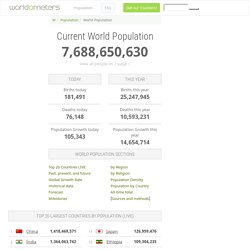
View the full tabulated data. At the dawn of agriculture, about 8000 B.C., the population of the world was approximately 5 million. Global Population Growth. Www.ined.fr/fichier/t_publication/534/publi_pdf1_pop_et_soc_francais_394. Le Monde en 2100…la future pyramide démographique. "Le Pouvoir et les richesses, à l'échelle de l'histoire passent toujours de ceux qui y ont titre à ceux qui y ont droit et le droit c'est le droit du plus fort" « La valeur de l'or n'est pas liée a la tradition c'est plus fondamental que cela L'or fait partie des archétypes qui constituent l'esprit humain au sens de Carl Jung et des alchimistes L'or est un symbole et c'est pour cela qu il est éternel L'éternité du métal ne réside pas dans sa matière mais dans son caractère symbolique ancré dans l'âme humaine il est éternel et universel dans l'esprit humain Mais pour comprendre cela il faudrait que Bernanke ait une culture !
How 10 Billion Can Survive - Room for Debate. Jamais Cascio is a research fellow at the Institute for the Future in Palo Alto, Calif., and a senior fellow at the Institute for Ethics and Emerging Technologies.
In 2009, Foreign Policy named him one of its Top 100 Global Thinkers. Population projections 90 years out – even 40 years out – are risky. There are big challenges to human civilization already under way this century, such as climate disruption and food sustainability, and more on the horizon. If any of them hit as hard as we fear, or if our responses are insufficient, there’s little likelihood that Earth’s population would get to 10 billion people. In a way, getting there would be a sign of successful navigation of this century’s problems. If Western diets and post-industrial consumption habits can be changed, the planet might make it. Such a level of population is itself a challenge, but positive scenarios are possible.
U.N. Forecasts 10.1 Billion People by Century’s End. Www.postcarbon.org/Reader/PCReader-Ryerson-Population.pdf. Hans Rosling: economies are made in bedrooms not markets.