
"Incantations for Muggles: The Role of Ubiquitous Web 2.0 Technologies in Everyday Life" "Incantations for Muggles: The Role of Ubiquitous Web 2.0 Technologies in Everyday Life" danah boyd O'Reilly Emerging Technology Conference March 28, 2007 [This is a rough crib of the actual talk.] Citation: boyd, danah. 2007. "Incantations for Muggles: The Role of Ubiquitous Web 2.0 Technologies in Everyday Life.
" O'Reilly Emerging Technology Conference, San Diego, CA. Gini coefficient. Gini coefficient of national income distribution around the world.
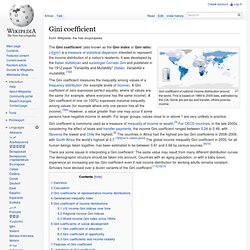
This is based on 1989 to 2009 data, estimated by the CIA. Some are pre-tax and transfer, others post-tax income. The Gini coefficient (also known as the Gini index or Gini ratio) (/dʒini/) is a measure of statistical dispersion intended to represent the income distribution of a nation's residents. It was developed by the Italian statistician and sociologist Corrado Gini and published in his 1912 paper "Variability and Mutability" (Italian: Variabilità e mutabilità).[1][2] The Gini coefficient measures the inequality among values of a frequency distribution (for example levels of income).