
#Change11 Using game and technology in teaching and learning. In this video, Sue Cranmer, Principal Researcher at Futurelab and Pedagogy 3.0 Consortium Leader, explores ways for educators to foster a deeper understanding of complex scientific concepts.
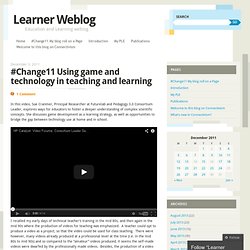
She discusses game development as a learning strategy, as well as opportunities to bridge the gap between technology use at home and in school. If I were to teach a topic about arts, science, engineering, or logistics, surely the production of video would help in translating the concepts that I intend to introduce, through a story or an artifact. There are few questions that spring into mind: 1. What skills and literacy are needed to produce such videos, games, or artifacts? 2. 3. I am still new to the production of online games, so more hands-on practice is necessary.
In Designing Sims, there are 5 phases listed. At the highest level, the Phases are: 1. These sound useful steps in guiding through the use of online games in online courses. Will consider exploring this further in coming posts. December. This is Part 2 of A story for you I have re-posted Part 1 below: What is my story?

I wasn’t as lucky as Joe, but I know that I could make up one fairy tale story, rather than a real one. However, I have been offered voluntary redundancy once, so I understand how it feels, to lose one’s job. Here is The situation: Wonderland-in Blogoland One Monday evening the following conversation took place over a virtual chat room: RoxannNys / SmartPhones in the Classroom. Smartphones in the classroom?
Yes, there are many educational applications! The cell phone industry is making a BIG pitch for using smartphones in the classroom. And, of course, there are a variety of opinions out there about using and not using them. My personal opinion--Why not? 10 Major Mobile Learning Trends to Watch For. Образование в Восточной Европе: как студенты используют современные информационные технологии. The Future of Learning & Technology. MOOC – A solution to Higher Education and Future Learning. Is MOOC the solution to future learning, especially online education and learning in Higher Education?
Our past experience with MOOC has interesting results. There are huge potential in its use, though there are still lots of challenges as I would like to share “our views” and experiences below: There has been a few rounds of MOOC conversation and lots of unanswered questions, relating especially to Stephen’s response to David Wiley’s response on knowledge transfer. I think this depends on what sort of knowledge that we are referring to. 5 Big Trends for Education in 2012-13. ABC – The 21st Century Learning Model. Moving Toward 2020: The Learning Decade. Four hundred years ago, British philosopher Francis Bacon declared that "Knowledge is Power.
" And, until recently, many corporate leaders would have wholeheartedly agreed with him. But, today, as we struggle to cope with an uncertain economy, complex globalization, and unprecedented technological transformation, executives on just about every continent increasingly believe that "Knowledge is Survival. " Companies around the world responded to the Great Recession by cutting and controlling costs to reap new efficiencies. The next challenge is growing the global economy; and corporate and government leaders now realize that learning-driven innovation is the most promising way to generate much-needed top-line revenue and the jobs that result.
The future of education will be open and distributed. Mobile and Informal Learning: Trends for 2012. Мобильное и неформальное обучение: тренды 2012. Josh Bersin выложил в сети презентацию своего доклада на конференции HR Technology Conference (октябрь 2011) Мобильное и неформальное обучение: тренды 2012 Josh Bersin один из самых известных специалистов в сфере обучения и развития и управления талантами.
Часть его текстов есть у нас в блогах, смотрите, например, в тему данных слайдов посты Скорость как ключевой элемент корпоративной системы обучения "В современной бизнес-среде из парадигмы «что теперь» мы выросли в «что дальше», требующая от L&D подразделения идти в ногу с быстро меняющимися обстоятельствами. What is Social Learning? The 21st-Century Definition —Part 1. What makes this definition different?
If you ask a friend, “What’s a house?” Chances are, they’ll point at the nearest building behind a white picket fence or your neighborhood apartment complex. Learning Networks: e-Learning 3.0. The future of education lies in technology. Last night, I attended a gathering of some of the smartest technology minds focusing on Education for grades K-12.
I didn’t know what to expect, other than Newark Mayor Cory Booker and LinkedIn‘s Founder and Chairman Reid Hoffman being there to listen to seven companies from the ImagineK12 startup incubator in Palo Alto. In a small office within the Palo Alto aol building, teams with big hearts (and sometimes very nervously) discussed their views on the future of Education for children all over the world. I’m going to be doing a few interviews with some of the companies in the near future, which include Goalbook, educreations, and Eduvant. This is a space that I’m very passionate about.
Each team had one thing in common, their belief in the importance of technology to make change happen in a system that hasn’t changed in decades. That change could very well come out of the ImagineK12 incubator, which says this about itself: We believe technology is transforming K-12 education.