
Energy Science Made Simple...Ben Wiens...innovation consultant...innovating through synergy...value innovation, theory, applications, physics, chemistry, biology, wavicle, field, substratum, thermodynamics, temperature, force, entropy, perpetual, motion, Fig 3 Major theories of how the universe behaves 5.

REASONS FOR A THEORY OF EVERYTHING It is a well known fact that Einstein's Special Relativity and General Relativity are not complete theories of the universe. They explain nothing of how the microscopic world of energy relates. Einstein is also father of the Quantum theory which describes how energy is exchanged on the microscopic level as vibrating particles. Fossil Fuels Archives - IER. Fossil fuels—coal, petroleum oil, and natural gas — are concentrated organic compounds found in the Earth’s crust.

Fossil fuels make modern life possible. The Institute for Energy Research conducts in-depth economic and policy research on energy and environmental issues. The follow studies provide an extensive analysis of fossil fuels as an energy resource, their impact on markets, and their importance in energy policy debates. Below these studies is an in-depth overview of fossil fuels. Fossil fuels—coal, petroleum (oil), and natural gas — are concentrated organic compounds found in the Earth’s crust. Fossil fuels make modern life possible. Scattered records of the use of coal date to at least 1100 BC. US Reports 'Unprecedented' Success With Methane Hydrate. U.S.
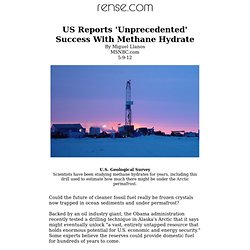
Geological Survey Scientists have been studying methane hydrates for years, including this drill used to estimate how much there might be under the Arctic permafrost. Could the future of cleaner fossil fuel really be frozen crystals now trapped in ocean sediments and under permafrost? Backed by an oil industry giant, the Obama administration recently tested a drilling technique in Alaska's Arctic that it says might eventually unlock "a vast, entirely untapped resource that holds enormous potential for U.S. economic and energy security. " Some experts believe the reserves could provide domestic fuel for hundreds of years to come. Program. What lessons from the IT revolution should inform the future of energy technology?

How can the information and communication technology industry address the energy issues it faces? 2012 ARPA-E Energy Innovation Summit. DOE - Fossil Energy: DOE - Fossil Energy: How Fossil Fuels Were Formed. Contrary to what many people believe, fossil fuels are not the remains of dead dinosaurs.
In fact, most of the fossil fuels we find today were formed millions of years before the first dinosaurs. Fossil fuels, however, were once alive! They were formed from prehistoric plants and animals that lived hundreds of millions of years ago. Think about what the Earth must have looked like 300 million years or so ago. The land masses we live on today were just forming. When these ancient living things died, they decomposed and became buried under layers and layers of mud, rock, and sand. During the millions of years that passed, the dead plants and animals slowly decomposed into organic materials and formed fossil fuels. For example, oil and natural gas were created from organisms that lived in the water and were buried under ocean or river sediments. Solar cell. Solar cells can be used in devices such as this portable monocrystalline solar charger.

A monocrystalline solar cell A solar cell (also called a photovoltaic cell) is an electrical device that converts the energy of light directly into electricity by the photovoltaic effect. It is a form of photoelectric cell (in that its electrical characteristics—e.g. current, voltage, or resistance—vary when light is incident upon it) which, when exposed to light, can generate and support an electric current without being attached to any external voltage source, but do require an external load for power consumption. Solar Panel Comparison, Most Efficient Solar Panels. Where to Get Solar Panels Solar panels are the future and there’s no better time to get solar panels installed on your home or building.
The founder of PayPal, SpaceX, and Tesla Motors, Elon Musk, is confident that “solar will beat everything, hands down, including natural gas.” The only question now is, “where can I get solar panels for myself?” The answer is simply to contact a handful of solar installers in your area and pick the one you trust most. The problem is, how do you know if the installer is good or not? These are the first recommendations I would give my Mom or Dad if they asked me to recommend a solar installer for them.
Renewable Energy. Renewables_overview. Hydroelectric Power: How it works, USGS Water Science for Schools. So just how do we get electricity from water?
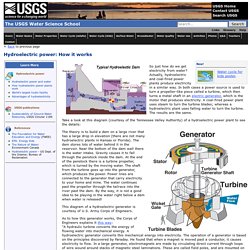
Actually, hydroelectric and coal-fired power plants produce electricity in a similar way. In both cases a power source is used to turn a propeller-like piece called a turbine, which then turns a metal shaft in an electric generator, which is the motor that produces electricity. A coal-fired power plant uses steam to turn the turbine blades; whereas a hydroelectric plant uses falling water to turn the turbine. The results are the same. How Geothermal Energy Works. Heat from the earth can be used as an energy source in many ways, from large and complex power stations to small and relatively simple pumping systems.
This heat energy, known as geothermal energy, can be found almost anywhere—as far away as remote deep wells in Indonesia and as close as the dirt in our backyards. Many regions of the world are already tapping geothermal energy as an affordable and sustainable solution to reducing dependence on fossil fuels, and the global warming and public health risks that result from their use. How Do Wind Turbines Work. Have you ever wondered how wind turbines actually work?

In this article we aim to explain the process that enables these devices to convert wind energy into useable electricity. Wind turbines work in essentially the same way as an electric fan, however instead of using electricity to turn a fan which will create a gust, we are using wind energy (the gust) to turn a fan that will create electricity. The Inside of a Wind Turbine As you can see above, a wind turbine features a large compartment that the blades are attached to via a rotary device. This rotary device is often connected to a pitch system that is able to point the entire blade system either upwards or downwards in order to be more efficient during different wind patterns. The rotary device is connected to a shaft which will be linked to a gearbox. All of the above process is carried out in the compartment of the wind turbine shown towards the top of this page.
Where Does The Electricity Go? Details. Wind Program: How Wind Turbines Work. The Energy Story - Introduction. The Energy Story - Chapter 6: Turbines, Generators and Power Plants. As we learned in Chapter 2, electricity flows through wires to light our lamps, run TVs, computers and all other electrical appliances. But where does the electricity come from? In this chapter, we'll learn how electricity is generated in a power plant. In the next few chapters, we'll learn about the various resources that are used to make the heat to produce electricity. Power Plants. Electricity is actually the flow or movement of electrons through a material. Electric generating plants typically produce electricity using magnetic conduction. This happens when a large number of conductive wires are spun around inside a magnetic field, causing electrons to move (i.e., electricity to flow).
In a generating plant, the potential energy of various types of fuels (fossil, nuclear, or renewable) is converted into another form of energy (usually mechanical or heat energy). This energy is used to turn fan-like blades inside a turbine. These blades are attached to a pole-like shaft. Wires coming from the generator are used to conduct the flow of electricity out to a neighboring switchyard, where the electricity is “stepped up” (i.e., the voltage is raised) so that it can be sent to customers. Steam-electric plants produce electricity by using heat energy to turn water into steam. Fossil Plants A gas-fired turbine does not use steam. Nuclear Plants.
Energy_Literacy_1.0_High_Res. Energy_Literacy_1.0_Low_Res. Fossil Fuels. The Institute for Energy Research conducts in-depth economic and policy research on energy and environmental issues. The follow studies provide an extensive analysis of fossil fuels as an energy resource, their impact on markets, and their importance in energy policy debates. Below these studies is an in-depth overview of fossil fuels. Fossil fuels—coal, petroleum (oil), and natural gas — are concentrated organic compounds found in the Earth’s crust. They are created from the remains of plants and animals that lived millions of years ago in the form of concentrated biomass. According to the US Energy Information Administration (EIA), fossil fuels meet around 82 percent [i] of U.S. energy demand. Fossil fuels make modern life possible.
National Renewable Energy Laboratory (NREL) Home Page. Michael Mann, From The Trenches Of The 'Climate War' Copyright © 2012 NPR. For personal, noncommercial use only. See Terms of Use. For other uses, prior permission required. This is SCIENCE FRIDAY. U.S. DOE Energy Efficiency and Renewable Energy (EERE) Home Page. USGS Energy Resources Program > Energy Resources Program. Energy Sources. Research. Science and technology for a clean energy future Enabling basic research is needed to underpin critical breakthroughs that can fundamentally alter energy systems, at large scale, several decades into the future, and to accelerate the implied transformations. Such pre-competitive research has a time scale well suited to the university environment, both because its impact is often beyond the time horizon for individual firms and because it prepares future leaders of forefront research.
Many of the expressed faculty interests fall in this part of the portfolio: