
How To Grow A Four-Season Garden – Part 2. How To Extend the Growing Season To Get the Most Out of Your Garden If you missed How To Grow A Four-Season Garden – Part 1, please take a look at it first, as it contains important background information.

Extending The Seasons. Top 10 Most Dangerous Plants in the World. 1. Most likely to eat a rat Giant Pitcher Plant: Nepenthes attenboroughii. 15 Unusual Flowers of the World. 1.

Toad Lily (Tricyrtis Hirta) Tricyrtis Hirta or Toad Lily is native of Japan and belongs to the Liliaceae family. It is a perennial plant and grows in partial sun and shady locations and prefers rich soil. Toad Lily booms in late summer to mid autumn and bears unusual flowers of whitish petals that bear purple spots. These unusual flowers are usually 2.5 cm wide. Toad Lily Flower ©André Karwath 2. Scoliopus Bigelovii also known as Fetid Adder’s Tongue is another unusual flowering plant from the Liliaceae family.
Dwarf Citrus Trees, Meyer Lemon, Kieffer Lime, Oranges – Order Online – Four Winds Growers. Buy plants online - Online Garden Centre for a wide variety of plants, garden tools, furniture and equipment. Aquaponics. Aquaponics is a combination of aquaculture (raising fish) and hydroponics (growing plants without soil).
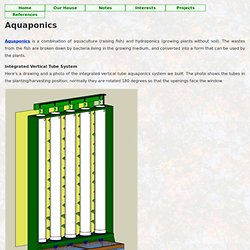
The wastes from the fish are broken down by bacteria living in the growing medium, and converted into a form that can be used by the plants. Integrated Vertical Tube System Here's a drawing and a photo of the integrated vertical tube aquaponics system we built. The photo shows the tubes in the planting/harvesting position; normally they are rotated 180 degrees so that the openings face the window. 66 Things You Can Grow At Home: In Containers, Without a Garden - Planet Green. Omega Hydroponic Garden Gets Five Times As Much Food Per Watt. We often wonder about the benefits of indoor hydroponic gardening, given that the sun is free.

After all, Illegal hydroponic installations are often discovered by their abnormally high electricity use. Last month Sami introduced us to the Omega Garden system; looking at it a bit more closely I wonder, can it make high tech urban gardening economically feasible and actually more energy efficient than growing outdoors? But Vancouver based Omega Garden's Carousel system rotates the plants around the bulb. They claim that it yields three to five times the weight of plant per watt of electricity used, compared to conventional flat systems.
Their commercial carousel system produces as much as a 1500 square foot greenhouse in only 150 square feet, and their LED system just sips electricity. They claim a lot of advantages; the light is always even and exactly the same distance from every plant, at a close enough distance to get maximum light efficiency. MyFarm Does the Work for You. Image source: MyFarm NPR reported this morning that a new group in San Francisco aims to take the work out of growing your own food in your own backyard with MyFarm.

San Francisco is not known for having huge backyards, or much sun depending on what side of the city you're on. So how is Trevor Paque, owner of MyFarm, able to keep the greens growing? Well, he and his crew will come and install a garden in your backyard at cost. Then four times a month the crew harvests a box of vegetables and homeowners pay between $25 and $35 a week for the service (probably what some people pay at the farmers market each week). More MyFarm pics after the jump. Crew members get around on bike or public transportation and move the food from your backyard to your backdoor.
How to Grow Raspberries. Raised beds eliminate root rot The original 20 plants have grown into a full bed from which the author picks 2 gallons of raspberries a day during the summer months, roughly a pint per plant, though the amount tapers off as fall approaches.

Raspberry plants hate wet feet, and they are gross feeders. We addressed these two critical points by building a 20-inch-high raised bed and filling it with a mixture of four-fifths good garden topsoil blended with about one-fifth sand, peat, and well-rotted manure. If, like us, you have acidic soil, you will also need to add some lime, because raspberries prefer a soil pH of around 6.0. We left one end of the box open to allow easy access with our wheelbarrows, then closed it in when the box was full. Garden Guides, Your Guide to Everything Gardening.
Family of Four Grows Their Food in a Swimming Pool. Images: Youtube screen grabs Food Doesn't Get More Local Than That A family living in Mesa, Arizona, has decided to convert an old unused backyard swimming pool into a very productive DIY urban greenhouse, which they named Garden Pool.
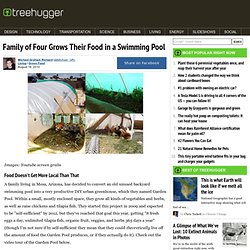
Within a small, mostly enclosed space, they grow all kinds of vegetables and herbs, as well as raise chickens and tilapia fish. They started this project in 2009 and expected to be "self-sufficient" by 2012, but they've reached that goal this year, getting "8 fresh eggs a day, unlimited tilapia fish, organic fruit, veggies, and herbs 365 days a year" (though I'm not sure if by self-sufficient they mean that they could theoretically live off the amount of food the Garden Pool produces, or if they actually do it). Check out the video tour of the Garden Pool below. An Oasis in the Desert.