
Joven universitaria fue asesinada por dos hombres que conoció a través de Facebook - 20091030. Ana María Chávez Niño, de 19 años de edad y estudiante de la Universidad Javeriana, fue encontrada muerta el pasado 17 de septiembre en su apartamento, ubicado en el barrio Quinta paredes, en el occidente de Bogotá.

Joven universitaria fue asesinada por dos amigos que conoció por Internet. La Policía de Bogotá encontró que Ana María Niño, una joven oriunda de Villavicencio que estaba estudiando arquitectura en una universidad de Bogotá, fue muerta asfixiada, posiblemente, por dos muchachos que había conocido por medio de redes sociales de Internet.

Según la Policía, Ana María. Social Media and Security in the Enterprise. Recently a fellow information security professional and I were discussing a malicious URL [1] making the rounds on Facebook.

The conversation went something like this: Me: Here's a heads up about a Facebook scam. Him: Thank you but I'm not sure my customers would be interested. We deal more with businesses. Me: Ok, I can appreciate that. Him: Good point, I may have to rethink this. As more enterprises allow employees to access social media sites, they should take into consideration the ramifications of this decision. The goal of this article is not to disparage social media usage. Jesse logan « Riesgos en Internet. ¿Puede internet ser el arma del crímen? 'Socialbots' steal 250GB of user data in Facebook invasion. Programs designed to resemble humans infiltrated Facebook recently and made off with 250 gigabytes of personal information belonging to thousands of the social network's users, researchers said in an academic paper released today.
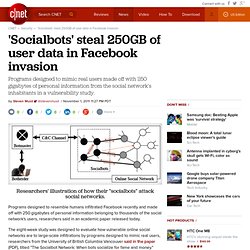
The eight-week study was designed to evaluate how vulnerable online social networks are to large-scale infiltrations by programs designed to mimic real users, researchers from the University of British Columbia Vancouver said in the paper (PDF), titled "The Socialbot Network: When bots socialize for fame and money. " The 102 "socialbots" researchers released onto the social network included a name and profile picture of a fictitious Facebook user and were capable of posting messages and sending friend requests. They then used these bots to send friend requests to 5,053 randomly selected Facebook users. Each account was limited to sending 25 requests per day to prevent triggering anti-fraud measures. Sarah Palin's Facebook Alter-Ego Gets Found Out. Free tool to combat Facebook security issues.
Posted on 26 September 2011.

Zscaler released a free security tool that protects against malicious threats, scams and spam propagated on Facebook through a technique called "Likejacking. " Likejacking Prevention is available today as a plug-in for Firefox, Chrome and Safari browsers. Twitter Accounts Found Spamming Malicious Links. A new spamming campaign has been observed by TrendMicro that is spreading on Twitter with malicious shortened URLs that contain a JPEG file from what appears to be a Facebook domain.

Files with the extension .JPEG are usually images and picture extensions, but here they link lead to a worm as WORM_KOLAB.SMQX as detected by Trend Micro (click image to enlarge): This Worm will add registry entries to enable automatic execution at every system startup. It can also infect any USB device, and it copies itself on the clean USB then connects to Internet Relay Chat (IRC) servers to execute remote instructions issued by the attacker.
In this case, the malware starts by creating a new directory “aaa” that contain 3 files: 3kal.cmd batch file to execute the mamatije2.exe and hsbca.exe . "mamatije2.exe" is a Bitcoin miner that connects to the malicious link with an incorrect login and password predefined. Robo de contraseñas de Facebook en Facebook. Georgian blogger Cyxymu blames Russia for cyber attack. The Georgian blogger known as Cyxymu, who was yesterday the victim of a cyber assault that affected hundreds of millions of web users around the world, has blamed the attack on the Kremlin.

Speaking to the Guardian from an office in the Georgian capital, Tbilisi, he said he believed the denial-of-service strike that hit LiveJournal, Facebook and Twitter stemmed from an attempt to silence his criticism over Russia's conduct in the war over the disputed South Ossetia region, which began a year ago today. "Maybe it was carried out by ordinary hackers but I'm certain the order came from the Russian government," said the blogger, whose monicker is a latinised version of the Russian spelling of Sukhumi, the capital of Georgia's other breakaway republic, Abkhazia.
Twitter-based Botnet Command Channel. While digging around I found a botnet that uses Twitter as its command and control structure.

Basically what it does is use the status messages to send out new links to contact, then these contain new commands or executables to download and run. It’s an infostealer operation. The account in question is under analysis by Twitter’s security team. I spotted it because a bot uses the RSS feed to get the status updates. As for the original bot in question that fetches the updates, here’s the VirusTotal analysis, where you can see it’s detected by 19/41 (46.34%) AV tools under evaluation. Let’s look at one of the update messages; it’s pretty clearly base64 encoded. Cyxymu. Before the 2009 attack[edit] Cyxymu's Russian-language LiveJournal blog was a source of information from Georgia for the news media during the 2007 state of emergency[4] and 2008 South Ossetia war.[5] Cyxymu's LJ blog had previously been targeted by denial-of-service attacks in October 2008, rendering the LiveJournal servers unavailable three times during October 26–27.[6] The attack on Cyxymu is internationally seen as part of an ongoing cyberwar between Russia and Georgia.[7] References[edit] Jump up ^ Mills, Elinor (August 6, 2009).
