
Egypt’s Escalating Islamist Insurgency-Carnegie Middle East Center - Carnegie Endowment for International Peace. Egypt is facing what is shaping up to be the deadliest and most complex insurgency in its modern history.
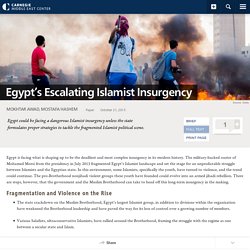
The military-backed ouster of Mohamed Morsi from the presidency in July 2013 fragmented Egypt’s Islamist landscape and set the stage for an unpredictable struggle between Islamists and the Egyptian state. In this environment, some Islamists, specifically the youth, have turned to violence, and the trend could continue. The pro-Brotherhood nonjihadi violent groups these youth have founded could evolve into an armed jihadi rebellion. Egypt: Rights & Liberties.
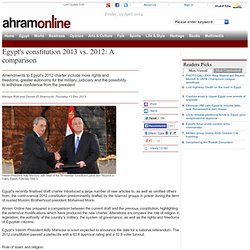
Egypt's constitution 2013 vs. 2012: A comparison. Egypt's constitution 2013 vs. 2012: A comparison Amendments to Egypt's 2012 charter include more rights and freedoms, greater autonomy for the military, judiciary and the possibility to withdraw confidence from the president Mariam Rizk and Osman El Sharnoubi, Thursday 12 Dec 2013 Interim President Adly Mansour with head of the 50-member constituent panel Amr Moussa in Cairo, Egypt, Tuesday, Dec 3.
The Shias: Egypt's forgotten Muslim minority - Features - Egypt. Last July, a young Egyptian Shia-Muslim man, Mohamed Asfour, was sentenced to three years in jail for "insulting the Prophet Mohamed's companions," who are revered by Sunni Muslims.
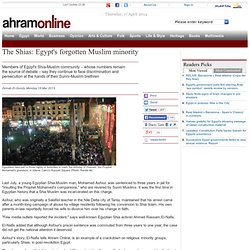
It was the first time in Egyptian history that a Shia Muslim was incarcerated on this charge. Asfour, who was originally a Salafist teacher in the Nile Delta city of Tanta, maintained that his arrest came after a month-long campaign of abuse by village residents following his conversion to Shia Islam. His own parents-in-law reportedly forced his wife to divorce him over his change in faith. "Few media outlets reported the incident," says well-known Egyptian Shia activist Ahmed Rassam El-Nafis. Egypt. The myth of the Islamist winter. In Tunisia, as in Egypt, the Islamists who came to power through the ballot box are seeing their popularity erode and are tempted to hold on to power by recourse to authoritarian measures.
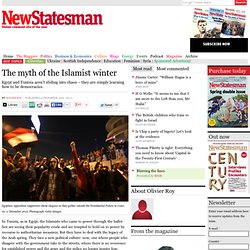
But they have to deal with the legacy of the Arab spring. They face a new political culture: now, one where people who disagree with the government take to the streets; where there is no reverence for established power and the army and the police no longer inspire fear. The Islamists are obliged to search for allies, as they control neither the army nor the religious sphere.
And if they are able to find allies among the Salafists – the religious conservatives – and the military, these two groups are nevertheless not prepared to allow them to become dominant. Egypt prosecutor orders probe in opposition leaders’ ‘treason’ case. Photo: An Egyptian Business woman lashed 300 times after falling out with a Saudi Princess ~ The Arab Digest. Painting over history in Tahrir Square. Cairo, Egypt - In Cairo's Tahrir Square, ground zero of the democratic uprising which overthrew the brutal 42-year dictatorship of Hosni Mubarak, the history of the 2011 revolution is literally drawn on the walls.

Down Mohamed Mahmoud Street, along the sides of the American University of Cairo (AUC) compound and all around the Square there are stunning and oft-emotional testaments to the historic events which led to the fall of the Mubarak regime and which galvanised the attention of the world. Pharaohnic imagery, written messages of inspiration, artistic depictions of soldiers, politicians, protestors and the ordinary Egyptians from all walks of life who came into the streets to finally lift the heavy weight of dictatorship from their nation - all these are painted on the walls around Tahrir in recognition of the transcendent events which took place there only so recently. 'They want us to forget' Uncensored street art Remembering martyrs.
The Brotherhood and Gulf security. “Push your flight back tomorrow,” Khaled al-Qazzaz, the foreign relations coordinator at the Muslim Brotherhood’s Freedom and Justice Party (FJP) told me on the phone, “you’re going to meet the boss.”
The boss it turned out was none other than Muslim Brotherhood Deputy Chairman and businessman Khairet al-Shater, perhaps one of the most influential people in post-Mubarak Egypt. I was invited to meet leaders of the Muslim Brotherhood following an opinion article I had written for Egypt Independent earlier this month. Cairo's Undercover Strongman - By Magdy Samaan. CAIRO -- When Hosni Mubarak fell from power in February 2011, many elements of his regime remained in place -- at least at first.
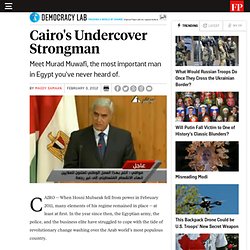
In the year since then, the Egyptian army, the police, and the business elite have struggled to cope with the tide of revolutionary change washing over the Arab world’s most populous country. Not one of these institutions has made it through the process entirely intact. Tahrir Square. How Egypt's Revolution Has Dialed Back Women's Rights. This past week was a pivotal moment for the struggle for women's rights in Egypt.
In response to more protests in Cairo's Tahrir Square, police and government security forces beat and stripped several female demonstrators. One moment captured by a photographer ricocheted around the country, and seemingly just as fast, around the world: A woman, her black abaya yanked over her head to expose her naked torso and blue bra, was dragged by helmeted security forces over the pavement. One of them stood over her, hurling his foot down at her bare stomach.
Days later, an estimated 10,000 women struck back in a mass rally in central Cairo declaring, "the daughters of Egypt are a red line" that cannot be crossed. But the abuse of female protesters in Tahrir Square is just the latest in a series of challenges to women's rights since the overthrow of Hosni Mubarak. To continue reading, please log in.
Two killed, hundreds hurt in Egypt street clashes. No to Military Trials for Civilians: International Day of Solidarity. “A Real Man”: Alaa Abdel Fattah writes from prison. We publish our translation of Egyptian blogger and revolutionary Alaa Abdel Fattah's latest letter from prison, where he remains detained for "insulting" the Egyptian military.
By Alaa Abdel Fattah This is a translation (from Egyptian Arabic) of this letter, by Egyptian blogger and revolutionary Alaa Abdel Fattah, who remains imprisoned on charges relating to “insulting” the Egyptian military.You can also check this alternative translation by Sultan Alqassemi and Mina Naguib. I am writing this note with a deep sense of shame. I have just been moved from Ist’naf (appeal) prison, at my request and insistence, because I simply couldn’t withstand the difficult conditions there: because of the darkness, the filth , the roaming cockroaches, crawling over my body night and day; because there was no courtyard, no sunshine and, again, the darkness. Khaled Said, Young Man Whose Death Inspired Egypt's Protests, Police Attackers Convicted. CAIRO — In a verdict that disappointed pro-democracy activists, two policemen who beat a man to death were convicted Wednesday of the lesser charge of manslaughter and given a relatively light sentence in a case that helped spark Egypt's uprising.

Relatives of defendants Mahmoud Salah and Awad Ismail Suleiman were still outraged by the sentence of seven years in prison each for the two officers. Egyptian blogger's hunger strike turns critical; hearing delayed. Egypt’s military prosecution today postponed the appeal hearing of Maikel Nabil Sanad, an imprisoned blogger convicted of criticizing the military.
His brother Mark said the three-week delay amounted to a death sentence, since Maikel – now 43 days into a hunger strike – has vowed to abstain from water as well as food beginning today. Skip to next paragraph Subscribe Today to the Monitor Click Here for your FREE 30 DAYS ofThe Christian Science MonitorWeekly Digital Edition “By postponing the case until Oct. 11, they are killing him,” said Mark, speaking outside the military prosecution headquarters today. EGYPT: More than 200 injured in protest march toward military headquarters. More than 200 people were injured Saturday in Cairo when antigovernment protesters clashed with armed civilians and thugs as demonstrators attempted to march on the Ministry of Defense in the third week of rallies against the ruling military council. The violence occurred when about 3,000 protesters left their sit-in at Tahrir Square and began marching toward the headquarters of the Supreme Council of the Armed Forces.
The march followed promises made in a nationally televised speech by Field Marshal Mohamed Hussein Tantawi that the ruling generals "are committed to pressing ahead in turning Egypt into a modern civilian state. " The people "want to bring down the field marshal!” Protesters chanted. Military police strung out barbed-wire barricades to block marchers from reaching the Defense Ministry. Egypt's gas pipeline a target for anger at Israel, Mubarak. EL ARISH, Egypt — For 30 years, the Bedouin tribes of the Sinai Peninsula threatened to bomb the pipeline that carries natural gas from Egypt's fields to Israel, which they still consider a mortal enemy.
But they never did, at least not while Egyptian President Hosni Mubarak was in power. Battle breaks out in Tahir Square, once again. Clashes between protesters and security forces engulfed Cairo once again on Tuesday night, as the fiercest street battles since the fall of Hosni Mubarak left dozens injured. Fighting began after dark, following earlier protests by relatives of those killed during this spring's uprising. Armed central security police showered Tahrir Square with tear gas canisters and fired bullets into the air as several thousand demonstrators amassed and called for the resignation of Egypt's de facto head of state, Field Marshall Mohamed Hussein Tantawi.
Some members of the crowd tore up paving stones and threw them towards police lines. Egypt judge fines Mubarak, ex-officials $90M for cellphone, Internet disruption during revolt. Mubarak to Face Trial for Killing of Protesters. “The True Face of Hosni Mubarak” is Now Being Televised Across the World: Democracy Now! Reports Live from Downtown Cairo. This is a rush transcript. Copy may not be in its final form. AMY GOODMAN: We are joined by Sharif Abdel Kouddous and Mona El Seif, who we brought you at the beginning of the broadcast, longtime Egyptian activist, was in the square overnight as the pro-Mubarak forces moved in on attack, on camels, on horses, with guns, with knives — still there now.
Global Voices · Egypt Revolution 2011. Protesters in Tahrir Square, Cairo, Egypt. Flickr: Jonathan Rashad (CC BY 2.0). 15 year old detained for 22 days by Amn Aldawla. People & Power - Building Egypt's future. An Open Letter to President Obama from Well-Reputed American Academics « बरगद Banyan Tree. Dear President Obama As political scientists, historians, and researchers in related fields who have studied the Middle East and U.S. foreign policy, we the undersigned believe you have a chance to move beyond rhetoric to support the democratic movement sweeping over Egypt.
As citizens, we expect our president to uphold those values. For thirty years, our government has spent billions of dollars to help build and sustain the system the Egyptian people are now trying to dismantle. Meet the Two American Companies Helping Egypt Restrict Its People - Culture. Although snuffing out dissent and cutting citizens off from the world aren't actions generally associated with the American ideal, two U.S. companies are helping the Egyptian government do just that as populist protests continue shaking the African nation.
The tear gas and smoke grenade manufacturer Combined Systems, Inc. is based out of Jamestown, Pennsylvania. But its wares have been showing up all over the Middle East as of late. Egypt protests: America's secret backing for rebel leaders behind uprising. The Battle in Cairo's Tahrir Square - Graeme Wood - International. Cairo’s Band of Geeks Survives Tahrir Square Assault. Updated Feb. 3, 5 p.m. Eastern with video (above). Egypt: Egypt opposition splinters after overthrowing Hosni Mubarak - latimes.com. Khaled Elsayd, 27, is an activist who helped mobilize Egyptians in protest… (Rick Loomis / Los Angeles…) Reporting from Cairo — They brought down an autocrat and now hunch over position papers, microphones, BlackBerrys and meals from McDonald's. In pictures: Egypt protests. Egypt: The Day the Secrets were Revealed. This post is part of our special coverage of Egypt Protests 2011. Muslim Brotherhood.
Please support our site by enabling javascript to view ads. The Secret Rally That Sparked an Uprising - WSJ.com - online.wsj.com. Egyptinfluencenetworklarge.gif (GIF Image, 3000x2473 pixels) - Scaled (26%) Ei: Muslim-Christian unity characterizes Egypt's uprising. CAIRO (IPS) - Over recent years, Egypt has witnessed mounting tension between its Muslim majority and its sizeable Coptic Christian minority. Gimme Shelter: The Game’s Afoot.
Ei: How Palestine's uprising inspired Egypt's. Memoirs of a closed Rafah crossing and how they might soon be erased « Sixteen Minutes to Palestine. Frustrations rise as Rafah crossing closed again. Yesterday Egypt, today Algeria.