
Inductive reasoning. Inductive reasoning (as opposed to deductive reasoning or abductive reasoning) is reasoning in which the premises seek to supply strong evidence for (not absolute proof of) the truth of the conclusion.
While the conclusion of a deductive argument is certain, the truth of the conclusion of an inductive argument is probable, based upon the evidence given.[1] The philosophical definition of inductive reasoning is more nuanced than simple progression from particular/individual instances to broader generalizations. Deductive reasoning. Deductive reasoning links premises with conclusions.
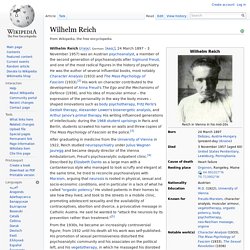
If all premises are true, the terms are clear, and the rules of deductive logic are followed, then the conclusion reached is necessarily true. Deductive reasoning (top-down logic) contrasts with inductive reasoning (bottom-up logic) in the following way: In deductive reasoning, a conclusion is reached reductively by applying general rules that hold over the entirety of a closed domain of discourse, narrowing the range under consideration until only the conclusion(s) is left. In inductive reasoning, the conclusion is reached by generalizing or extrapolating from, i.e., there is epistemic uncertainty. Note, however, that the inductive reasoning mentioned here is not the same as induction used in mathematical proofs – mathematical induction is actually a form of deductive reasoning. Wilhelm Reich. Wilhelm Reich (/raɪx/; German: [ʀaɪç], 24 March 1897 – 3 November 1957) was an Austrian psychoanalyst, a member of the second generation of psychoanalysts after Sigmund Freud, and one of the most radical figures in the history of psychiatry.
He was the author of several influential books, most notably Character Analysis (1933) and The Mass Psychology of Fascism (1933).[2] His work on character contributed to the development of Anna Freud's The Ego and the Mechanisms of Defence (1936), and his idea of muscular armour – the expression of the personality in the way the body moves – shaped innovations such as body psychotherapy, Fritz Perls's Gestalt therapy, Alexander Lowen's bioenergetic analysis, and Arthur Janov's primal therapy. His writing influenced generations of intellectuals: during the 1968 student uprisings in Paris and Berlin, students scrawled his name on walls and threw copies of The Mass Psychology of Fascism at the police.[3] Early life[edit] Childhood[edit]